Algeria
 Egypt
 Libya
 Morocco
 Sudan
 Tunisia
 Benin
 Burkina Faso
 Cabo Verde
 Côte d'Ivoire
 Ghana
 Guinea
 Guinea-Bissau
 Liberia
 Mali
 Mauritania
 Niger
 Nigeria
 Senegal
 Sierra Leone
 The Gambia
 Togo
 Cameroon
 Central African Republic
 Chad
 DR Congo
 Equatorial Guinea
 Gabon
 Republic of the Congo
 São Tomé and Príncipe
 Burundi
 Comoros
 Djibouti
 Eritrea
 Ethiopia
 Kenya
 Malawi
 Mauritius
 Mozambique
 Rwanda
 Seychelles
 Somalia
 South Sudan
 Tanzania
 Uganda
 Angola
 Botswana
 Eswatini
 Lesotho
 Namibia
 South Africa
 Zambia
 Zimbabwe
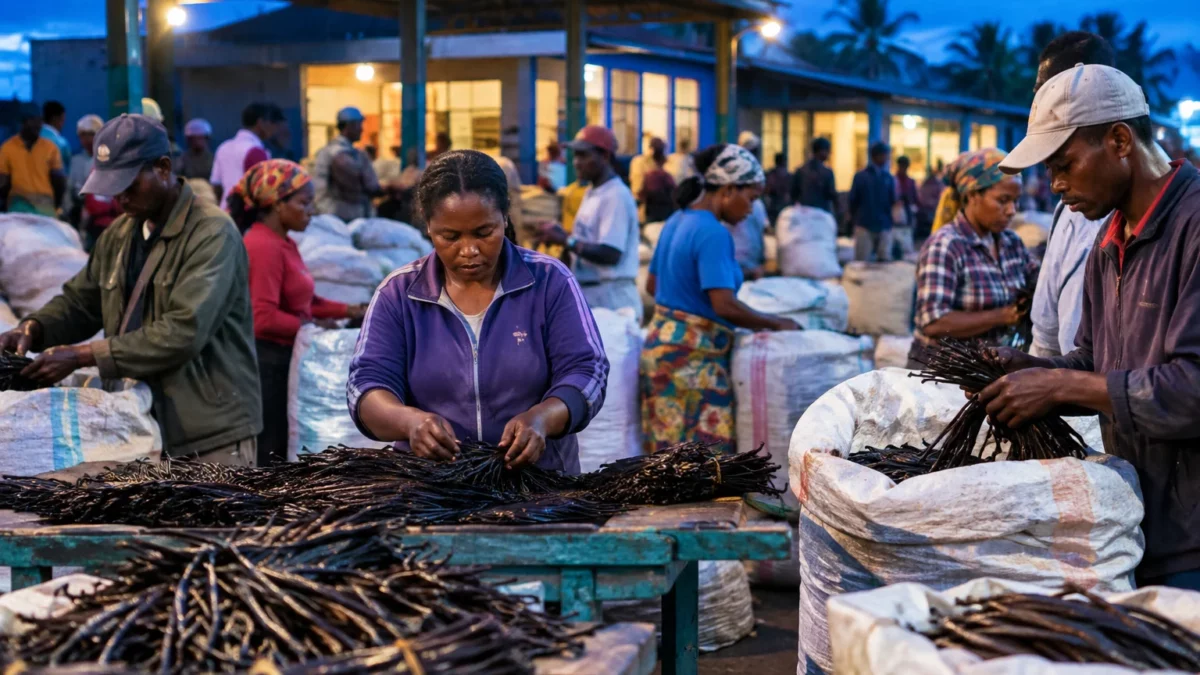
In north-eastern Madagascar, vanilla provides a livelihood for producers, collectors, processors and exporters. But higher initial offers do not guarantee that the supply chain will return to stable incomes: accumulated stocks continue to weigh on prices, and buyers can wait before returning to the market.
A season begins in a still-saturated market
The 2026-2027 export season began on 9 October and is due to run until 30 June 2027. The first offers observed in Madagascar are 10 to 20% higher than the levels at the end of the previous season, depending on the quality of the pods. This increase remains limited and could be reversed as transactions proceed.
Canadian trader Aust & Hachmann estimates that reserves remain high, both in the country and among traders abroad. It puts Madagascar’s 2025 crop at more than 4,000 tonnes. Its provisional estimate for 2026-2027 is between 2,500 and 3,500 tonnes. These are market estimates, not a definitive official tally.
The size of the surplus itself remains uncertain. In September, industry professionals quoted by Midi Madagasikara referred to as much as 7,000 tonnes of exportable vanilla carried over. This figure, cited by industry players, is not a verified inventory. It nevertheless indicates the scale of local concern.
Stocks are not all concentrated in the same place, and estimates do not necessarily use the same definitions. Some pods have been bought by foreign operators to cover their future needs. These purchases can reduce the volumes available at source, without the vanilla having yet been used by manufacturers. The surplus therefore does not automatically disappear from supply chains.
From export prices to producers’ incomes
This distinction matters to producers. The price paid for green vanilla at the farm gate depends on competition between buyers, quality, collection costs and local rules. It does not mechanically follow quoted prices for cured vanilla destined for export. In September, the Malagasy press reported purchases of green vanilla in SAVA at between 11,000 and 13,000 ariary a kilo in some localities. These figures describe local, occasional transactions, not a uniform price across the island.
The previous season had shown the other side of the problem. Exporters quoted by Midi Madagasikara estimated that international prices ranged from $15 to $60 a kilo, depending on length and quality. The same outlet reported the introduction of a scheme to buy back green vanilla at regulated prices, funded in part by resources from the Malagasy Vanilla Alliance (AVM). The support can provide an outlet for some sellers, but it does not by itself resolve the level of stocks or final demand.
Governance reform and widening the pool of operators are another potential lever. In November, Malagasy outlet Newsmada reported that the authorities had opened new export ports, including Vohémar, Antsiranana and Nosy Be, and eased licensing requirements. The stated aim is to widen access to the market and strengthen competition. But more exporters do not necessarily mean more global orders: sales will also depend on the ability to sell existing stocks.
Quality and markets are two areas to watch
The low-price environment can also affect how pods are processed. Aust & Hachmann warns that conditioning, drying and maturation require time and money. The trader considers that black vanilla from the new crop should not be considered ready for export before January at the earliest. This is the assessment of a market operator, but it highlights a practical constraint: selling faster does not guarantee a stable lot or consistent quality.
For producers, rural households and small processing businesses, pressure on incomes begins at harvest. Exporters, meanwhile, must finance stocks and find buyers able to absorb the volumes. International traders have another option: their reserves sometimes allow them to defer purchases. This imbalance in storage capacity weighs on negotiations, even when the country of origin supplies a major share of global supply.
Competing origins are not all interchangeable. Aust & Hachmann notes that Indonesia and Papua New Guinea have distinct aromatic profiles. However, significant price differences can encourage some buyers to favour Malagasy vanilla. Madagascar’s dominance of the global market is therefore a commercial advantage, but it also exposes its industry to shifts in demand and the storage decisions of major buyers.
A Malagasy challenge with regional repercussions
The sector is part of an export-oriented economy in which vanilla generates foreign-currency earnings and links farming areas to ports and international markets. Antananarivo is the centre of political and administrative decision-making, while production and some trade take place far from the capital, notably in north-eastern growing regions. The impact of a national measure therefore also depends on how it is implemented in these areas.
Regionally, Madagascar is a member of the Southern African Development Community (SADC), which brings together countries in southern Africa and the Indian Ocean to strengthen economic co-operation. The country also belongs to COMESA, the Common Market for Eastern and Southern Africa. These frameworks could support discussion of trade and regional processing, even though the current crisis depends above all on the balance between Malagasy supply and global demand.
Several indicators will be crucial in the months ahead: the volume actually exported, price movements by quality, transparency in local purchases and buyers’ ability to run down their reserves. The initial rise in offers is a signal, not proof of a turnaround. As long as stocks remain abundant and demand does not grow fast enough, Malagasy producers and operators will have to contend with a market in which any recovery remains fragile.