Algeria
 Egypt
 Libya
 Morocco
 Sudan
 Tunisia
 Benin
 Burkina Faso
 Cabo Verde
 Côte d'Ivoire
 Ghana
 Guinea
 Guinea-Bissau
 Liberia
 Mali
 Mauritania
 Niger
 Nigeria
 Senegal
 Sierra Leone
 The Gambia
 Togo
 Cameroon
 Central African Republic
 Chad
 DR Congo
 Equatorial Guinea
 Gabon
 Republic of the Congo
 São Tomé and Príncipe
 Burundi
 Comoros
 Djibouti
 Eritrea
 Ethiopia
 Kenya
 Madagascar
 Malawi
 Mauritius
 Mozambique
 Rwanda
 Seychelles
 Somalia
 South Sudan
 Tanzania
 Uganda
 Angola
 Botswana
 Eswatini
 Lesotho
 Namibia
 South Africa
 Zambia
 Zimbabwe
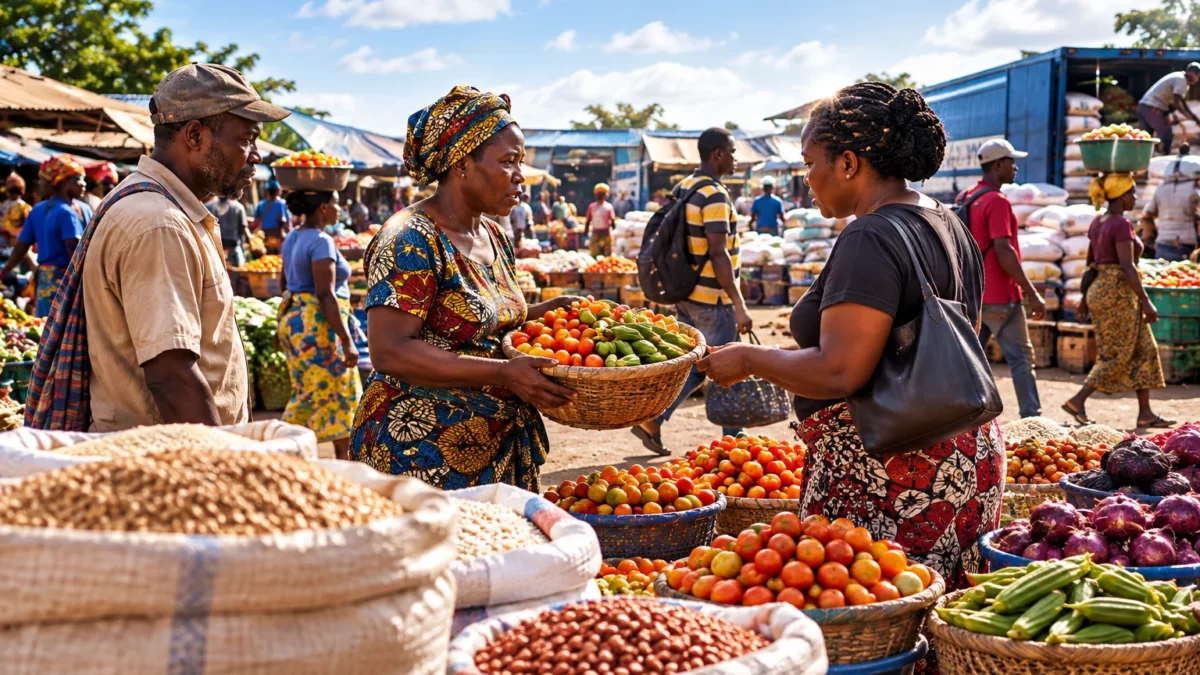
An agricultural app cannot replace a passable road, a warehouse or a reliable buyer. But when properly connected to these services, it can help a farm obtain inputs, financing and a market for its produce. It is on this basis that agritech can contribute to food security in West Africa.
Finance, the crucial link in the chain
In Ghana, the agricultural sector relies heavily on small-scale producers, who often face limited access to credit and irregular markets. An agritech company — one that applies digital tools to agricultural activities — seeks to reduce these barriers by linking producers, financial institutions, suppliers and buyers.
Complete Farmer, a Ghanaian company led by Desmond Koney, is developing this model. The principle goes beyond simply collecting data: a platform can help organise input orders, monitor crops and connect harvests with buyers. But digital technology alone does not guarantee that smallholders will obtain affordable loans or a remunerative price.
A partnership announced in September 2026 by the International Finance Corporation (IFC) with Complete Farmer is intended to expand access to finance and agricultural services. The IFC says it aims ultimately to support up to 240,000 farmers and provide the company with a convertible loan of $2.4 million, as well as advisory services. This arrangement is a concrete example of investment in a Ghanaian company; it does not, by itself, confirm the existence of a regional $650 million facility mentioned in available information. The details and allocation of that facility could not be independently verified.
The need for finance extends far beyond a single company. An IFC study of seven sub-Saharan African markets estimated the financing gap for smallholders and agricultural small and medium-sized enterprises at $117 billion. It also found that partnerships between digital companies and financial institutions were still at an early stage and heavily dependent on national contexts.
Producing more is not enough
Agricultural results also depend on seeds, irrigation, technical advice, storage, energy and transport. Better weather information can help farmers decide when to sow. A loan at the right time can make it possible to buy seeds or fertiliser. But without suitable roads, storage facilities and regular buyers, a larger harvest may still be difficult to sell or may go to waste.
The Central Bank of West African States (BCEAO), which monitors the West African Monetary Union, estimates food-crop production for the 2025-2026 season at 81.2 million tonnes, 4.2% higher than in the previous season. This regional increase is a reminder that local production is not simply a technological promise. It also depends on farming conditions, public policies and producers’ ability to reach markets.
Digital tools can nevertheless offer practical solutions: better documentation of farm activities, easier risk assessment for lenders, coordinated purchases or more traceable transactions. For farmers to benefit from these uses, clear rules on data, services accessible despite patchy connectivity and understandable contracts are needed. Otherwise, technology risks benefiting mainly those who are already well equipped.
From domestic markets to regional trade
Ghana can serve as a point of reference, but West African agricultural markets do not form a uniform space. Producers, trade rules, infrastructure and needs vary from one country to another. The Economic Community of West African States (ECOWAS), a regional organisation, seeks to strengthen co-operation among its member states. The African Continental Free Trade Area (AfCFTA), meanwhile, aims to facilitate trade between African countries.
For agricultural businesses, access to these wider markets will depend on their ability to overcome very practical obstacles: compatible health standards, customs formalities, cross-border payments and the transport of goods. A platform can put a seller and buyer in two countries in touch. It cannot, on its own, harmonise inspections or eliminate delays at borders.
Smoother supply chains could give farmers markets beyond their local area and provide buyers with more predictable supplies. But regional integration must also protect producers’ position in negotiations. The volume sold does not reveal who sets the price, who bears logistics costs or where products are processed.
Who captures the value created?
Investors and companies can become more efficient through more reliable data and better co-ordination of purchases. For producers, the challenge is different: obtaining inputs on time, selling at a viable price and avoiding a situation in which loan repayments become unsustainable after a poor season. Climate risks and price fluctuations do not disappear with an app.
Projects will therefore have to be assessed on the basis of their results for farms: the number of producers actually financed, loan terms, changes in incomes, post-harvest losses and markets secured. Investment announcements, whether public or private, are no substitute for these indicators. Transparency about costs and beneficiaries will also help distinguish a platform’s growth from a genuine improvement in production conditions.
The challenge also lies in linking innovation to local capacity. In March 2026, the World Bank announced a regional $46 million programme for applied research, climate services and agricultural innovation in six countries, including Ghana, Mali and Senegal. This funding is not the separately mentioned $650 million facility; rather, it illustrates the variety of mechanisms being used to strengthen food systems.
In the coming years, the question will not simply be how much capital agritech companies attract. It will be necessary to see whether producers can borrow on suitable terms, whether goods move more easily between countries and whether more value is created in the places where they are grown. It is these results, not the technological promise alone, that will determine agritech’s contribution to regional food security.
Agricultural finance partnership announced in Ghana by the IFC · IFC study on agritech and agricultural finance in sub-Saharan Africa · BCEAO data on regional food-crop production