Algeria
 Egypt
 Libya
 Morocco
 Sudan
 Tunisia
 Benin
 Burkina Faso
 Cabo Verde
 Ghana
 Guinea
 Guinea-Bissau
 Liberia
 Mali
 Mauritania
 Niger
 Nigeria
 Senegal
 Sierra Leone
 The Gambia
 Togo
 Cameroon
 Central African Republic
 Chad
 DR Congo
 Equatorial Guinea
 Gabon
 Republic of the Congo
 São Tomé and Príncipe
 Burundi
 Comoros
 Djibouti
 Eritrea
 Ethiopia
 Kenya
 Madagascar
 Malawi
 Mauritius
 Mozambique
 Rwanda
 Seychelles
 Somalia
 South Sudan
 Tanzania
 Uganda
 Angola
 Botswana
 Eswatini
 Lesotho
 Namibia
 South Africa
 Zambia
 Zimbabwe
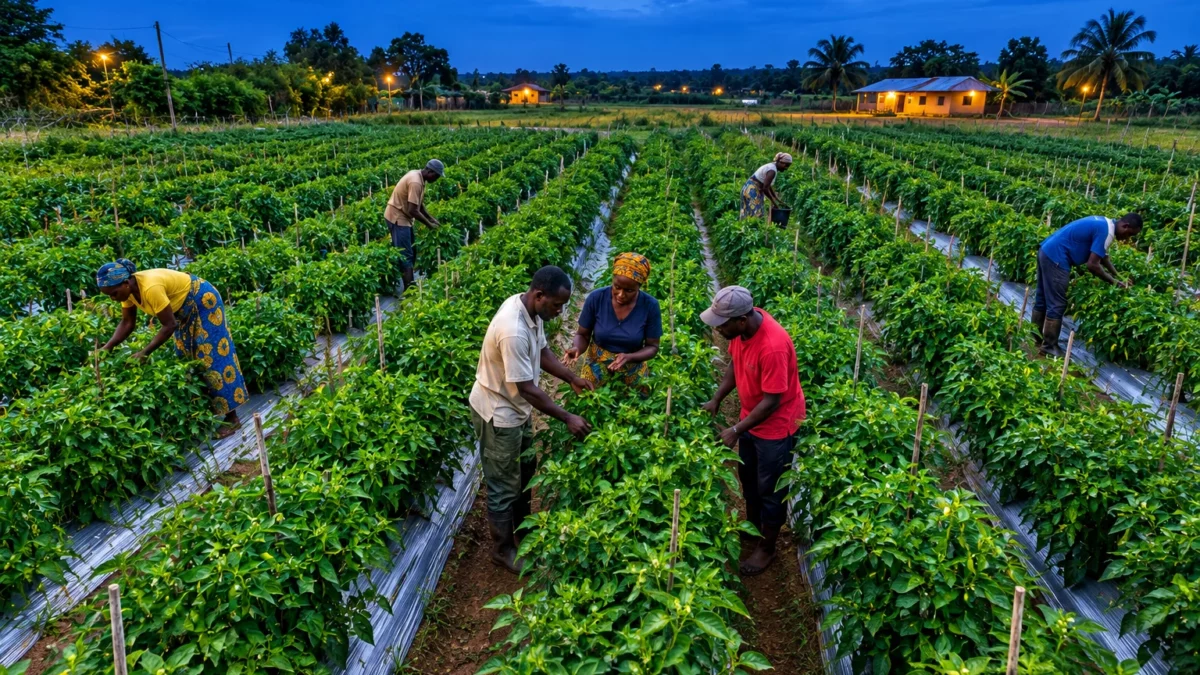
For some salaried workers in Abidjan, agriculture is no longer just their parents’ activity or a prospect for retirement. It is becoming an investment pursued alongside city work, with the hope of diversifying income. But from buying inputs to the first harvest, a project requires time, skills and secure access to land.
An agricultural economy that also attracts city dwellers
The trend is part of an economy in which agricultural production remains central. According to the 2024-2025 Annual Agricultural Survey published by the National Statistics Agency (ANStat), Côte d’Ivoire has nearly 1.735 million agricultural households. The sector accounts for around 15% of gross domestic product, according to the same publication.
These figures first describe an activity sustained by millions of people, most of them connected to rural areas. They also shed light on the interest of city dwellers looking to invest part of their income in food crops, export crops, livestock or fish farming. For some, it is a supplementary income; for others, preparation for a career change or retirement.
This diversification does not necessarily mean leaving the city. A salaried worker can finance a farm and entrust its day-to-day management to a manager or local team. This model allows them to keep their job, but makes regular monitoring of expenditure, production decisions and sales essential.
Land and financing: the first tests of viability
The main obstacle can arise even before the first seeds are sown: finding a plot with clear land rights. In Côte d’Ivoire, the 1998 law governs rural land and the recognition of land rights. Customary agreements, available documents and steps to secure rights must therefore be examined carefully, particularly when an investor does not live in the area.
Accessible land does not, however, guarantee a profitable operation. The activity must suit the soil, available water, agricultural calendar and markets. Input costs, transport, storage and price fluctuations must also be factored in. A harvest can be abundant without making a profit if costs have been poorly anticipated or getting produce to market is difficult.
The distance between the city and the fields also affects management. Without a regular presence, the investor depends heavily on those responsible for running the operation. This delegation can create local jobs and transfer skills, but it requires clearly defined responsibilities, careful bookkeeping and a relationship of trust built over time.
Public programmes aim to support some project holders. At SARA 2025, the National Agency for Rural Development Support (ANADER) held training sessions on financing and preparing agricultural projects. The Ivorian Press Agency also reported the announcement of a 1.5 billion CFA franc fund for young agripreneurs. These initiatives do not eliminate the risks; rather, they highlight the importance of preparing a project before applying for credit.
A shared concern for cities and rural areas
The trend can bring urban resources closer to rural activities. Better-prepared investments can support food production, livestock farming or processing, and create opportunities for local workers and suppliers. The benefits will nevertheless depend on the place afforded to communities already living off the land, as well as on partnerships with producers and cooperatives.
The trend also affects residents differently. For an executive with savings, investing in a plantation may be a wealth-building strategy. For a farmer based in a rural area, the daily challenge remains access to inputs, equipment, financing and markets. The two realities intersect, but do not offer the same room for manoeuvre.
At regional level, the issue extends beyond Côte d’Ivoire’s borders. ECOWAS, the Economic Community of West African States, is seeking to strengthen trade and food security in a region where agricultural sectors are linked through commerce and mobility. Urban investments can contribute to local supply, provided they strengthen production and processing chains rather than simply the ownership of land.
The next indicator to watch will therefore not simply be the number of city dwellers who get involved. It will be necessary to monitor how long farms remain in operation, their effective access to land and markets, and the share of value that goes to local producers and workers. These are the results that will measure the economic significance of this agricultural wager.