Algeria
 Egypt
 Libya
 Morocco
 Sudan
 Tunisia
 Benin
 Burkina Faso
 Cabo Verde
 Ghana
 Guinea
 Guinea-Bissau
 Liberia
 Mali
 Mauritania
 Niger
 Nigeria
 Senegal
 Sierra Leone
 The Gambia
 Togo
 Cameroon
 Central African Republic
 Chad
 DR Congo
 Equatorial Guinea
 Gabon
 Republic of the Congo
 São Tomé and Príncipe
 Burundi
 Comoros
 Djibouti
 Eritrea
 Ethiopia
 Kenya
 Madagascar
 Malawi
 Mauritius
 Mozambique
 Rwanda
 Seychelles
 Somalia
 South Sudan
 Tanzania
 Uganda
 Angola
 Botswana
 Eswatini
 Lesotho
 Namibia
 South Africa
 Zambia
 Zimbabwe
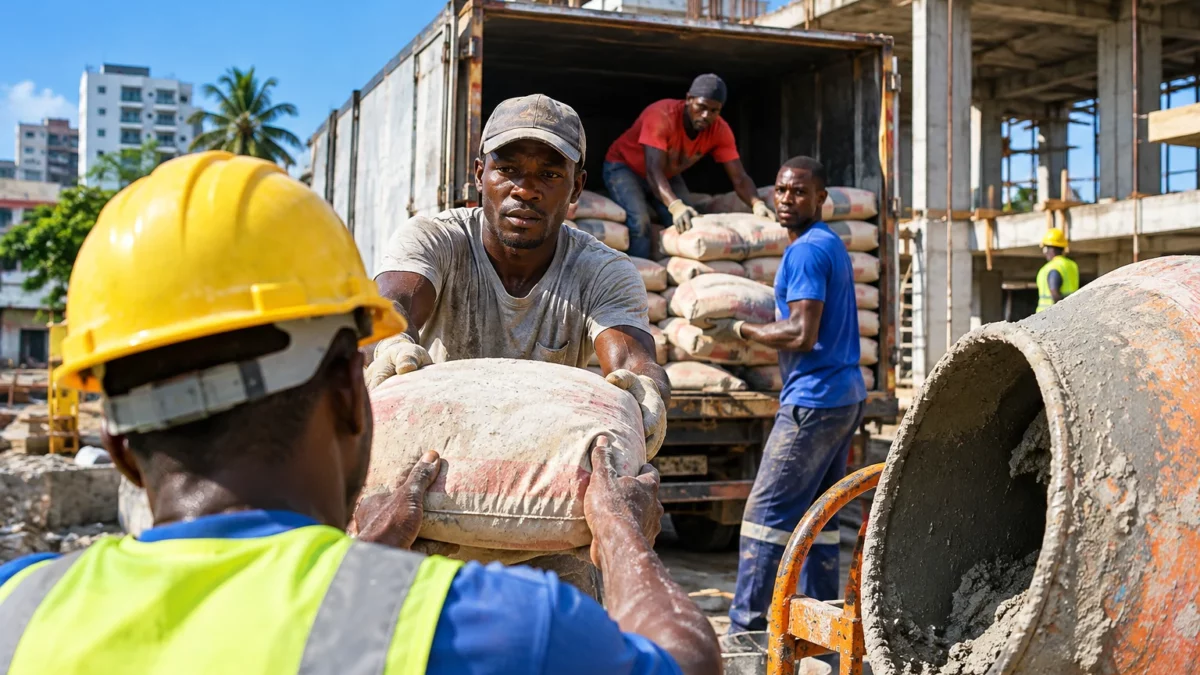
A country can produce large quantities of cement while relying on foreign suppliers for one of its key ingredients. In Ivory Coast, this contradiction is playing out as the authorities seek to contain overcapacity in the sector and a new project bets on a formula less dependent on imported clinker.
A new plant in a market already well supplied
On 18 November 2026, the board of the African Development Bank (AfDB) approved €20 million in financing for Ciments écologiques de Côte d’Ivoire (CIMECI), a company belonging to the YESHI industrial group. The project involves a complex at Attinguié, in the sub-prefecture of Anyama, north of Abidjan. The AfDB describes the operation as an investment in cement production with a lower carbon footprint.
The industrial programme includes a calcined clay unit with a planned capacity of 350,000 tonnes a year and a grinding facility capable of producing 500,000 tonnes of cement. The environmental and social impact assessment locates the site at PK 27 and also describes concrete prefabrication and plaster production activities. The project is therefore set to extend beyond cement manufacturing alone. Project documents estimate that around 250 permanent jobs will be created.
These figures describe projected capacity, not production that is already available. Construction, commissioning and the ramp-up will determine the volumes actually marketed. The site’s proximity to Abidjan may facilitate access to construction sites and transport networks, while local benefits will depend in particular on recruitment, purchases from Ivorian suppliers and monitoring of environmental risks.
Clinker, the imported link in the chain
Clinker is an intermediate product made by heating mineral materials. It is then used in cement. Its production is energy-intensive and emits carbon dioxide. Cement plants can therefore have substantial grinding capacity in the country without producing all the clinker they use locally.
Ivorian customs statistics show that 5.67 million tonnes of clinker were imported in 2025, worth around 183.2 billion CFA francs. These figures, cited in the documents consulted, give an indication of the commercial stakes. They do not, however, mean that every imported tonne could be replaced by the future plant: cement formulations, required grades and supply contracts also matter.
CIMECI is betting on LC3, a cement that combines, among other ingredients, limestone and calcined clay with a reduced proportion of clinker. Calcined clay can replace part of this component in the mix. Research associated with the technology points to lower emissions than conventional cement, but the outcome depends on the industrial process, raw materials and energy used. The claimed climate benefit will therefore need to be assessed on the basis of the plant’s actual performance, not its nominal capacity alone.
Overcapacity raises questions about demand
The project is being pursued in a sector where supply already far exceeds domestic demand. In September 2025, Ivory Coast’s Ministry of Trade and Industry estimated installed capacity at more than 20 million tonnes a year, against national consumption of less than 10 million tonnes. It had then announced the removal of cement manufacturing from the benefits of the Investment Code, which includes tax and customs incentives.
The regional assessment by the West African Development Bank had already noted a substantial gap between Ivorian capacity and demand in 2023. The precise figure has since changed, but the underlying problem remains: new capacity can support innovation and reduce some imports, while also intensifying competition for market share. AfDB financing does not remove this commercial risk.
For companies, the challenge will be to sell cement at a competitive price compared with products already available. For households and construction professionals, the expected impact will not be measured solely by the volume produced: it will depend on whether any savings are passed on in prices, the reliability of supply and compliance with standards. For employees and municipalities near the site, the promised jobs and local benefits will depend on the project’s timetable and execution.
An industrial issue that extends beyond Ivory Coast
Ivory Coast is a member of WAEMU, the West African Economic and Monetary Union, and ECOWAS, which brings together West African states. Cement and clinker move between neighbouring markets within this regional area. Ivorian production using more locally sourced materials could therefore alter trade flows, provided it remains competitive and meets the needs of countries in the region.
The project thus brings two objectives that are often difficult to reconcile into sharp relief: developing local industry and avoiding the addition of capacity that is hard to make profitable. The course of the Attinguié complex will depend on construction demand, cement quality, energy costs and the ability to effectively replace part of the imported clinker. The next steps to watch are the completion of construction, the start of production and the publication of data that will make it possible to compare volumes, jobs and emissions with the initial projections.