Algeria
 Egypt
 Libya
 Morocco
 Sudan
 Tunisia
 Benin
 Burkina Faso
 Cabo Verde
 Côte d'Ivoire
 Guinea
 Guinea-Bissau
 Liberia
 Mali
 Mauritania
 Niger
 Nigeria
 Senegal
 Sierra Leone
 The Gambia
 Togo
 Cameroon
 Central African Republic
 Chad
 DR Congo
 Equatorial Guinea
 Gabon
 Republic of the Congo
 São Tomé and Príncipe
 Burundi
 Comoros
 Djibouti
 Eritrea
 Ethiopia
 Kenya
 Madagascar
 Malawi
 Mauritius
 Mozambique
 Rwanda
 Seychelles
 Somalia
 South Sudan
 Tanzania
 Uganda
 Angola
 Botswana
 Eswatini
 Lesotho
 Namibia
 South Africa
 Zambia
 Zimbabwe
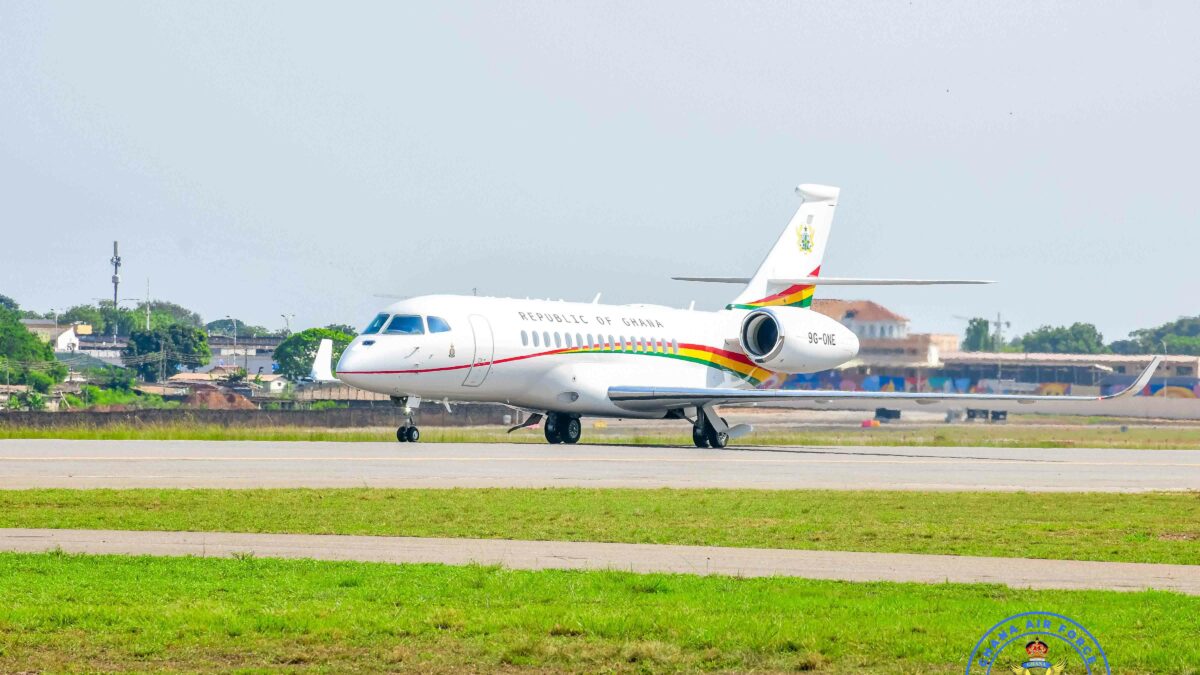
A water-cannon salute and officials standing beside a jet from which no head of state disembarks… And for good reason: the star on the tarmac at Accra International Airport this Monday, 16 November, was… the aircraft itself. A brand-new Falcon 6X from Dassault Aviation, newly acquired by Ghana. Behind the reception ceremony, another welcome awaited the aircraft: that of an opposition demanding answers over a bill of more than $60 million. John Dramani Mahama’s government is defending an investment intended to modernise the country’s air capabilities. Its critics see spending that is difficult to reconcile with social priorities and the governing party’s past positions.
An air force aircraft or a presidential jet?
The aircraft is part of a wider programme to modernise the Ghanaian air force, whose operational needs extend beyond transporting the head of state. But in public debate, the Falcon has already been identified as the new presidential aircraft.
The Falcon 6X contract with Dassault Aviation is worth $60.68 million. It was presented to parliament on 3 December 2025 and approved the following day, according to the report of the parliamentary Defence and Interior Committee. The air force is to operate and maintain it.
For the authorities, renewing the fleet addresses an operational need. The new aircraft is to replace a Falcon 900EX that has been in service since 2010, inspections of which have revealed corrosion problems and fuel leaks. Difficulty finding spare parts — the model is no longer in production — also makes maintenance more challenging.
Felix Kwakye Ofosu, the minister responsible for government communications, says the purchase meets a request from the air force. According to him, the military initially requested six aircraft, including two executive jets. Parliament ultimately approved just one.
The opposition disputes this account. Samuel Abu Jinapor, an MP and member of the parliamentary minority, says the Falcon is primarily intended for President John Dramani Mahama’s travel. The fact that the air force will manage it does not, in his view, change its primary purpose. “This government has bought a $60 million aircraft, equivalent to 720 million cedis, for the president’s use. This is not new equipment intended to renew the air force,” he said on JoyNews.
NDC accused of changing its tune
Beyond the aircraft’s intended use, the government’s political consistency is at the heart of the controversy. The National Democratic Congress (NDC), John Mahama’s party, had in the past strongly criticised plans to acquire a new presidential aircraft, arguing that Ghana’s economic situation could not support such spending.
Samuel Abu Jinapor, a former natural resources minister and a prominent figure in the parliamentary opposition, is now accusing the government of a double standard. “What was unacceptable in opposition cannot suddenly become acceptable in government simply because those in power have changed,” he said.
The MP points out that Ghanaians continue to face the cost of living and youth unemployment. He is asking the government to publish the total cost of the deal, its financing arrangements, the procurement procedures and the approvals obtained.
The majority, for its part, argues that the economic context has changed. Peter Lanchene Toobu, chair of the parliamentary Defence and Interior Committee, says the NDC never rejected the principle of a new presidential aircraft. “We agreed, in principle, on the need to buy a new aircraft,” he said. According to him, the reservations expressed at the time concerned the timing and the country’s ability to bear the cost. Ghana exited the $3 billion financing programme agreed with the International Monetary Fund (IMF) in May 2026. It moved to a monitoring arrangement without a new loan. The government says fiscal discipline has helped stabilise the economy.
Transparency at the heart of the debate
The Falcon 6X can travel up to 10,186 kilometres without stopping, which should facilitate international travel and reduce refuelling stops. The authorities also cite the former aircraft’s maintenance costs and repeated periods out of service to justify the purchase.
One question remains: how much will this investment actually cost the public finances over time? The opposition is also asking about future maintenance, operating and crew training expenses.
The parliamentary report presents the fleet renewal as a way to strengthen Ghana’s strategic transport and security capabilities. But to convince people beyond its own ranks, the government will also have to show that the choice of aircraft meets a clearly established need and that its cost is under control.
Sources: Ghana Air Force statement on the delivery ; parliamentary committee report on aviation contracts ; report on Samuel Abu Jinapor’s criticism ; parliamentary minority’s calls for transparency ; labour statistics from the Ghana Statistical Service ; presidency announcement on the end of the IMF programme.