Algeria
 Egypt
 Libya
 Morocco
 Sudan
 Tunisia
 Benin
 Burkina Faso
 Cabo Verde
 Côte d'Ivoire
 Ghana
 Guinea
 Guinea-Bissau
 Liberia
 Mali
 Mauritania
 Niger
 Nigeria
 Sierra Leone
 The Gambia
 Togo
 Cameroon
 Central African Republic
 Chad
 DR Congo
 Equatorial Guinea
 Gabon
 Republic of the Congo
 São Tomé and Príncipe
 Burundi
 Comoros
 Djibouti
 Eritrea
 Ethiopia
 Kenya
 Madagascar
 Malawi
 Mauritius
 Mozambique
 Rwanda
 Seychelles
 Somalia
 South Sudan
 Tanzania
 Uganda
 Angola
 Botswana
 Eswatini
 Lesotho
 Namibia
 South Africa
 Zambia
 Zimbabwe
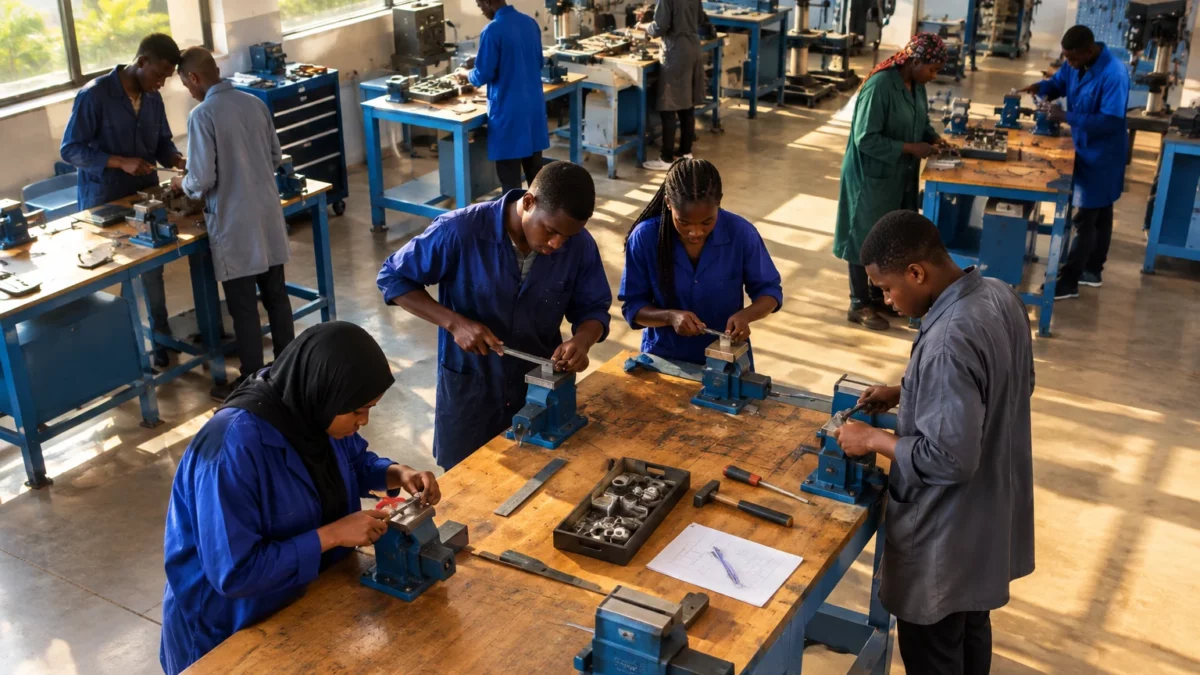
In Senegal, gaining a certificate does not guarantee a job. But without a recognised qualification, many young people remain even further from entering the workforce. That is the challenge behind the 4,000 training vouchers announced by the Fund for the Financing of Vocational and Technical Training (3FPT), as recent data show a marked divide between urban and rural areas, and between women and men.
A divide that goes beyond access to training
In the second quarter of 2026, 35.3% of Senegalese aged 15 to 24 were not in employment, education or training. This group, known as NEET, increased by 2.5 percentage points in a year, according to the National Employment Survey by the National Agency of Statistics and Demography (ANSD).
The national average masks significant differences. The proportion reaches 46.3% in rural areas, compared with 27.5% in cities. It stands at 40.4% among young women and 29.4% among young men. These disparities are a reminder that access to a training centre, mobility, family responsibilities and job opportunities are not distributed in the same way according to where people live and their sex.
The figure does not mean that all these young people are inactive in the everyday sense. It refers to those who, during the reference period, were not working and were not in education or training. In Senegal, the ANSD also notes that employment remains largely self-employed: in the second quarter of 2026, six out of ten people in work were working for themselves or as employers. Certification can open up opportunities, but its value also depends on job prospects and the practical conditions for working in a particular trade.
4,000 vouchers, but access is time-limited
On 12 November, the 3FPT announced a call for applications to award 4,000 vouchers to young people who had left school or were NEET. The courses, offered in several vocational fields, are intended to lead to a Certificate of Specialised Vocational Training (CPS). Registration was free and restricted to people living in the areas covered by the project. The application period ended on 16 November 2026, according to the terms published for the call.
This short timetable and geographical scope are decisive: a nationwide offer in terms of numbers does not mean that every young person can actually access it. The available information does not specify how beneficiaries will be selected, what indirect costs they will still have to bear, or what support will follow the training. Nor does it detail any job-placement scheme.
The training is part of a broader policy to prevent pupils from dropping out. On 29 July 2026, the Council of Ministers called for communities to help identify pupils in CM2—the final year of primary school—in the 2025-2026 school year who might drop out at the start of the following school year. It also referred to rolling out school and social inclusion projects, including “Daara atelier”, and mobilising support funds. The official statement is available on the Senegalese Prime Minister’s Office website.
Capacity has grown, but employment outcomes remain to be assessed
The fund has a network of institutions whose capacity has expanded. An evaluation of 3FPT funding awarded to public institutions between 2016 and 2024, conducted with support from the ANSD, was presented in Dakar on 12 November. Mamadou Camara Fall, secretary-general of the ministry responsible for employment and vocational training, said the investments had increased capacity by 176% and enabled the creation of 185 courses. He also reported that 4,227 people had benefited from capacity-building activities, with a satisfaction rate of 83.5%, according to the Senegalese Press Agency.
These results relate to capacity and institutions, not directly to the career outcomes of young people who have been trained. They therefore do not, by themselves, show how many find jobs, start a business or earn a stable income. For beneficiaries, the value of a certificate will depend on whether employers recognise it, whether it matches local needs and whether they can access the equipment, finance or networks needed to get started.
The challenge is particularly concrete outside Dakar, where distances and the concentration of training courses can make access more difficult. For young women, the disparities recorded by the ANSD also raise questions about schedules, transport and domestic responsibilities. Without addressing these obstacles, an available training place does not automatically become an accessible pathway.
A response that must be linked to regional economic needs
Senegal has included skills development in its national transformation agenda to 2050. At regional level, ECOWAS—the Economic Community of West African States—links the economies of the sub-region, where workers and businesses operate in markets that extend beyond national borders. Clear, relevant qualifications can facilitate this movement, but recognition and real job prospects remain essential.
The next step, then, will be less about the number of vouchers announced than about tracking outcomes: training actually completed, certifications obtained, employment or businesses created, and differences in results between urban and rural areas, and between women and men. ANSD statistics establish the scale of the problem and its inequalities; evaluation of the schemes will need to show whether this training durably reduces distance from employment and education.