Algeria
 Egypt
 Libya
 Morocco
 Sudan
 Tunisia
 Benin
 Burkina Faso
 Cabo Verde
 Côte d'Ivoire
 Ghana
 Guinea
 Guinea-Bissau
 Liberia
 Mali
 Mauritania
 Niger
 Nigeria
 Senegal
 Sierra Leone
 The Gambia
 Togo
 Cameroon
 Central African Republic
 Chad
 DR Congo
 Equatorial Guinea
 Gabon
 Republic of the Congo
 São Tomé and Príncipe
 Burundi
 Comoros
 Djibouti
 Eritrea
 Ethiopia
 Kenya
 Malawi
 Mauritius
 Mozambique
 Rwanda
 Seychelles
 Somalia
 South Sudan
 Tanzania
 Uganda
 Angola
 Botswana
 Eswatini
 Lesotho
 Namibia
 South Africa
 Zambia
 Zimbabwe
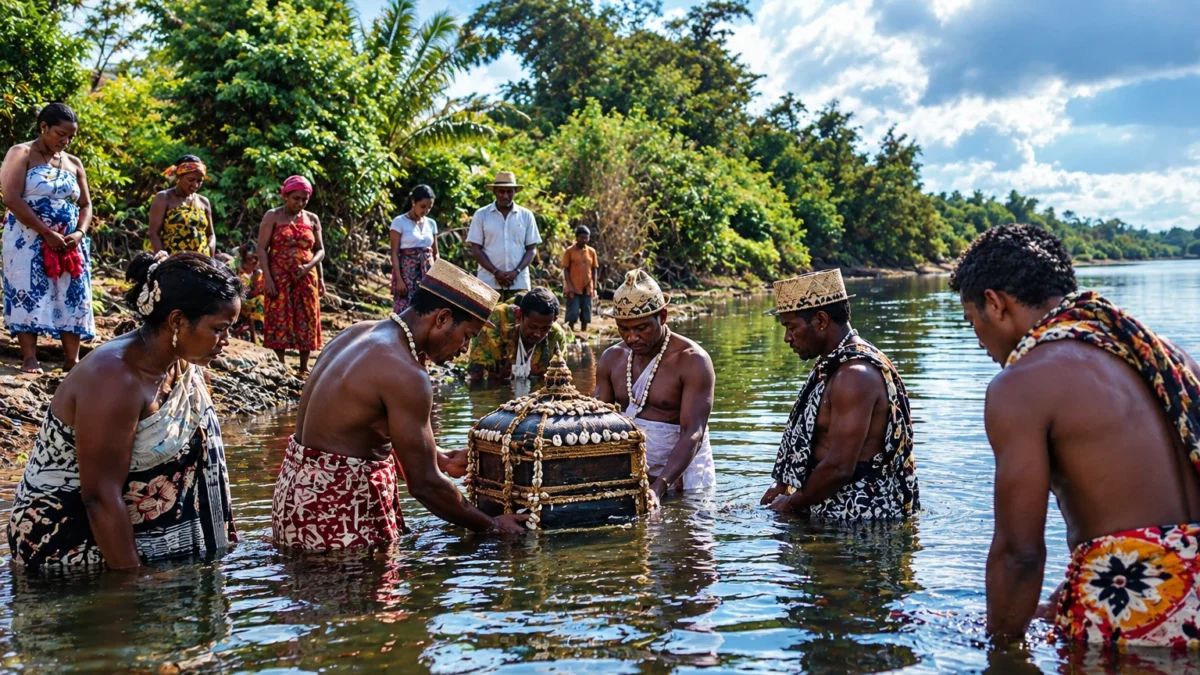
In Belo-sur-Tsiribihina, in western Madagascar, the return of a relic restored King Toera’s place in a Sakalava ritual passed down from generation to generation. Fitampoha 2026, which ended on 28 August, marked the first time the ruler’s presumed skull had taken part in the bathing of royal relics since his death in 1897.
A royal ritual revived in Menabe
Fitampoha is a Sakalava ceremony in Menabe during which the relics of former rulers, known as “dady”, are bathed in the Tsiribihina river. The rite honours ancestors and renews “hasina”, a concept linked to the authority and sacred power of royalty.
From 20 to 28 August 2026, ceremonies took place in Belo-sur-Tsiribihina. Malagasy media report that Toera’s skull, repatriated the previous year, took its place among the relics. The ritual bath thus brought together dynastic memory, spiritual practice and cultural transmission.
The return had been prepared by the Malagasy authorities and Sakalava representatives after France returned three skulls. In January 2025, the government announced that Toera’s relic was to be taken to the zomba, the royal space where the relics are kept, for a ceremony in Menabe.
From colonial violence to restitution
Toera ruled the Sakalava kingdom of Menabe, in the west of the island. He was killed in 1897 during the French colonial conquest. His skull and those of two other Sakalava were subsequently kept in the collections of the National Museum of Natural History in Paris.
Restitution does not, however, mean that the skull has been scientifically identified with certainty as Toera’s. The Franco-Malagasy committee studied the provenance of the three remains. According to France’s Ministry of Culture, the Sakalava community recognised the third skull as that of the king, while historical and scientific analyses documented its journey.
The French decree of 2 April 2025 authorised the return of the three skulls to Madagascar. The official handover ceremony took place on 26 August 2025. The decree responded to a Malagasy request submitted in 2022 and applied for the first time the 2023 French law allowing human remains from public collections to be returned for funerary purposes.
The legal process highlights a broader issue: French public collections are in principle inalienable, meaning they cannot be freely transferred. A specific procedure was therefore needed to make restitution possible. For Sakalava descendants and authorities, the issue was not merely one of heritage: it was about reintegrating a relic into the royal funerary and ritual cycle.
A memory carried by multiple actors
The 2026 ceremony gave the communities of Menabe a central role in deciding how to receive and honour the relics. State authorities were also present. According to Malagasy media outlet Newsmada, the government contributed 50 million ariary towards the organisation of the event and provided zebu cattle to accompany the ceremonies.
This public involvement underscores the national significance assumed by a regional tradition. But it also requires a distinction between responsibilities: the state can support heritage preservation, while the meaning and conduct of the rite belong first and foremost to the communities and holders of Sakalava knowledge.
The restitution had already sparked disagreements between branches of the royal family over representation and the conduct of the ceremonies. This context is a reminder that the physical return of an object does not automatically settle questions of legitimacy, memory and cultural governance. Fitampoha nevertheless allowed the relic to be restored to a ritual setting shaped by the practices of Menabe.
A significance beyond Madagascar
For Madagascar, whose capital is Antananarivo, the event links local history to the national memory of colonialism. Toera’s story is a reminder that the conquest did not only transform political institutions: it also displaced human remains and interrupted funerary practices.
In the Indian Ocean and across the continent, the case feeds into debates about the restitution of human remains and cultural property held by former colonial powers. It raises a practical question: who decides how a relic is used, and what evidence or recognition is considered sufficient to return it to its descendants?
The August 2026 ceremony is therefore a cultural milestone rather than a definitive resolution of all historical controversies. It also shows that restitution takes on its full meaning when the physical return is followed by the communities concerned reclaiming the relic according to their own institutions and rites.