Algeria
 Egypt
 Libya
 Morocco
 Tunisia
 Benin
 Burkina Faso
 Cabo Verde
 Côte d'Ivoire
 Ghana
 Guinea
 Guinea-Bissau
 Liberia
 Mali
 Mauritania
 Niger
 Nigeria
 Senegal
 Sierra Leone
 The Gambia
 Togo
 Cameroon
 Central African Republic
 Chad
 DR Congo
 Equatorial Guinea
 Gabon
 Republic of the Congo
 São Tomé and Príncipe
 Burundi
 Comoros
 Djibouti
 Eritrea
 Ethiopia
 Kenya
 Madagascar
 Malawi
 Mauritius
 Mozambique
 Rwanda
 Seychelles
 Somalia
 South Sudan
 Tanzania
 Uganda
 Angola
 Botswana
 Eswatini
 Lesotho
 Namibia
 South Africa
 Zambia
 Zimbabwe
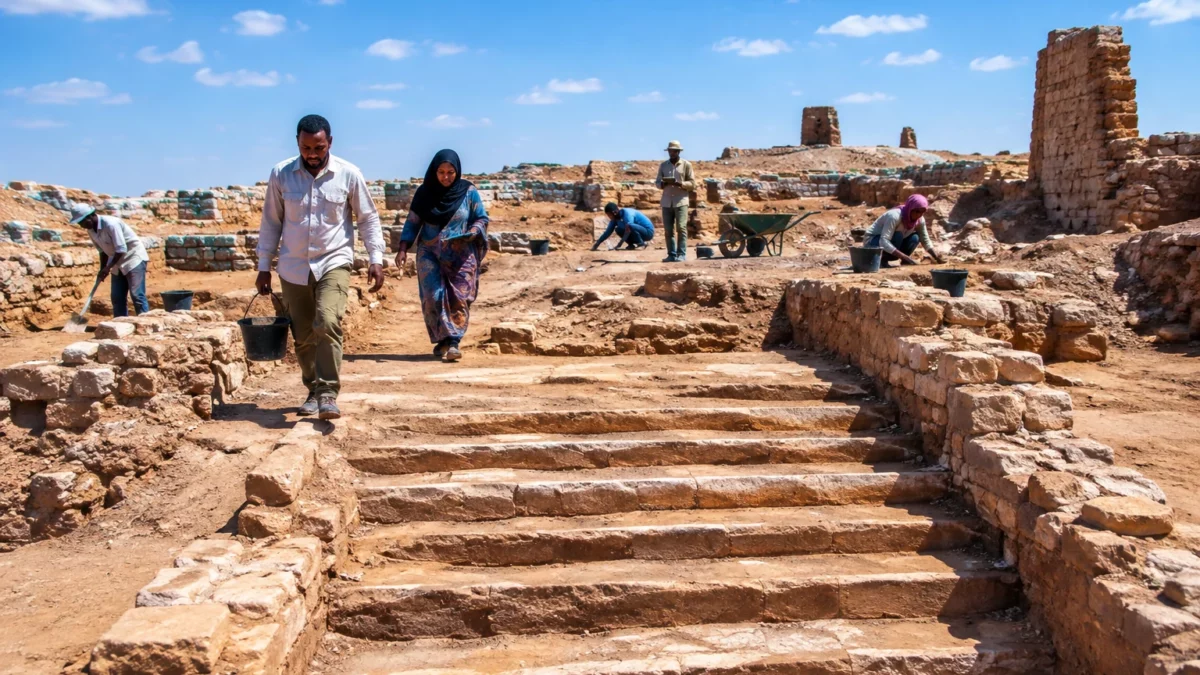
At Old Dongola, a descent through the sand has brought to light a fragment of the floor of a building that could redraw the map of the great religious centres of medieval Nubia. The discovery sheds light on Sudanese history, in which the kingdoms of the Nile were also centres of power, learning and architecture.
An ancient capital at the heart of Nubia
Old Dongola, in Northern State, was the capital of Makuria, a Christian kingdom established along the Nile between the 7th and 14th centuries. The site brings together churches, civic buildings and mosques. It is on UNESCO’s Tentative List of World Heritage, the first step towards a possible nomination, and not on the World Heritage List itself.
Makuria was among the Nubian kingdoms that developed after Christianity arrived in the region in the 6th century. It maintained ties with its neighbours along the Nile, both to the north and to the south. This history belongs to a region now divided between Sudan and Egypt, but whose medieval political and religious trajectories do not correspond to contemporary borders.
Sudan is also facing a war that broke out in April 2023 between the army and the Rapid Support Forces. In this context, protecting heritage and ensuring the continuity of archaeological work take on particular importance. Excavations at Old Dongola bring together Polish researchers and Sudan’s National Corporation for Antiquities and Museums.
Access to the floor, but not yet the whole cathedral
During the most recent fieldwork season, the team cleared a monumental staircase leading down to the original floor level of the Great Church of Jesus. The walls on either side of the descent remain preserved to a height of about 11 metres. For now, archaeologists have reached the floor only at this point: much of the building remains buried.
The existence of the structure was identified in 2021. Measurements presented by the team put it at about 47 metres wide and 57 metres long, with its height cautiously estimated at nearly 21 metres. These dimensions would make it one of the largest known churches in medieval Nubia. The comparison with the White House, made by mission director Artur Obłuski, gives an idea of its scale, but is not an archaeological measurement.
The building’s institutional significance remains to be established. Researchers believe it could be the cathedral where the archbishop of Makuria resided, overseeing the kingdom’s church hierarchy. This hypothesis would prompt a reassessment of the role of another church, hitherto considered Dongola’s cathedral. It will be confirmed only as excavations and the study of the remains progress.
Clues to practices and exchanges
The discoveries are not limited to the building’s dimensions. In a structure adjoining the great church, the team identified another church on the upper floor, whose walls retain traces of paint. Plaster fragments bear Greek inscriptions. Epigrapher Agata Deptuła identified some of them as biblical hymns, including a passage from the prayer of Hannah, mother of the prophet Samuel.
These elements point to a liturgical environment in which Greek had a place, but are not enough on their own to describe the language spoken by local people or the full range of religious practices. They add to the frescoes and texts already studied at Old Dongola. Together, these remains may help explain how architectural forms, images and written traditions circulated in the Nile Valley.
Work is progressing slowly because the layers of sand and debris are thick and the walls are exceptionally tall. This constraint is also an advantage for preservation: a significant part of the architecture remained protected beneath the deposits. But excavation requires resources, precise recording and stabilisation measures before more of the site can be exposed.
A living heritage, vulnerable to the elements
The excavations are part of a relationship with neighbouring communities. The team and Sudanese institutions conduct outreach activities and work with local residents. The issue extends beyond studying a monument: it also concerns the transmission of heritage and the potential benefits for a region far from the country’s political and economic centres.
The site suffered severe flooding in autumn 2024, described by the mission director as the worst since 1988. It damaged some of the coverings that protected the remains. Meanwhile, the photovoltaic system completed during the fieldwork season is intended to power pumps used for water supply and irrigation of cultivated land. This intersection of research, conservation and local needs is a reminder that archaeology takes place in an inhabited area, with its everyday constraints.
Old Dongola thus connects Sudanese history with broader debates about safeguarding cultural property during conflict and the place of African knowledge in writing the history of the continent. The next fieldwork season will have to determine the extent of the church and test its identification as an episcopal seat. Until then, the dimensions put forward remain estimates, and the exposed floor represents only a small window into the building.
The University of Warsaw presents the findings of the Sudanese-Polish mission. The site’s historical context is also documented in Old Dongola’s entry on UNESCO’s Tentative List.