Algeria
 Egypt
 Libya
 Morocco
 Sudan
 Tunisia
 Benin
 Burkina Faso
 Cabo Verde
 Ghana
 Guinea
 Guinea-Bissau
 Liberia
 Mali
 Mauritania
 Niger
 Nigeria
 Senegal
 Sierra Leone
 The Gambia
 Togo
 Cameroon
 Central African Republic
 Chad
 DR Congo
 Equatorial Guinea
 Gabon
 Republic of the Congo
 São Tomé and Príncipe
 Burundi
 Comoros
 Djibouti
 Eritrea
 Ethiopia
 Kenya
 Madagascar
 Malawi
 Mauritius
 Mozambique
 Rwanda
 Seychelles
 Somalia
 South Sudan
 Tanzania
 Uganda
 Angola
 Botswana
 Eswatini
 Lesotho
 Namibia
 South Africa
 Zambia
 Zimbabwe
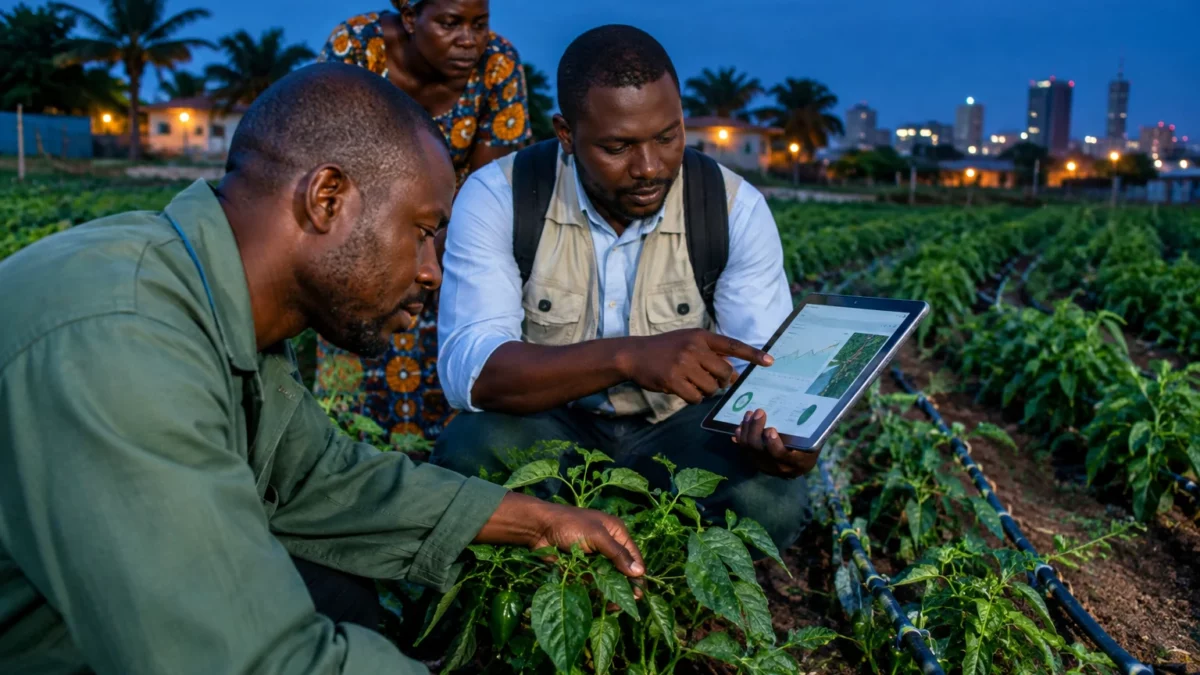
A spraying drone, an app that monitors crops, a remotely controlled irrigation system: these tools are only worthwhile if they meet farms’ needs. In Côte d’Ivoire, the DigiGreen Days showcased digital farming solutions and the people trained to put them to work in the field.
Held from 11 to 13 November 2026 at the Sofitel Abidjan Hôtel Ivoire, as part of the Ivoire Tech Forum, the event presented the results of the DigiGreen & Agri programme. It says it has supported 101 AgriTech start-ups and trained nearly 3,000 people. These figures were reported after the event by the Ivorian Press Agency and Fraternité Matin.
Tools, but also skills
Demonstrations featured spraying drones, crop-monitoring apps and connected drip-irrigation systems. The programme also trained participants in drone piloting, agricultural production techniques and digital farm monitoring. The challenge is to link technology to production practices, rather than reduce it to a showcase.
The programme’s official presentation took place on Thursday 12 November. Young people who had received training, start-ups and partners shared a space with forum visitors. According to the organisers, some solutions are already being deployed among planters and producers. This implementation is an important part of the programme’s record, but published information gives no details on the number of farms involved or the measured effects on yields, incomes or water consumption.
The distinction matters. Training nearly 3,000 people is an activity metric; on its own, it does not show how many subsequently found a job, started a business or adopted a practice over the long term. Similarly, support for 101 start-ups says nothing about their revenue, medium-term survival or ability to serve producers far from major urban centres. These outcomes still need to be documented to assess the programme’s economic impact.
Digital transformation also depends on value chains
Côte d’Ivoire is a major player in agricultural value chains, particularly cocoa. In this context, digital technology can make it easier to monitor plots and access technical services. Connected irrigation, for example, can help manage water use more effectively; its practical value, however, depends on the cost of equipment, its maintenance, network coverage and how well it is suited to the realities of each farm.
The benefits are not automatically distributed equally. A young company may gain customers and test its tools, while a producer needs to be able to finance the equipment and obtain reliable support. Rural areas, where connectivity and maintenance services may be less accessible, do not necessarily have the same conditions as urban hubs. The information available does not specify how beneficiaries are distributed by region, value chain, or between women and men.
The programme is co-financed by the European Union and Germany’s Federal Ministry for Economic Cooperation and Development (BMZ). GIZ implements it under develoPPP, in cooperation with Orange, through the Orange Digital Center. The Agence universitaire de la Francophonie also describes DigiGreen & Agri as an initiative linked to digital training, youth employability and the low-carbon transition in Côte d’Ivoire.
This arrangement brings together public cooperation and private enterprise. It can provide funding, training and technical expertise. It also raises a question of continuity: once support ends, who will maintain the solutions, provide further training and ensure producers can access them? The information published so far does not answer this question.
An Ivorian challenge within a West African trend
Abidjan hosts events aimed at bringing technology companies, investors and institutions together. Côte d’Ivoire’s Ministry of Digital Transition describes the Ivoire Tech Forum as a regional innovation event, part of the 2026-2028 Digital Acceleration Plan. The DigiGreen Days add a practical challenge to this ambition: connecting digital tools with productive sectors, including agriculture.
Across West Africa, this experience speaks to a shared question: how can digital services be adapted to each country’s agriculture and value chains, without assuming that needs or infrastructure are the same everywhere? The Economic Community of West African States (ECOWAS) provides a regional framework for cooperation, but the results announced here relate to the Ivorian programme. They are not, on their own, enough to conclude that there has been a regional impact.
The next step, then, will be less about demonstration than about proving results over time: measuring the actual use of the tools, their cost to farmers and the career prospects of those trained. Such data will show whether the 101 supported companies and thousands of beneficiaries translate into accessible services, lasting jobs and practices better suited to the constraints of Ivorian agriculture.