Algeria
 Egypt
 Libya
 Morocco
 Sudan
 Tunisia
 Benin
 Burkina Faso
 Cabo Verde
 Côte d'Ivoire
 Ghana
 Guinea
 Guinea-Bissau
 Liberia
 Mali
 Mauritania
 Niger
 Nigeria
 Senegal
 Sierra Leone
 The Gambia
 Togo
 Cameroon
 Central African Republic
 Chad
 Equatorial Guinea
 Gabon
 Republic of the Congo
 São Tomé and Príncipe
 Burundi
 Comoros
 Djibouti
 Eritrea
 Ethiopia
 Kenya
 Madagascar
 Malawi
 Mauritius
 Mozambique
 Rwanda
 Seychelles
 Somalia
 South Sudan
 Tanzania
 Uganda
 Angola
 Botswana
 Eswatini
 Lesotho
 Namibia
 South Africa
 Zambia
 Zimbabwe
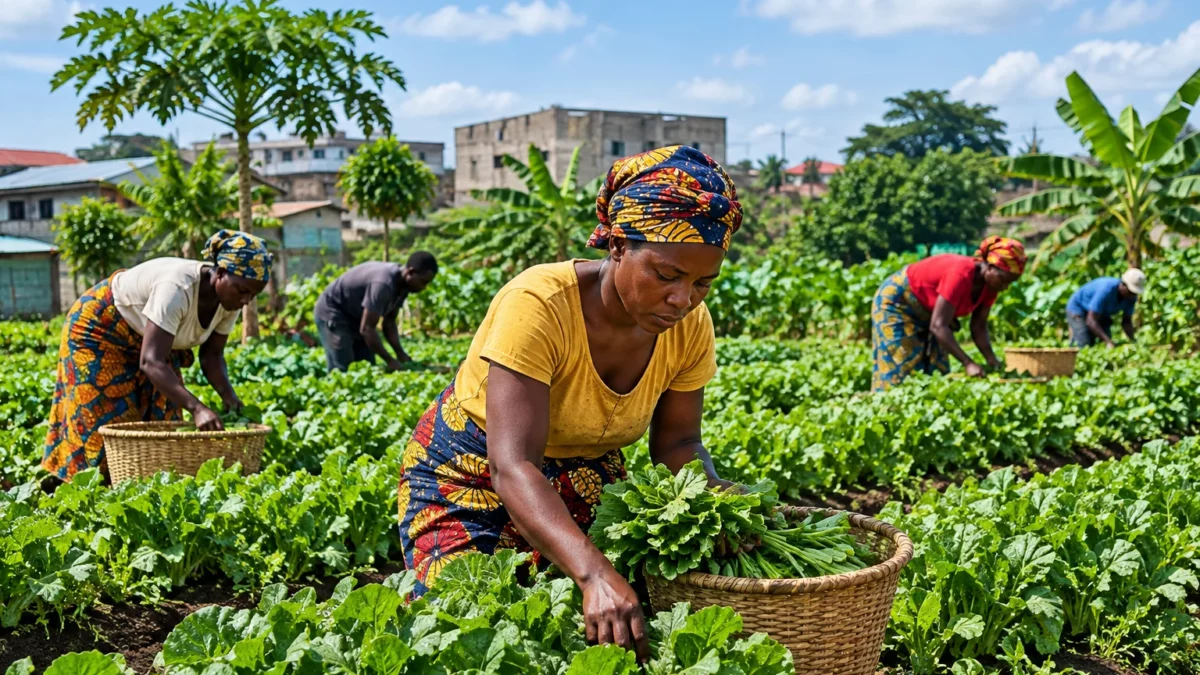
In the Democratic Republic of the Congo, a multi-billion-dollar humanitarian budget does not, by itself, guarantee that displaced families or small-scale farmers will receive regular assistance. The challenge for the food plan announced for 2027-2030 will therefore be as much about mobilising funds as turning them into practical support, in a country where needs vary widely from one province to another.
A national plan amid regional tensions
Crises in eastern DR Congo have effects that extend beyond conflict zones: they displace households, disrupt harvests and make access to markets more difficult. The eastern provinces are also linked to neighbouring countries through trade and population movements. DR Congo is notably a member of the Southern African Development Community (SADC) and the East African Community (EAC), two regional frameworks concerned with stability and cross-border trade.
Hunger is not, however, confined to the east. Data from the Integrated Food Security Phase Classification (IPC), a commonly used tool for assessing the severity of food insecurity, cover several regions of the country. They also show that emergency needs coexist with challenges relating to agricultural production, nutrition and social protection.
Projected funding of $2.6bn
The Congolese government announced on 16 November that the World Food Programme (WFP) plans nearly $2.6bn for its operations in DR Congo from 2027 to 2030. This amount is a projected budget for the plan, not money already raised or disbursed.
Prime Minister Judith Suminwa Tuluka was due to make the case for Kinshasa’s backing of the strategic plan before the WFP Executive Board, meeting in Rome from 16 to 19 November. According to Congolese media, the programme is presented as aligned with the National Strategic Development Plan. It includes actions relating to food and nutrition security, human capital, social protection and the resilience of food systems.
The announcement was reported by several Congolese media outlets, but the WFP’s public pages consulted did not allow independent confirmation of either the total amount or the details of its funding. The $2.6bn figure should therefore be understood as a projection communicated by the authorities and reported in the local press. The prime minister was also due to meet WFP contributors to call for more predictable funding.
Needs could continue to rise
The IPC estimates that 28.8 million people in DR Congo will face acute food insecurity at Phase 3 or above between September and December 2026. In this classification, Phase 3 denotes a crisis, while Phase 4 signals an emergency. The projection for January-June 2027 rises to 30.3 million people. These figures are published in the IPC analysis dated 30 October 2026 and are cited by the humanitarian organisation Save the Children.
In the north-east and east — notably Ituri, North Kivu and South Kivu — the IPC counts 10.4 million people at Phase 3 or above in the current period. Conflict and displacement can prevent farmers from planting or harvesting, reduce household incomes and disrupt supplies. An Ebola outbreak is also complicating the response in some areas: on 11 November, the World Health Organization reported nearly 11,000 confirmed cases and more than 5,300 deaths in the country. These health figures are distinct from the food security estimates.
The challenge: turning commitments into accessible aid
For the authorities, alignment with the national plan should help link emergency response with development policies. For displaced households, the impact will depend instead on food availability, continuity of assistance and the opportunity to resume earning a living. Small-scale farmers may need seeds or access to markets, while urban families are feeling the effects mainly through rising costs and lost income.
A multi-year plan can help organisations schedule their operations and avoid funding gaps. But the announced amount alone does not specify what share will go to direct food assistance, nutrition support or strengthening livelihoods. Nor does it say how the funds will be allocated between provinces, or what proportion depends on contributions yet to be secured.
This distinction matters: a projected budget is neither a promise of full disbursement nor a measure of the assistance actually received. Predictable funding can facilitate procurement, transport and operational planning. However, humanitarian access, the safety of teams and the capacity of local markets will remain decisive, particularly in conflict-affected areas.
A milestone to watch beyond DR Congo
The plan’s presentation in Rome places DR Congo within a broader debate on the predictability of humanitarian funding. For neighbouring countries, displacement and disruption to trade in eastern DR Congo also have regional consequences. The issue is therefore of interest to SADC, the EAC and, more broadly, the African Union, although these organisations are not direct funders of the announced budget.
The next step will be to verify the WFP Executive Board’s formal decisions, then track contributions actually confirmed and their implementation. The IPC projections for the first half of 2027 will provide another benchmark: they will show whether needs evolve as forecast and whether interventions reach the populations concerned.