Algeria
 Egypt
 Libya
 Morocco
 Sudan
 Tunisia
 Benin
 Burkina Faso
 Cabo Verde
 Côte d'Ivoire
 Ghana
 Guinea
 Guinea-Bissau
 Liberia
 Mali
 Mauritania
 Niger
 Nigeria
 Senegal
 Sierra Leone
 The Gambia
 Togo
 Cameroon
 Central African Republic
 Chad
 Equatorial Guinea
 Gabon
 Republic of the Congo
 São Tomé and Príncipe
 Burundi
 Comoros
 Djibouti
 Eritrea
 Ethiopia
 Kenya
 Madagascar
 Malawi
 Mauritius
 Mozambique
 Rwanda
 Seychelles
 Somalia
 South Sudan
 Tanzania
 Uganda
 Angola
 Botswana
 Eswatini
 Lesotho
 Namibia
 South Africa
 Zambia
 Zimbabwe
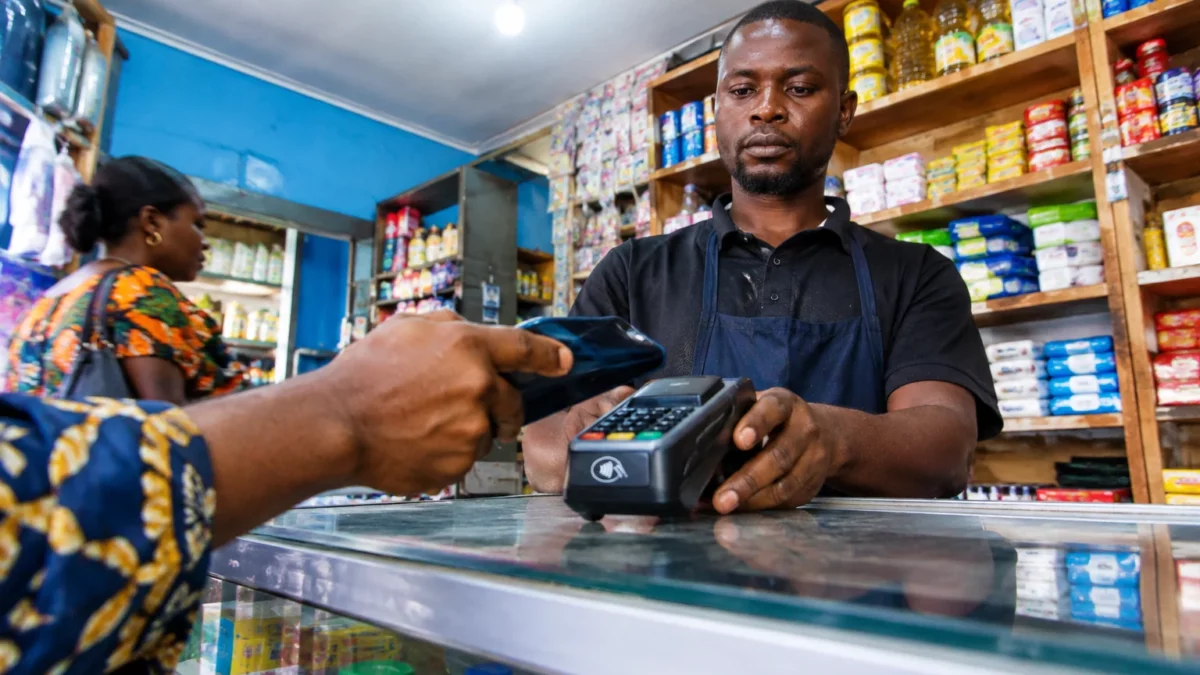
In Kinshasa, it is becoming possible to pay for a meal with a phone without scanning a code or transferring money to the merchant. But this simplicity depends on a network of compatible terminals, a suitable smartphone and fees that customers and small businesses can afford.
The launch of Tap to Pay on Visa Pay on 16 November is part of a broader shift in the Democratic Republic of the Congo. The Central Bank of Congo (BCC) is preparing to ban commercial cash payments in foreign currencies from 9 April 2027. Payments in dollars or other currencies will then have to go through banking or electronic channels. Cash payments in Congolese francs will remain permitted. The measure does not mean that individuals will no longer be able to hold foreign currencies, the BCC says.
From smartphone to payment terminal
The new feature lets customers pay for a purchase by bringing a compatible Android phone close to a contactless terminal. The phone and terminal exchange the information needed for the transaction. Merchants do not have to replace their device if they already have a compatible terminal.
BCC Governor André Wameso made a demonstration transaction at a restaurant in Kinshasa during the launch. Radio Okapi also reported the launch of the feature in Kinshasa on 16 November. Visa describes the Democratic Republic of the Congo as the first market where this option is available on Visa Pay. This commercial claim could not be independently verified.
Tap to Pay adds in-store payments to Visa Pay’s existing uses. Launched in the DRC in September 2025, the platform aims to link payments, transfers and bank accounts or mobile money wallets. Visa says its service can work with various financial partners and operators. In July 2026, the company described Visa Pay as an interoperable solution intended in particular for banks, mobile money operators and fintechs.
Monetary reform requires alternatives
The BCC’s decision gives these new payment methods a significance that goes beyond convenience. From 9 April 2027, commercial payments in foreign currencies will still be possible by bank transfer, card, terminal or mobile money. The ban applies to cash payments for goods and services in foreign currencies, not to private holdings of those currencies or to all bank withdrawals and deposits.
The central bank says it aims to improve the traceability of financial flows, develop digital payments and promote financial inclusion. It says the reform is not intended to bring about the immediate de-dollarisation of the economy. These clarifications matter in a country where the dollar plays a significant role in transactions. The BCC believes interoperable tools — capable of working across different networks and institutions — will be essential to implementing the measure.
The transition will not happen at the same pace for everyone. Businesses equipped with terminals and customers with compatible phones will be able to adopt contactless payments quickly. For small vendors, informal businesses and areas where connectivity remains patchy, the cost of commissions, access to equipment and network reliability may limit use. The availability of a digital payment method does not, by itself, guarantee that it is affordable or accessible everywhere.
André Wameso has raised the prospect of payments that can work offline, with settlement once the connection returns. This approach addresses a practical problem: a transaction that depends on the internet can fail in places with poor coverage. However, in the information reviewed, the BCC has not set out a timeline or the technical details of this system.
Acceptance, the next test for digital payments
Launching a feature on an app is not enough to make it part of daily life. Merchants need compatible terminals, banks and operators must ensure transactions can be completed reliably, and users need to understand the fees and security mechanisms. Radio Okapi has identified the cost of digital payments as one of the obstacles to their wider adoption. For businesses, equipment and commissions will also affect whether they choose to accept these payments.
Interoperability is another issue. If a customer can pay only at a limited network of merchants or through certain institutions, the practical benefit remains limited. At a meeting with the Congolese Bankers Association on 10 November 2026, the BCC stressed the need for terminals that allow payments regardless of the customer’s bank. This requirement concerns the organisation of the sector as much as the technology itself.
At regional level, the DRC takes part in Central African monetary exchanges and is also a member of the Southern African Development Community (SADC), which brings together countries in southern and central Africa around economic co-operation. In early November, the BCC took part in a meeting of its committee of central bank governors. The development of interoperable digital payments is therefore part of issues that extend beyond the Congolese market, even though the rules and infrastructure remain national.
The next concrete deadline is 9 April 2027, the date set by the BCC for the restriction on commercial cash payments in foreign currencies to take effect. Until then, the main challenge will be less the number of new apps than their actual acceptance by businesses, their cost and how well they work outside areas with good connectivity. The launch of Tap to Pay gives Congolese people another option; it does not yet address the conditions needed to make digital payments commonplace.
Sources consulted: Radio Okapi on the launch of Tap to Pay in the DRC, Central Bank of Congo on the arrangements for the 2027 reform and Visa on the development of its Visa Pay platform.