
 Algeria
 Egypt
 Libya
 Morocco
 Sudan
 Tunisia
 Benin
 Burkina Faso
 Cabo Verde
 Ghana
 Guinea
 Guinea-Bissau
 Liberia
 Mali
 Mauritania
 Niger
 Nigeria
 Senegal
 Sierra Leone
 The Gambia
 Togo
 Cameroon
 Central African Republic
 Chad
 DR Congo
 Equatorial Guinea
 Gabon
 Republic of the Congo
 São Tomé and Príncipe
 Burundi
 Comoros
 Djibouti
 Eritrea
 Ethiopia
 Kenya
 Madagascar
 Malawi
 Mauritius
 Mozambique
 Rwanda
 Seychelles
 Somalia
 South Sudan
 Tanzania
 Uganda
 Angola
 Botswana
 Eswatini
 Lesotho
 Namibia
 South Africa
 Zambia
 Zimbabwe
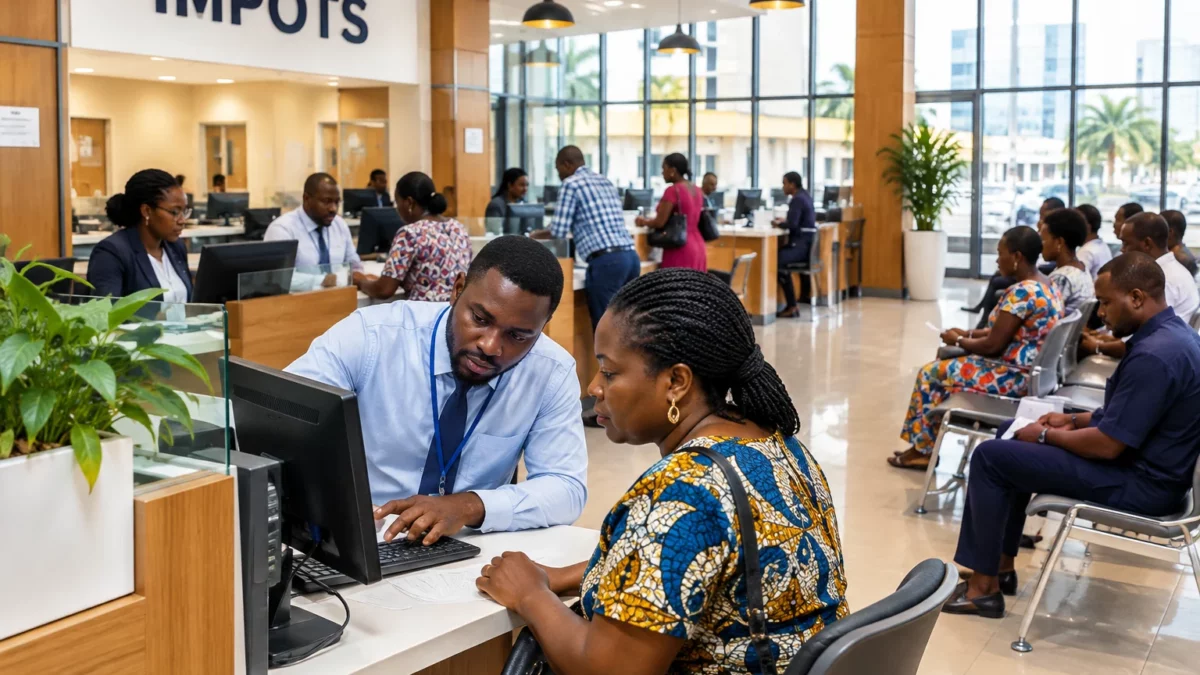
Digitising tax, better tracking spending and factoring in climate risk: in Côte d’Ivoire, these administrative reforms will weigh on the state’s ability to fund its priorities. But an announced allocation alone does not guarantee more accessible services or better-controlled spending.
A national budget subject to parliamentary scrutiny
Côte d’Ivoire’s 2027 draft budget stands at 18,466.1 billion CFA francs, up 6.4% on the budget approved for 2026. The National Assembly’s Economic and Financial Affairs Committee (CAEF) unanimously adopted it on 14 November, after four days of review. The bill is then due to be examined by the Senate in Yamoussoukro from 10 to 13 December, before possible promulgation.
The government forecasts growth of 6.6% in 2027, against 6.2% in 2026. It also expects the budget deficit to fall from 3.8% to 3.5% of gross domestic product, with a target of 3% in 2028. This threshold corresponds to the regional standard of the West African Economic and Monetary Union (WAEMU), which brings together eight countries that share, among other things, the CFA franc and a framework for budgetary convergence.
These projections describe targets, not outcomes already secured. The reduction in the deficit will depend in particular on revenue actually collected and on the execution of spending. Parliamentarians adopted the bill in committee; the Senate’s examination remains a separate stage in the process.
Funding for financial administrations
The budget presented by Minister Adama Coulibaly for his department is stated at 814.787 billion CFA francs. However, the breakdown reported by the Ivorian Press Agency lists 294.2 billion for the ministry’s services, 203.6 billion for Treasury special accounts and 8,122.9 billion for common expenditure and other allocations. These components add up to more than the amount stated for the ministry: the figures available do not allow this discrepancy to be resolved. The budget for the services should therefore not be confused with the special accounts or the total of allocations attached to the department.
For the ministry’s services, personnel expenditure amounts to 111.5 billion CFA francs. Investment accounts for 87.2 billion, goods and services for 86 billion, and transfers for 9.4 billion. These items indicate the planned administrative resources, but do not yet measure the results that will be achieved in 2027.
Projects announced include continuing the digitisation of tax administration, introducing a unique identifier to secure revenue, modernising the Treasury and consolidating the electronic land registry. The ministry also plans to incorporate climate risks into economic policies and create a sovereign wealth fund. According to the government’s budget framework, the fund is to start with an endowment of 100 billion CFA francs.
Revenue collection and implementation, decisive tests
Tax digitisation can make filing and payment tracking easier. It can also expand the data available to the administration. Its impact, however, will depend on the reliability of the systems, the protection of information and taxpayers’ effective access to services, particularly outside major urban centres.
For small businesses and workers in the informal economy, broadening the tax base may change procedures and compliance costs. For the state, improved collection could reduce dependence on volatile revenue. But the ministry will also have to show how it measures results and limits errors or inequitable treatment.
Factoring in climate risks addresses another practical concern: weather shocks can affect infrastructure, agricultural incomes and public spending. Taking them into account in planning can help anticipate these costs. The criteria used and the projects covered still need to be specified. Likewise, the creation of a sovereign wealth fund raises governance questions: investment rules, transparency of decisions and parliamentary oversight.
A fiscal path monitored at regional level
Côte d’Ivoire is framing its budget within WAEMU, whose convergence rules cover, among other things, the public deficit. The BCEAO, the Union’s common central bank, also monitors regional economic balances. Côte d’Ivoire’s 3% target for 2028 is thus part of a shared objective, even if member states’ fiscal paths and constraints differ.
For Ivorians, the ultimate test will be less the overall volume of spending than the quality of the services it funds and the transparency of its execution. For the region’s economic partners, revenue mobilisation and deficit control will also be indicators to watch. The next steps are the Senate’s examination of the bill in December, followed by publication of the promulgated allocations and, in due course, execution data.
The dates, amounts and parliamentary stages are reported by the Ivorian Press Agency and cross-checked against information from the Directorate-General of Budget and Finance. The Senate’s examination timetable was announced by the Directorate-General of Public Procurement.



