Algeria
 Egypt
 Libya
 Morocco
 Sudan
 Tunisia
 Benin
 Burkina Faso
 Cabo Verde
 Ghana
 Guinea
 Guinea-Bissau
 Liberia
 Mali
 Mauritania
 Niger
 Nigeria
 Senegal
 Sierra Leone
 The Gambia
 Togo
 Cameroon
 Central African Republic
 Chad
 DR Congo
 Equatorial Guinea
 Gabon
 Republic of the Congo
 São Tomé and Príncipe
 Burundi
 Comoros
 Djibouti
 Eritrea
 Ethiopia
 Kenya
 Madagascar
 Malawi
 Mauritius
 Mozambique
 Rwanda
 Seychelles
 Somalia
 South Sudan
 Tanzania
 Uganda
 Angola
 Botswana
 Eswatini
 Lesotho
 Namibia
 South Africa
 Zambia
 Zimbabwe
To finance its priorities without allowing the deficit to widen, Ivory Coast is seeking to capture more revenue from resources already being exploited and to step up controls on products sold in its market. Two tax measures targeting gold and certain drinks could together raise CFAF 111.3 billion in 2027, according to forecasts presented to parliament.
A growing budget under regional constraints
Ivory Coast’s draft budget for 2027 stands at CFAF 18,466.1 billion, 6.4% higher than in 2026. The government plans to bring the public deficit down to 3.5% of gross domestic product, from 3.8% in 2026, before reaching the community ceiling of 3% in 2028. This is the standard set by WAEMU, the West African Economic and Monetary Union, of which Ivory Coast is a member.
The budget and its tax annex are being examined by MPs in Abidjan, the country’s political and economic centre. Yamoussoukro remains the political and administrative capital. The tax bill contains 41 measures, divided between revenue mobilisation, support for investment and competitiveness, simplification and technical provisions.
This fiscal course is part of the 2026–2030 National Development Plan. The authorities are forecasting economic growth of 6.6% in 2027. But the gap between the planned increase in spending and the reduction in the deficit will make the actual yield of the new levies and the administration’s ability to collect them decisive.
Gold and drinks: two tax levers
The National Assembly’s Economic and Financial Affairs Committee adopted the tax annex on 13 November 2026, according to the Ivorian Press Agency. Adama Coulibaly, the Minister of Economy, Finance and Budget, presented the measures and their projected yields. Adoption by the committee does not, in itself, mean that all legislative stages have been completed or that the law has been promulgated.
The first measure concerns gold. The bill gradually revises the ad valorem tax, which is calculated as a proportion of a product’s value. The announced rates range from 5% when an ounce sells for 1,000 dollars or less, up to 12% above 6,000 dollars. The expected additional yield is CFAF 69 billion. It will therefore depend on international prices and the volumes declared and exported.
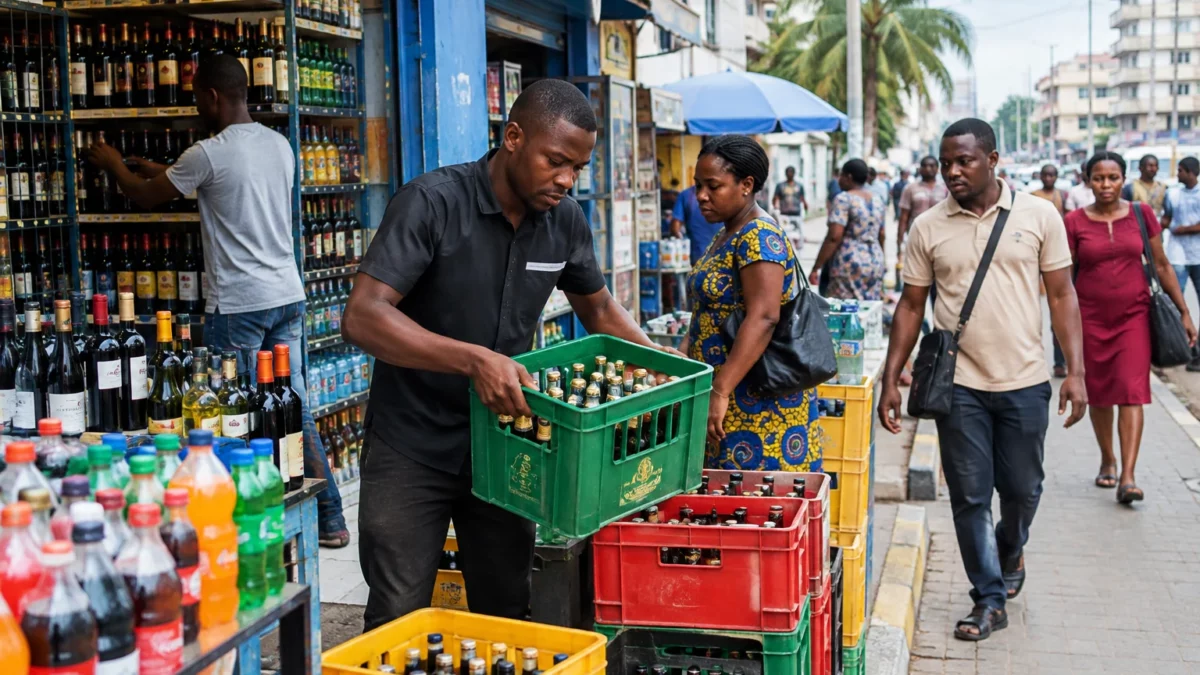
The second measure extends fiscal marking and the authentication system previously applied to tobacco to wine, spirits, beer and carbonated drinks. Water is excluded. The government expects an additional CFAF 42.3 billion from it. Marking is intended to make it easier to identify products subject to tax and strengthen checks against counterfeiting, smuggling and fraud.
The two amounts add up to CFAF 111.3 billion. This is a revenue forecast, not money already collected. The final figure will depend on how the rules are implemented, the monitoring of operators and market developments.
Who will bear the cost, and who will benefit from tighter controls?
For gold producers and exporters, the progressive rate links the tax burden more closely to the sale price. As prices rise, so does the share collected. This approach can increase public revenue when market conditions are favourable, but it also makes forecasts more sensitive to fluctuations in the global market. Small and large companies may not have the same resources to meet reporting requirements and document their transactions.
In the drinks sector, marking adds a traceability requirement for manufacturers, importers and distributors. An effective system can reduce the advantage enjoyed by operators that evade taxes and improve competition for compliant businesses. However, the practical arrangements and the cost of compliance will matter for local producers, small businesses and retailers. In time, any cost increases passed on in prices could also affect consumers; the available text does not make it possible to assess the scale of this effect.
Implementation is also a key issue. Marking will reduce fraud only if checks cover both formal and informal channels, from points of import to retail outlets. Similarly, a gold tax scale alone cannot guarantee the projected yield: the administration must be able to verify declared values. New revenues will therefore test the capacity to collect taxes as much as reflect the mechanical effect of the rates.
Natural resource revenues and public investment
Another provision calls for part of the state’s income from natural resources to be allocated to the Strategic Sovereign Fund for the Development of Côte d’Ivoire (FSD-CI). Created by ordinance in April 2026, the fund is intended to manage and develop public assets and help finance infrastructure projects and investments deemed strategic.
The link between taxation and investment is thus central: additional revenues can support public priorities, while allocating part of extractive revenues aims to channel this wealth into long-term projects. For Ivorians, the issue will be how the money is collected, allocated and monitored, and which projects concretely benefit.
Across West Africa, Ivory Coast’s budget timetable forms part of the shared objective among WAEMU members of containing deficits. The announced path towards 3% of GDP in 2028 will bear watching, as will the tax annex’s progress from parliamentary examination to implementation. The actual yield from taxes on gold and drinks will then show whether these new tools sustainably strengthen revenue without placing a disproportionate burden on compliant businesses.