
 Algeria
 Egypt
 Libya
 Morocco
 Sudan
 Tunisia
 Benin
 Burkina Faso
 Cabo Verde
 Ghana
 Guinea
 Guinea-Bissau
 Liberia
 Mali
 Mauritania
 Niger
 Nigeria
 Senegal
 Sierra Leone
 The Gambia
 Togo
 Cameroon
 Central African Republic
 Chad
 DR Congo
 Equatorial Guinea
 Gabon
 Republic of the Congo
 São Tomé and Príncipe
 Burundi
 Comoros
 Djibouti
 Eritrea
 Ethiopia
 Kenya
 Madagascar
 Malawi
 Mauritius
 Mozambique
 Rwanda
 Seychelles
 Somalia
 South Sudan
 Tanzania
 Uganda
 Angola
 Botswana
 Eswatini
 Lesotho
 Namibia
 South Africa
 Zambia
 Zimbabwe
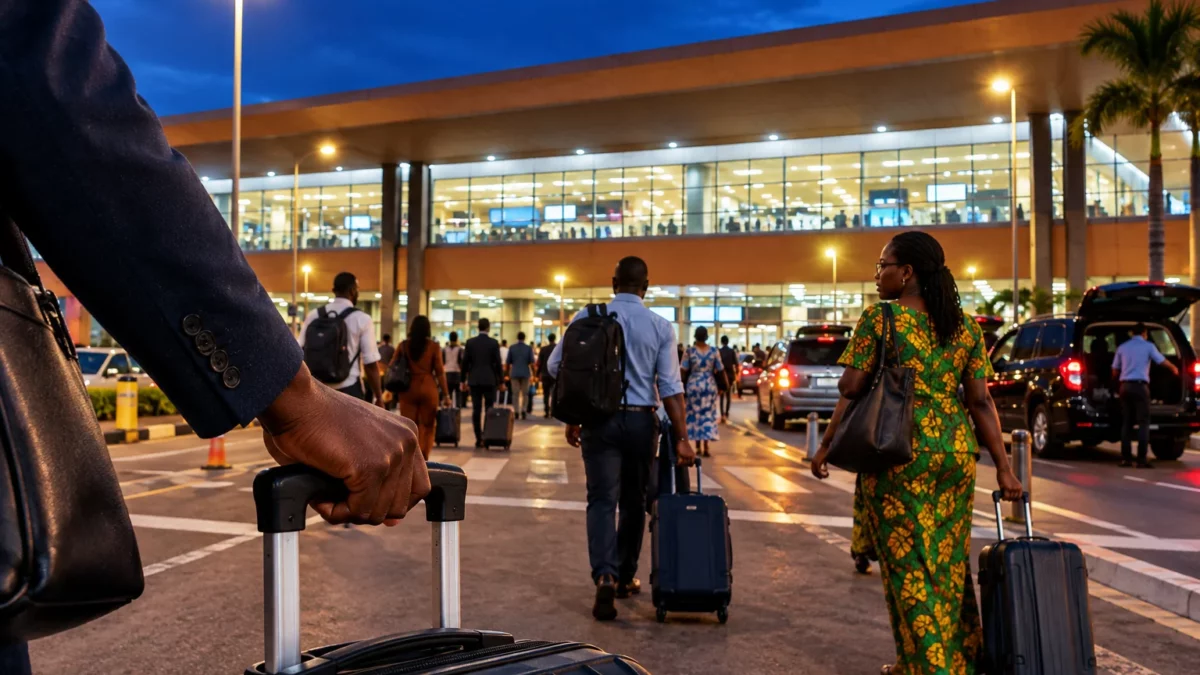
An airport can accommodate more travellers without becoming a preferred stopover. For Abidjan, the challenge in the coming years will therefore be twofold: expand the airport and make connections simple, regular and affordable enough to retain transit passengers.
An ambition to be measured against actual traffic
On 12 November 2026, Côte d’Ivoire’s Minister for Infrastructure and Road Maintenance, Yacouba Hien Sié, announced that Félix-Houphouët-Boigny International Airport could handle up to 8 million passengers a year by 2030. The government compares this target with the 2.4 million passengers recorded in 2025. Figures released by the Ministry of Transport give a more precise total: 2,551,915 travellers. The difference between the two formulations calls for a distinction between the order of magnitude presented by the government and the detailed count published by the ministry.
The announcement builds on work already under way. In December 2022, Prime Minister Patrick Achi launched the third phase of the airport’s expansion, rehabilitation and modernisation. The announced investment amounted to 330 billion CFA francs. The capacity target for this phase was 5 million passengers a year. The new target of 8 million therefore implies a further increase in capacity, but the government has yet to provide details of its cost, financing or operational schedule.
For context on these announcements and their limitations, see the government account of the Gouv’Talk on 12 November 2026, the Ivorian Ministry of Transport’s data on 2024 traffic and the official statement on the expansion phase launched in 2022.
Competition also hinges on connections
The figures show growth, but no recent acceleration. Traffic rose from 2,535,451 passengers in 2024 to 2,551,915 in 2025, an increase of 16,464 travellers, or about 0.65%. This was well below the 8.72% recorded between 2023 and 2024. The planned capacity will therefore not automatically translate into an equivalent rise in passenger numbers.
Regional comparisons highlight the scale of the challenge. Accra airport handled about 3.63 million passengers in 2025, while Blaise-Diagne International Airport, which serves Dakar, recorded nearly 2.94 million. These figures place Abidjan in a genuine West African competition. However, on their own they do not show which airport attracts more connecting passengers, or how many remain in each country.
Côte d’Ivoire nevertheless has a geographical and commercial advantage to build on. According to Ministry of Transport data cited in the material available, routes between Abidjan and ECOWAS countries accounted for 33.9% of passenger traffic in 2024. ECOWAS, the economic and political organisation of West African states, is therefore central to the hub strategy. These flows include business and family travel as well as regional journeys linked to economic exchanges.
To turn this position into connecting traffic, Air Côte d’Ivoire has reorganised its schedule around a central window, from 12.30pm to 2.30pm. The airline said in April 2025 that the arrangement was intended to make connections easier between its West and Central African destinations, and then its flights to Paris. Coordinated schedules can reduce waiting times, but they are not enough: a useful connection also depends on punctuality, baggage handling and compatibility between tickets and flights operated by partner airlines.
Fares, financing and local benefits
Ivorian authorities have also announced a 25% reduction in certain passenger and security charges for flights within the ECOWAS zone. The Council of Ministers adopted the relevant texts on 29 April 2026 as part of the regional harmonisation of aviation charges. The reduction applies to fees paid by the aviation sector. It does not guarantee an equivalent cut in the price paid by each traveller: final fares also depend on airlines, demand and other taxes.
The expansion involves several stakeholders, whose interests do not coincide. The state and the airport operator will have to fund the facilities and their operation. Airlines want more efficient operations and controlled costs. For passengers, particularly those travelling between West African capitals, the practical benefits come down to the total price, journey time and reliability of connections. Airport-related businesses in Abidjan may also benefit from increased traffic, but the gains will depend on jobs created, contracts awarded locally and the ability of transport services to connect the airport with the rest of the metropolitan area.
The West African Development Bank, according to Côte d’Ivoire’s Ministry of Infrastructure, conducted an assessment mission for the expansion and rehabilitation project in October 2026 in its capacity as a financial partner. This indicates that financing is among the issues still to be clarified. It does not, in itself, amount to an announcement of a final agreement or confirmation of the full financing structure.
A test for regional air integration
Abidjan’s trajectory extends beyond Côte d’Ivoire. ECOWAS’s common policy on aviation taxes and charges aims to make regional travel more consistent. Its implementation could affect the cost of routes between member states and the ability of African airlines to offer integrated networks. But harmonising charges will not resolve problems with schedules, frequency or commercial cooperation between carriers.
The next step will therefore be less spectacular than an announcement of capacity, but more consequential for travellers: publish the schedule, budget and arrangements for the new expansion, then track traffic and connections. In Côte d’Ivoire, where Yamoussoukro is the political capital and Abidjan the main economic centre, the project’s success will be measured not only by the size of the terminals, but also by the quality of the connections offered to the country and its neighbours.



