Algeria
 Egypt
 Libya
 Morocco
 Sudan
 Tunisia
 Benin
 Burkina Faso
 Cabo Verde
 Côte d'Ivoire
 Ghana
 Guinea
 Guinea-Bissau
 Liberia
 Mali
 Mauritania
 Niger
 Nigeria
 Senegal
 Sierra Leone
 The Gambia
 Togo
 Cameroon
 Central African Republic
 Chad
 Equatorial Guinea
 Gabon
 Republic of the Congo
 São Tomé and Príncipe
 Burundi
 Comoros
 Djibouti
 Eritrea
 Ethiopia
 Kenya
 Madagascar
 Malawi
 Mauritius
 Mozambique
 Rwanda
 Seychelles
 Somalia
 South Sudan
 Tanzania
 Uganda
 Angola
 Botswana
 Eswatini
 Lesotho
 Namibia
 South Africa
 Zambia
 Zimbabwe
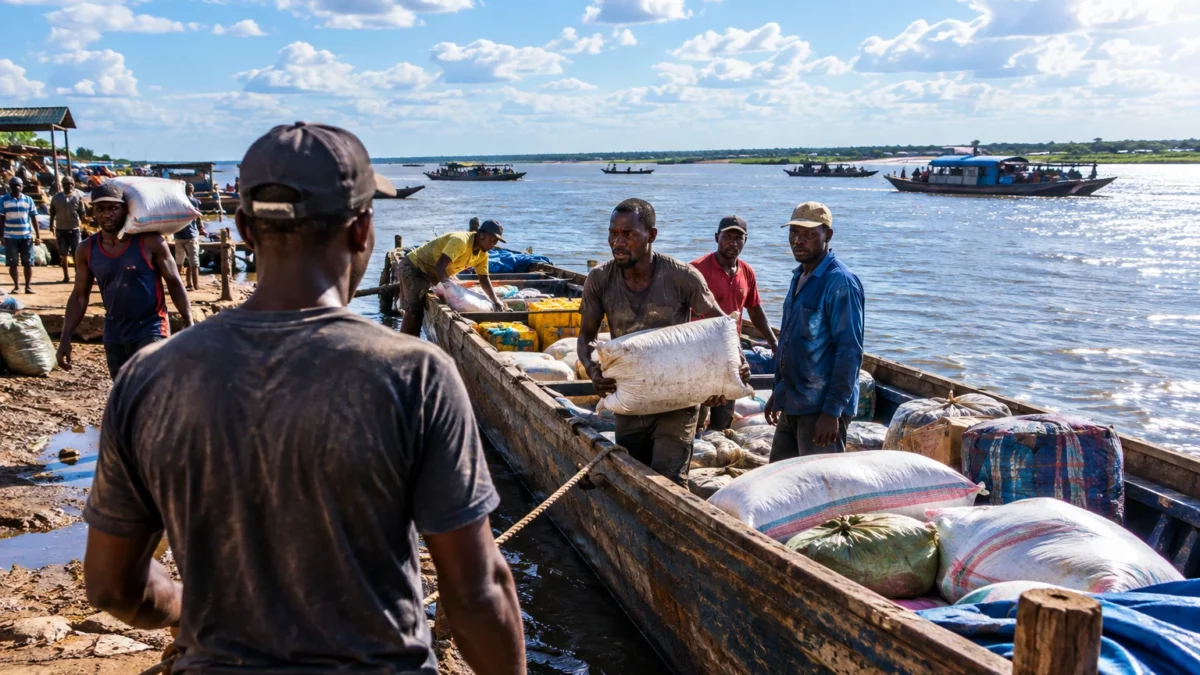
In several provinces of the Democratic Republic of the Congo, the river is much more than a transport route: it connects markets, villages and towns that are difficult to reach by road. The restriction on wooden boats therefore raises an immediate question: how can safety be improved without disrupting the trade on which riverside populations depend?
A ban with limited exceptions
The Ministry of Transport has set 15 November 2026 as the date the ban on wooden boats on the Congo River and the country’s main waterways and lakes takes effect. The order nevertheless provides for a transitional period of up to three months for some short routes, within a single province and on inland rivers. The vessels concerned must operate during daylight hours, between 6am and 6pm, comply with their authorised tonnage and require passengers to wear life jackets. Stopping and disembarking outside authorised points are also prohibited, reports Radio Okapi’s article on navigation conditions.
The protest is not coming only from boat owners. In Équateur province, provincial MPs have called for a suspension until a sufficient number of metal boats have been deployed. They fear supply disruptions and a slowdown in economic activity, according to the Congolese Press Agency. In Tshopo, provincial officials had also sought a moratorium before the deadline, a sign that concern extends beyond boat owners.
Boat owners call for time and dialogue
In Kinshasa, the Association of Congo River Boat Owners announced a strike starting on Monday 16 November. It intends to suspend the transport of goods by wooden vessels until the measure is lifted or dialogue begins. Its rapporteur, Jérémie Mwabikungu, says it is difficult to replace wooden boats with metal vessels within two or three months. The association is calling for a two-year moratorium and says it does not reject safety rules, including the ban on night-time navigation and the requirement to wear life jackets.
The true extent of the action remains to be seen: the announcement concerns freight transport and port operations. Radio Okapi reports that the association wants to block the loading and unloading of wooden boats. At this stage, the announcement of a strike should therefore not be confused with evidence that all river routes in the country have been suspended.
The call for more time does not mean that the risks are disputed. Recent shipwrecks have renewed calls for tighter controls on navigation. In September 2025, two accidents in Équateur province left at least 193 people dead, according to the Associated Press, citing officials and state media. The toll documents the scale of the disasters, but does not, on its own, allow each accident to be attributed to a particular type of hull. Overloading, night-time navigation and operating conditions are also among the factors cited in available reports.
River safety and livelihoods
For the authorities, banning wooden vessels is intended to reduce exposure to shipwrecks and speed up the modernisation of the fleet. But a safety rule does not, by itself, replace the boats taken out of service. The sources consulted do not specify how many metal vessels are available or how long their deployment will take. This lack of information makes it difficult to assess the practical replacement capacity.
The consequences could vary from one area to another. A disruption to sailings could affect traders transporting their goods, carriers, small markets and households that depend on river trade. Communities far from road networks are particularly exposed to delays and higher costs. In Kinshasa, arrivals from the west and north-east also contribute to the capital’s supplies, although the scale of any potential disruption has not yet been established.
Boat owners, for their part, say they face harassment by some officials responsible for river inspections and claim this is driving navigators to travel at night. This is their account of events, not an independent conclusion about the causes of the accidents. It nevertheless highlights an implementation challenge: enforcing tonnage limits, schedules and equipment requirements depends on predictable inspections and consistently applied rules.
A test for the governance of waterways
The DRC, a Central African country, shares transport safety and regional movement concerns with its neighbours, but this decision is primarily a matter for the Congolese authorities and the needs of the country’s vast inland network. The African Union and the Economic Community of Central African States provide frameworks for continental and regional cooperation; available information does not, however, indicate that either organisation has taken a decision on this ban.
The point of friction therefore goes beyond the choice between wooden and metal boats. It also concerns the state’s ability to support a transition: a realistic timetable, the availability of replacement vessels, port inspections and representation for the provinces affected. Elected representatives in Équateur are calling for a suspension, while boat owners are asking for two years. The ministry, meanwhile, is maintaining the general ban while temporarily authorising some local services under certain conditions.
In the coming days, three elements will need to be distinguished: whether the announced strike is actually observed, whether services authorised on a transitional basis continue, and what measures Kinshasa takes to replace the capacity withdrawn. The effectiveness of the reform will be judged by how it balances passenger safety, access to markets and fair enforcement of the rules.