Algeria
 Egypt
 Libya
 Morocco
 Sudan
 Tunisia
 Benin
 Burkina Faso
 Cabo Verde
 Côte d'Ivoire
 Ghana
 Guinea
 Guinea-Bissau
 Liberia
 Mali
 Mauritania
 Niger
 Nigeria
 Senegal
 Sierra Leone
 The Gambia
 Togo
 Cameroon
 Central African Republic
 Chad
 DR Congo
 Equatorial Guinea
 Gabon
 Republic of the Congo
 São Tomé and Príncipe
 Burundi
 Comoros
 Djibouti
 Eritrea
 Ethiopia
 Kenya
 Madagascar
 Malawi
 Mauritius
 Rwanda
 Seychelles
 Somalia
 South Sudan
 Tanzania
 Uganda
 Angola
 Botswana
 Eswatini
 Lesotho
 Namibia
 South Africa
 Zambia
 Zimbabwe
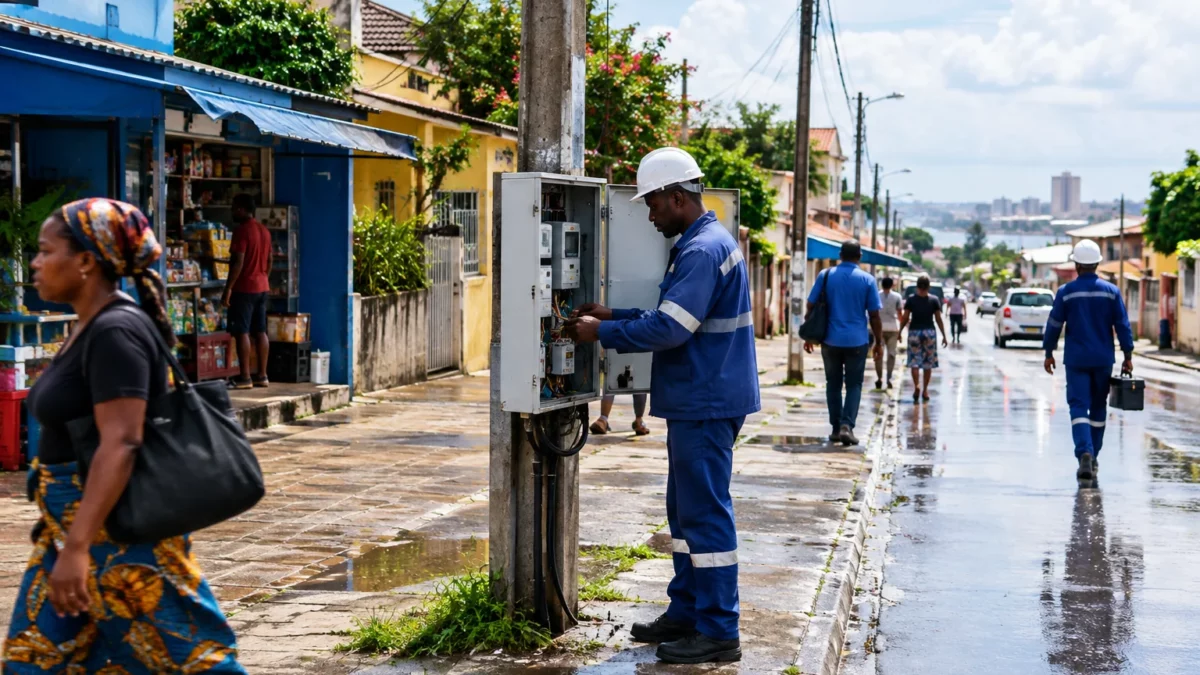
Generating electricity is not enough to guarantee access to it. In Mozambique, the challenge is now to connect power plants to homes, businesses and public services without financing new lines through public debt already deemed unsustainable.
The challenge is tangible: expanding the national grid while serving rural areas where conventional lines are not always the most suitable solution. For households, access will depend on connections and service reliability. For businesses, it is also a question of having a sufficient and predictable electricity supply.
A national goal, a regional challenge
Mozambique’s National Energy Compact, drawn up under the Mission 300 initiative, aims to achieve universal access to electricity by 2030. The access rate rose from 31% in 2018 to 60.1% in 2024, according to the national document and data cited by the African Development Bank. The target entails a further 4.9 million new connections, combining the electricity grid and off-grid solutions.
The country is a member of the Southern African Development Community (SADC), which supports cooperation and energy trade among its members. The interconnections planned by Maputo are therefore part of a broader challenge: improving electricity transmission within Mozambique while also strengthening links with neighbouring grids.
This ambition comes amid tight budgetary constraints. In its debt sustainability analysis published in January 2026, the International Monetary Fund and the World Bank classify Mozambique as being in debt distress and deem its debt trajectory unsustainable. The figure of 95% of GDP cited for 2026 is a projection, not a final outturn.
Lines to build, capital to mobilise
At a meeting on the Global Grids Accelerator held in Antalya on 12 November 2026, Mozambique’s Finance Minister, Carla Loveira, advocated mobilising sustainable finance to modernise the grids without worsening public debt. The event is listed on the official COP31 programme. The United Nations initiative aims, among other things, to improve the preparation and financing of grid projects.
The National Compact estimates that around $18.6 billion in funding is needed for the entire energy programme. It includes $4.8 billion for electricity transmission. The plan envisages public and private financing, but these figures represent needs and mobilisation targets: they do not mean the funds have already been raised.
To transmit energy, Mozambique plans to build more than 2,000 kilometres of transmission lines, as well as a 400-kilovolt backbone linking the north, centre and south. Regional interconnections are also expected to help electricity flow. But a high-voltage line alone does not guarantee a last-mile connection: local distribution and connections remain essential.
The Chimuara-Nacala project gives an indication of the scale of the work. The line is expected to link the centre and north over about 460 kilometres. Gridworks and state-owned Electricidade de Moçambique are developing the project. Prequalification of companies for the works was launched in October 2026, according to Portuguese news agency Lusa. The IFC describes a project comprising several lines and substations, developed as a private-sector-led transmission project.
The private sector can complement the state, not replace public oversight
Private investors can reduce the state’s direct financing requirements. That does not automatically make a project less costly for the public. Contract terms, the allocation of risks, any public guarantees and future tariffs will determine who pays and who benefits from the infrastructure.
The authorities’ challenge, therefore, is to attract capital without creating public commitments that are difficult to meet. Transparent tenders and predictable rules can foster competition. At the same time, decisions on routes and connections will need to take provincial needs into account, not just those of major urban centres or industrial areas.
Off-grid solutions can also speed up access in remote communities. However, these systems must remain affordable and be supported by sustainable maintenance services. The choice between the national grid, mini-grids and standalone systems will depend, among other things, on distance, population density and local uses.
A test of implementation for the region
Mozambique’s case illustrates a question that extends beyond its borders: how can the energy infrastructure needed for growth be developed while preserving fragile public finances? The country’s experience is of interest to SADC, where grid coordination can facilitate trade, but every project must also meet specific national needs.
The next step will be to turn funding announcements into contracts, construction work and actual connections. Progress towards 2030 will be measured by monitoring the Chimuara-Nacala project, publishing financing terms and tracking the pace of new connections. For Mozambicans, the decisive measure will not simply be the number of kilometres of lines built: it will be reliable, affordable access to electricity in practice.