Algeria
 Egypt
 Libya
 Morocco
 Sudan
 Tunisia
 Benin
 Burkina Faso
 Cabo Verde
 Côte d'Ivoire
 Ghana
 Guinea
 Guinea-Bissau
 Liberia
 Mali
 Mauritania
 Nigeria
 Senegal
 Sierra Leone
 The Gambia
 Togo
 Cameroon
 Central African Republic
 Chad
 DR Congo
 Equatorial Guinea
 Gabon
 Republic of the Congo
 São Tomé and Príncipe
 Burundi
 Comoros
 Djibouti
 Eritrea
 Ethiopia
 Kenya
 Madagascar
 Malawi
 Mauritius
 Mozambique
 Rwanda
 Seychelles
 Somalia
 South Sudan
 Tanzania
 Uganda
 Angola
 Botswana
 Eswatini
 Lesotho
 Namibia
 South Africa
 Zambia
 Zimbabwe
For households in Niamey and users in urban and semi-urban centres, tap water is about more than continuity of service. Its quality also depends on regular checks, a well-maintained network and management capable of funding these requirements.
A provisional report by Niger’s Court of Accounts calls these different aspects of the management of the Nigérienne des eaux into question. Its findings concern both the quality of the water distributed and the state-owned company’s financial organisation.
A state-owned company in transition
The Nigérienne des eaux was created to take over from the Société d’exploitation des eaux du Niger (SEEN). The government adopted its statutes in January 2024, before operations, production and distribution in urban and semi-urban centres were transferred from 1 January 2024. The reorganisation placed an essential service under public responsibility, after it had been entrusted to an operator under a lease-management contract. The Agence Nigérienne de Presse has traced the company’s creation.
The Court examined management in the 2023 and 2024 financial years, a period that spans this transition. According to details from the provisional report cited in several Nigerien publications, the audit records more than 150 findings. The final version is not available in the information consulted, so the conclusions should be read as those of a provisional document, rather than as a definitive ruling on any potential liability.
The issue also forms part of a broader reform agenda. In June 2026, the Council of Ministers adopted a draft new water code intended, according to the Agence Nigérienne de Presse, to update the framework for managing resources and incorporate greater accountability and sustainable management of shared waters. The ANP reported on the proposed reform.
Checks raise public health concerns
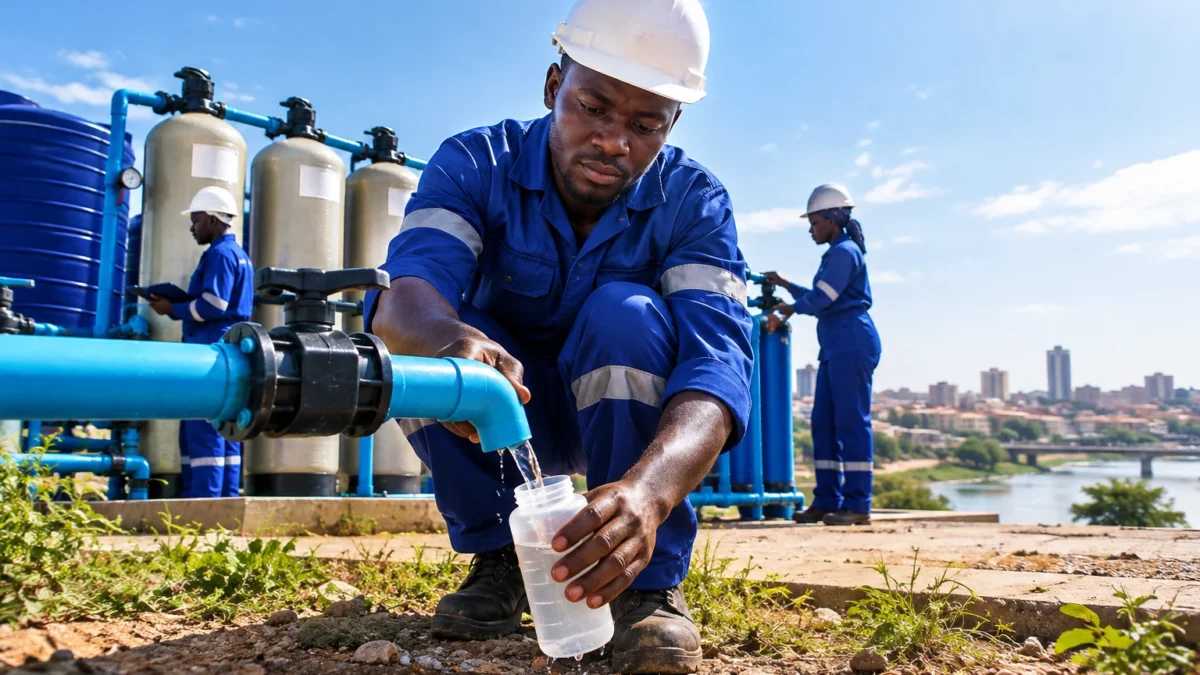
The report covers analyses of 54 physicochemical samples and 54 microbiological samples collected in six regions: Dosso, Tahoua, Maradi, Zinder, Tillabéri and Niamey. These figures have been reported by Nigerien media that consulted or relayed the provisional document. They do not, on their own, provide a comprehensive measure of water quality in every locality in the country.
According to findings attributed to the Court, the analyses point to weaknesses in ensuring the quality of distributed water. The document mentions, in particular, insufficient chlorination, disinfection failures and risks of network contamination. Local publications also refer to leaks and seepage into ageing pipes, notably in Maradi and Zinder. These details describe risks that need to be investigated and addressed; they do not support the claim that all distributed water is contaminated.
The distinction matters to users. A localised or one-off failure will not necessarily have the same consequences across every network. But when treatment, testing and maintenance do not work together, residents have fewer assurances about the water they consume. Areas served by fragile networks may be more exposed to interruptions and seepage.
Financial management at the heart of the findings
The audit also covers cash management, public procurement and human resources. Among the examples cited is the award, in early 2024, of a 30% seniority bonus to the director-general and his deputy, calculated on the basis of 27 years of service. The report also refers to bonuses without formalised objectives or an evaluation system, as well as equipment recorded among the company’s assets but not found during physical checks.
These observations do not automatically establish an offence. They do, however, raise questions about expenditure tracking and the company’s ability to link remuneration and investment to service outcomes. For a company responsible for a network requiring repairs, treatment products and laboratory testing, opaque management can undermine operational oversight as well as public trust.
According to accounts of the report, the Court is calling for immediate corrective measures. It considers that the scale and structural nature of the problems could jeopardise the company’s viability and the quality of service. What happens next will depend in particular on publication of the final report, the Nigérienne des eaux’ responses and verifiable action on the ground.
An issue that goes beyond the company’s accounts
Water provision in Niger varies sharply between regions and types of network. An African Development Bank project document reports that in 2023 the theoretical rate of access to drinking water in rural areas was 49.9%, while the urban service coverage rate stood at 97.1%. These indicators do not measure the same thing: theoretical access does not guarantee a constant supply at the tap or consistent quality. The AfDB sets out these disparities in a document on water and sanitation in Niger.
The findings on the Nigérienne des eaux concern urban and semi-urban centres; they do not therefore sum up the particular challenges facing rural areas, where access often depends on different infrastructure and services. For the authorities, the challenge is to make the public takeover measurable in its results: monitored quality, regular maintenance, traceable accounts and a swift response to problems.
At regional level, the sustainable management of shared resources also concerns countries in the Niger River basin. The new national framework cited by the ANP explicitly refers to this dimension. But the audit’s immediate significance is very practical: whether the day-to-day service will be adequately monitored and funded to provide safe water in the capital and other areas it serves.