Algeria
 Egypt
 Libya
 Morocco
 Sudan
 Tunisia
 Benin
 Burkina Faso
 Cabo Verde
 Côte d'Ivoire
 Ghana
 Guinea
 Guinea-Bissau
 Liberia
 Mali
 Mauritania
 Niger
 Nigeria
 Senegal
 Sierra Leone
 The Gambia
 Cameroon
 Central African Republic
 Chad
 DR Congo
 Equatorial Guinea
 Gabon
 Republic of the Congo
 São Tomé and Príncipe
 Burundi
 Comoros
 Djibouti
 Eritrea
 Ethiopia
 Kenya
 Madagascar
 Malawi
 Mauritius
 Mozambique
 Rwanda
 Seychelles
 Somalia
 South Sudan
 Tanzania
 Uganda
 Angola
 Botswana
 Eswatini
 Lesotho
 Namibia
 South Africa
 Zambia
 Zimbabwe
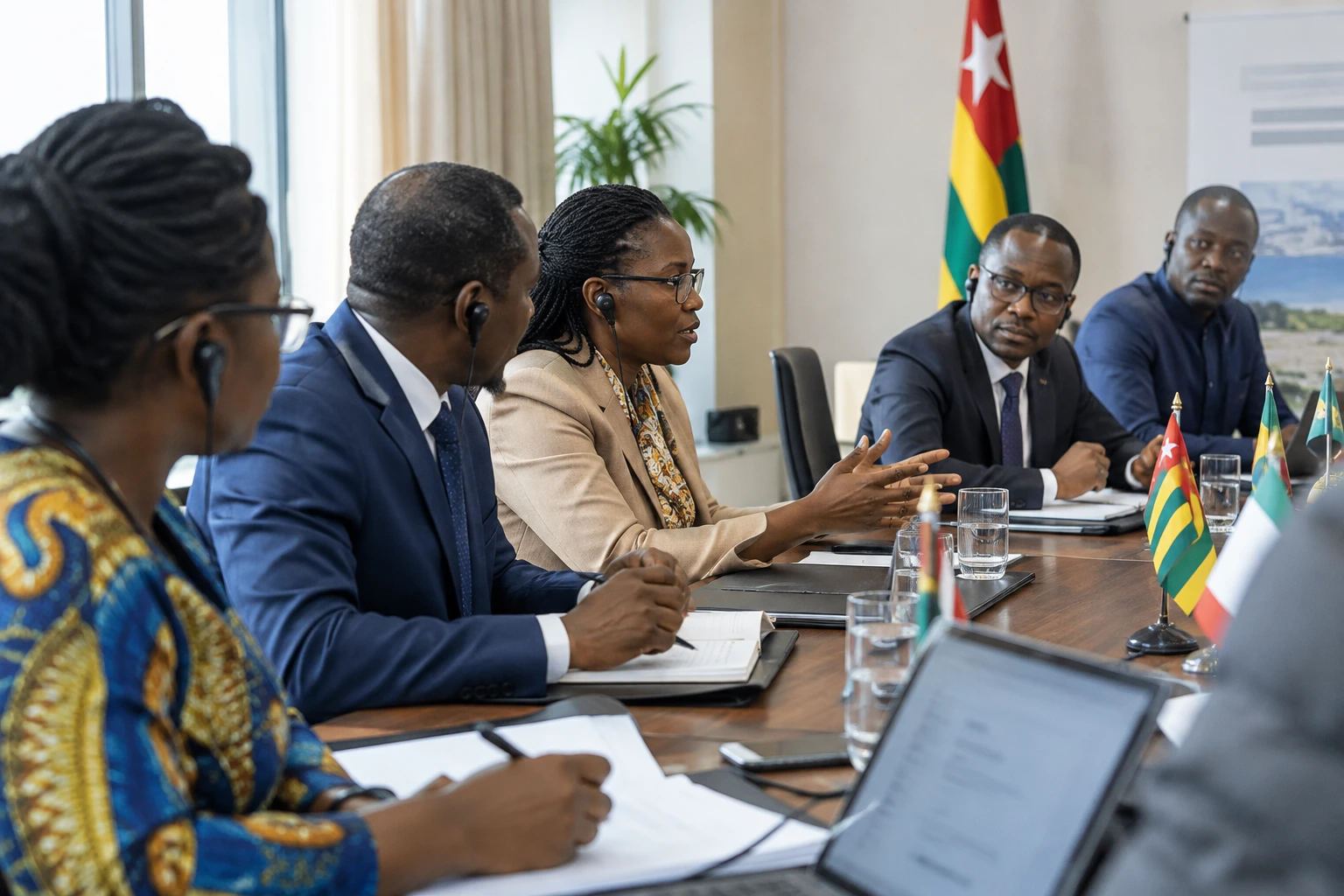
For a young business, advice is not enough if funding arrives too late or is aimed at organisations that are already established. In Lomé, entrepreneurship support organisations put this question at the heart of a broader debate: what value can they bring at a time when artificial intelligence fits in a phone?
In Lomé, a decade-old network faces a new challenge
From 5 to 7 November 2026, the Afric’innov summit brought together entrepreneurship support organisations from 18 African countries in the Togolese capital. The network, established in 2016, brings together incubators, accelerators, hubs and technology parks. It aims to strengthen their skills and their capacity to support businesses. The programme and dates are confirmed on the official Afric’innov Summit 2026 website. The event’s location in Lomé was also reported by the Togolese media outlet Infos du Continent.
Togo’s choice as host gives the meeting regional significance. The country is a member of the Economic Community of West African States (ECOWAS), which organises economic co-operation among several West African states. The region’s banking and financial network, including the ECOWAS Bank for Investment and Development, can contribute to business financing, but access to small sums remains a separate issue from financing large-scale projects. The ECOWAS presentation of EBID sets out its mandate to finance development and regional trade.
The summit also marked a decade of a sector that has become more structured since the network was established. According to information presented by Afric’innov, its members now act as interlocutors for public authorities and financial partners. But their own financial stability remains uncertain: the entrepreneurs they support cannot always afford to pay for their services.
Providing organisations with sustainable funding
In Lomé, Afric’innov president Christian Jekinnou advocated an approach based on several sources of revenue. Organisations need to develop their business models, but support for small businesses cannot rely solely on services paid for by clients that are still fragile. An incubator funded on a project-by-project basis also risks losing its teams and expertise between programmes.
Presented on 7 November, the Lomé Manifesto calls on public authorities and donors to support organisations’ long-term capacity, rather than just cohorts of entrepreneurs or one-off activities. It also proposes that sufficiently robust organisations experiment with financing tools: loans, repayable advances or revolving funds. The text sets out the network’s priorities; its recommendations do not, in themselves, constitute financial commitments already adopted by states or donors.
The distinction matters. Funding a workshop or a group of entrepreneurs makes it possible to measure immediate activity. Retaining advisers, methods and tools requires longer-term support. For entrepreneurs, the difference can mean receiving sustained support rather than assistance that ends when the project funding it runs out.
The manifesto also calls on governments to recognise qualified organisations and contract them to provide verifiable services. This approach focuses on results: the quality of advice, how well it is adapted to businesses’ circumstances and the concrete changes it enables. Afric’innov plans to follow up the text with a white paper for partners, then with pilot projects and a monitoring mechanism.
Artificial intelligence: a tool, not an automatic substitute
Artificial intelligence is changing expectations. Entrepreneurs can now turn to a digital assistant to prepare a document or get management suggestions. But access to a tool guarantees neither sound advice nor the ability to act on it. Jekinnou believes organisations must learn how to support businesses in using AI, rather than simply handing out licences.
A study published in July 2026 in the scientific journal Management Science urges caution. It followed 640 Kenyan entrepreneurs who were offered an AI assistant on WhatsApp. The researchers found no statistically significant average improvement in revenues and profits. However, the effects varied according to businesses’ initial performance: the highest-performing participants appeared to benefit more from the tool, while the lowest-performing ones could be harmed. These findings, available in the study on the uneven impact of AI on entrepreneurs in Kenya, relate to a specific context and experiment; they do not make it possible to predict mechanically what the effects will be in Togo.
This qualification reinforces the need for training. Support providers need to know how to use AI in their own work, help businesses integrate it into their activities and explain its limitations, including the quality of its responses and data protection. Without these skills, entrepreneurs who are already better equipped risk benefiting more from the technology than those most in need of support.
Redirecting finance towards small businesses
The financing problem is therefore not simply a matter of how much is available. Jekinnou says some investors favour businesses that are already fairly large and funding amounts greater than those needed by many young businesses. For small entrepreneurs, access to credit or investment can remain out of reach even when resources are available in the ecosystem.
Public authorities should therefore share some of the risk, the Afric’innov president believes. Start-up funding can fail; some entrepreneurs learn from these experiences and later relaunch their businesses. Taking this risk does not mean providing finance without oversight. Rather, it requires mechanisms suited to small amounts, transparent criteria and monitoring that distinguishes the failure of an experiment from poor management.
The issue also concerns Togolese businesses based outside the capital, informal activities and women entrepreneurs, whose needs and access to financial networks may differ from those of technology start-ups already connected to investors. The summit does not resolve these disparities. It does, however, set a practical priority: measure who actually benefits from the schemes and which businesses are left out.
For West Africa, the Lomé meeting thus opens up a task that goes beyond adopting AI. The next step will be to check whether the manifesto’s proposals lead to public contracts, multi-year funding or documented trials. The network will also need to show what difference support makes to businesses. It is against this evidence, rather than the number of participants or tools deployed, that the significance of its next ten years will be measured.