Algeria
 Egypt
 Libya
 Morocco
 Sudan
 Tunisia
 Burkina Faso
 Cabo Verde
 Côte d'Ivoire
 Ghana
 Guinea
 Guinea-Bissau
 Liberia
 Mali
 Mauritania
 Niger
 Nigeria
 Senegal
 Sierra Leone
 The Gambia
 Togo
 Cameroon
 Central African Republic
 Chad
 DR Congo
 Equatorial Guinea
 Gabon
 Republic of the Congo
 São Tomé and Príncipe
 Burundi
 Comoros
 Djibouti
 Eritrea
 Ethiopia
 Kenya
 Madagascar
 Malawi
 Mauritius
 Mozambique
 Rwanda
 Seychelles
 Somalia
 South Sudan
 Tanzania
 Uganda
 Angola
 Botswana
 Eswatini
 Lesotho
 Namibia
 South Africa
 Zambia
 Zimbabwe
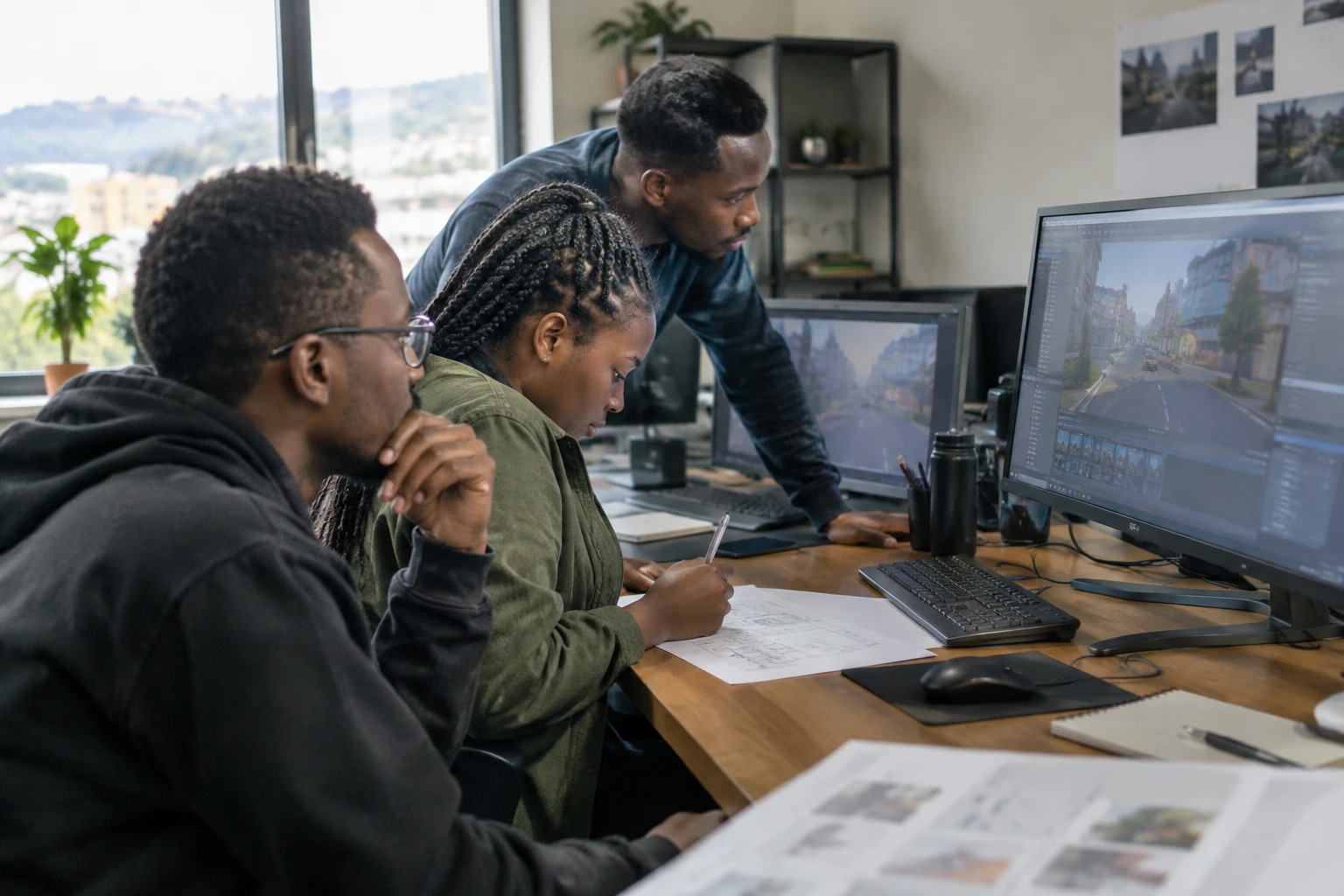
A city is more than a backdrop. In a video game, its streets, transport, sounds and customs also tell us who has the right to occupy the screen. In Casablanca, Abidjan and Cotonou, creators want to make their cities the setting for interactive stories designed on the continent.
Living cities, not interchangeable backdrops
Open-world games, popularised on a large scale by series such as Grand Theft Auto, allow players to move freely through a fictional space inspired by the real world. African studios are taking up some of these conventions — exploration, travel and missions — without simply reproducing a formula. Their aim is to put places, characters and references familiar to their audiences at the centre.
This approach is taking shape in different contexts. In Morocco, Benin and Côte d’Ivoire, the teams do not share the same industry or resources. But they are all seeking to broaden the range of worlds available, at a time when major international productions still offer few African cities as detailed gaming environments.
The movement is not new. Cameroon’s Kiro’o Games studio has already built a fantasy world with Aurion: Legacy of the Kori-Odan. These initiatives show that the continent’s creators are exploring several genres, from role-playing games to urban investigations, rather than following a single model.
Casablanca told through music
In Morocco, Cazafonia is being developed by AJB Games Studio in partnership with Dizzy Gaming, drawing on the world of rapper Dizzy Dros. The project combines open-world exploration with a story inspired by the artist’s life. Casablanca becomes a place to explore, while music created with the rapper contributes to the game’s sound identity.
The project was presented at the Morocco Gaming Expo in Rabat. The event’s organiser lists it among the creations developed by Moroccan studios, and a Moroccan business publication also reported on its presentation. These details confirm that the game has moved beyond a simple announcement, but do not establish a definitive release date.
The choice of rap as a narrative thread gives Cazafonia a distinct cultural anchor. The game is not simply about showing recognisable streets: music, popular references and the story of a Moroccan artist help build its world. This approach may resonate with local audiences while giving players elsewhere points of reference rarely found in mainstream productions.
Projects at different stages in Abidjan and Cotonou
In Côte d’Ivoire, Babi City is described as a game project set in Yopougon, a commune in the Abidjan district. Its developer, Stéphane Malick Ocho, wants to create a world with which Ivorian players can identify. Publicly available information remains limited, however, so the project should be treated as an announced initiative, without assigning it a launch date or features that have not been confirmed by several independent sources.
“Babi” is a familiar name for Abidjan. Yopougon, meanwhile, is not the whole metropolis but one of its communes, with its own neighbourhoods and dynamics. This distinction matters. Representing a city is not a matter of sticking a local label on a generic map, but of choosing which places, activities and characters make up the experience.
In Benin, GTB – Gbê Town Bénin has reached a more concrete stage. The demo released by Emar Games puts players in the role of Sènan, who returns to Cotonou after ten years away. He investigates his father’s disappearance as a cargo plane wreck is due to be dismantled. Exploration, travelling by motorcycle taxi and neighbourhood activities are woven into the story.
The demo’s page states that the story is fictional and that the locations are inspired by Cotonou. This distinction avoids confusing the plot with real events. It also shows how a city can inform a game without claiming to offer a complete documentary reproduction of it.
Making games also means building an industry
An open world takes time, a range of skills and resources: design, programming, animation, music, testing and distribution. For small teams, visibility is not enough. They also need to secure funding, access production tools, recruit or train specialists, and reach players on the platforms they actually use.
In Morocco, events and initiatives dedicated to video games are seeking to connect studios, young creators and partners. Across the continent, challenges differ from country to country: market size, access to equipment, development costs and distribution opportunities. The projects in Casablanca, Abidjan and Cotonou do not therefore represent a uniform industry, but they do bear witness to local initiatives facing obstacles that are sometimes similar.
The audience matters too. A game designed for Ivorian or Beninese players can draw on places and customs that speak directly to them. But digital distribution also offers the possibility of reaching the diaspora and players abroad. To do so, studios will need to balance local roots, technical accessibility and viable business models.
Representation is also in the details
These creations address more than the question of visibility. They shift the viewpoint: African cities are no longer seen only from the outside or used as backdrops. They become places where players investigate, move around and follow characters whose experiences are rooted in specific settings.
This ambition alone does not guarantee commercial success or perfect representation. The outcome will depend on the quality of the game, its reception by audiences and the teams’ ability to continue development. Care will also be needed to avoid reducing each city to a handful of easily recognised signs. A neighbourhood, a musical style or a mode of transport can never sum up a society.
The next step will be practical: following playable versions, confirmed launch dates and distribution choices. The GTB demo is already available, while Cazafonia was presented to the public at the Rabat event. Verifiable information about Babi City remains scarcer. It is in these advances — and in their ability to endure — that the place these worlds occupy in video games will be measured.