
 Algeria
 Libya
 Morocco
 Sudan
 Tunisia
 Benin
 Burkina Faso
 Cabo Verde
 Côte d'Ivoire
 Ghana
 Guinea
 Guinea-Bissau
 Liberia
 Mali
 Mauritania
 Niger
 Nigeria
 Senegal
 Sierra Leone
 The Gambia
 Togo
 Cameroon
 Central African Republic
 Chad
 DR Congo
 Equatorial Guinea
 Gabon
 Republic of the Congo
 São Tomé and Príncipe
 Burundi
 Comoros
 Djibouti
 Eritrea
 Ethiopia
 Kenya
 Madagascar
 Malawi
 Mauritius
 Mozambique
 Rwanda
 Seychelles
 Somalia
 South Sudan
 Tanzania
 Uganda
 Angola
 Botswana
 Eswatini
 Lesotho
 Namibia
 South Africa
 Zambia
 Zimbabwe
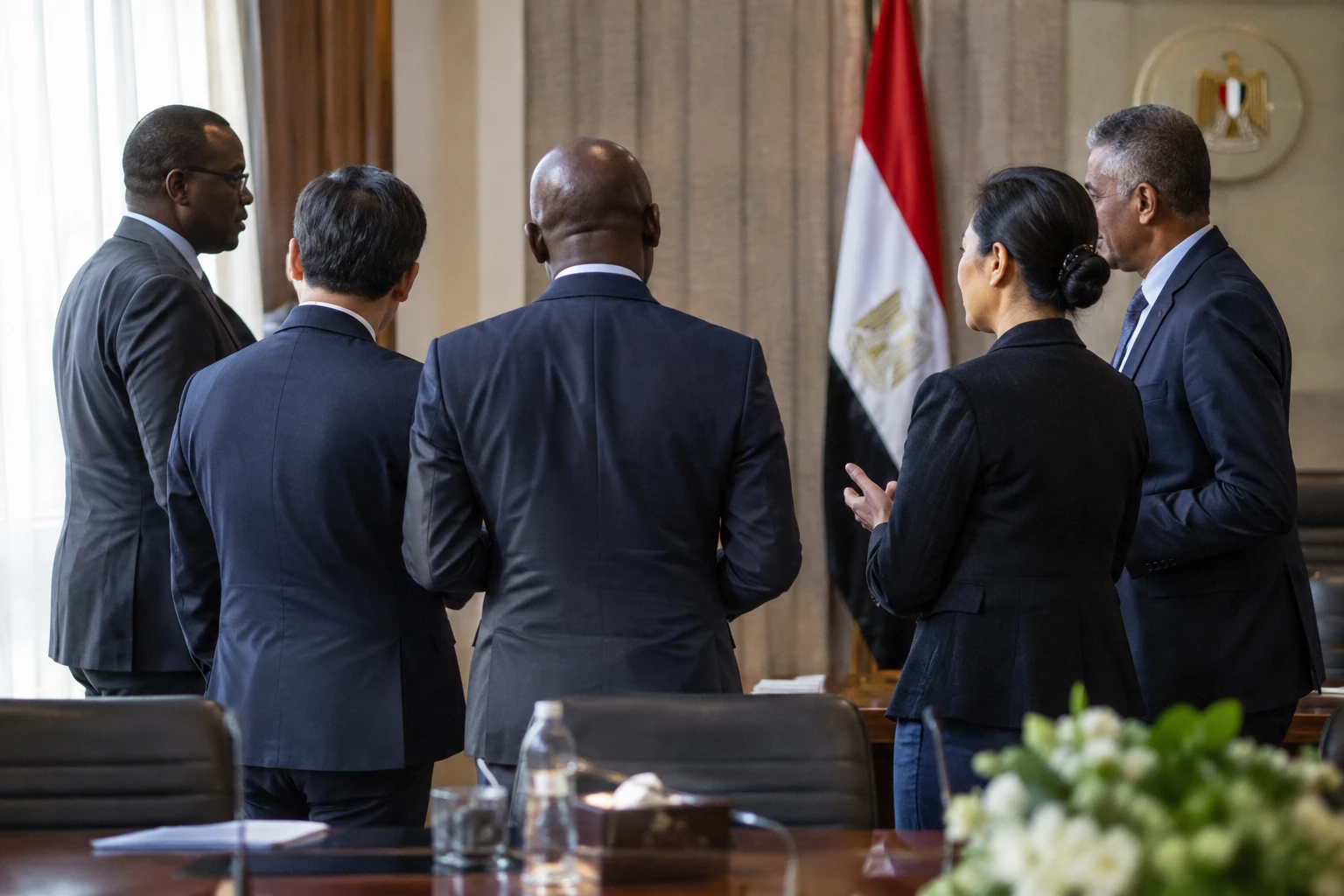
The Nile, the Red Sea and development projects link issues that are often treated separately. In Cairo, a meeting between Egypt and China brought these matters together, without announcing mediation or producing a public agreement.
Cairo, a crossroads for Nile and Red Sea issues
Egypt’s geographical position gives these discussions particular significance. The country links North Africa to the Red Sea and the Middle East. The Suez Canal, a major trade route, further heightens this strategic interest. Regional maritime tensions may therefore affect shipping and revenues from vessels passing through the canal.
To the east, relations between Egypt, Ethiopia and Sudan remain shaped by the sharing of the Nile’s waters. The Grand Ethiopian Renaissance Dam, built on the Blue Nile, entered service in 2025. Addis Ababa presents it as a project for electricity generation and development. Cairo, together with Khartoum, is calling for a negotiated framework for its filling and operation. Ethiopia defends its sovereignty over the project. Talks have not produced a comprehensive tripartite agreement.
The African Union Commission called on Egypt, Ethiopia and Eritrea to exercise restraint and maintain dialogue in October 2026. The warning comes as several tensions in the Horn of Africa intersect: access to the sea, border security, the war in Sudan and rivalries over the Nile.
Political meeting, with no formalised mediation
On Wednesday 11 November, in Cairo, Egyptian Foreign Minister Badr Abdelatty received Liu Xianfa, the Chinese government’s special representative for African affairs. It was Liu’s first visit to the Egyptian capital. Egypt’s foreign ministry said the discussions covered the Horn of Africa, the Red Sea, Sudan, Somalia and the Nile.
On water issues, Abdelatty reaffirmed the principles of water security championed by Egypt, respect for international law and its opposition to unilateral measures on the river. This wording expresses Cairo’s position. In itself, it does not constitute a compromise proposal accepted by the other riparian countries.
China had sent Liu to Ethiopia a few days earlier. On 4 November, in Addis Ababa, he met Ethiopian Foreign Minister Gedion Timothewos. Beijing said it wished to contribute to regional peace and stability, while emphasising dialogue and African participation in solutions. The sequence shows that Chinese diplomacy is consulting several capitals whose interests sometimes diverge. It does not prove that a joint mediation process is under way.
The Egyptian statement says the two sides agreed to continue their consultations in international forums. It makes no mention of a newly established negotiating mechanism or specific commitments on the dam or maritime security. Caution is therefore warranted: for now, this is a diplomatic exchange, not a settlement agreement.
China’s partnership beyond security concerns
Cairo also wants to extend Sino-Egyptian cooperation to development projects in other African countries. Badr Abdelatty raised the training of professionals and the strengthening of skills. He specifically cited the Cairo International Centre for Conflict Resolution, Peacekeeping and Peacebuilding, which organises training and supports peace initiatives.
This dimension should be followed beyond general announcements. Training projects can strengthen local skills, but their impact will depend on partner countries, funding, the sectors involved and the role given to African institutions. The statement does not yet provide a list of projects or an implementation timetable.
The sixth Aswan Forum for Sustainable Peace and Development, scheduled for 21 and 22 November 2026, will provide a further platform for discussion. Public officials, regional and international organisations, financial institutions and civil society representatives are due to take part. The forum may extend the discussions, but it does not replace negotiations between the Nile’s riparian states.
Regional significance will depend on concrete follow-up
For Egypt, the challenge is to defend its interests in water and shipping while strengthening its role as an African diplomatic hub. For Ethiopia and the other states in the Horn, the central issues remain sovereignty, security and cooperation between neighbours. The consequences for populations differ: Nile management affects, in particular, water supplies and downstream agriculture, while maritime disruptions affect trade and activities linked to ports and the Suez Canal.
Liu’s tour comes amid a region where Nile issues, the Red Sea and political stability intersect. It gives Beijing an opportunity to engage with several governments and Egypt a chance to highlight its priorities. What follows will depend less on diplomatic language than on regular exchanges, verifiable initiatives and, on the Nile, an agreement involving all three of the riparian countries concerned.
The next steps to watch are the conclusions of the Aswan Forum and the continuation of consultations between Egypt, Ethiopia and Sudan. At continental level, the African Union is still called upon to support channels for dialogue. The 11 November meeting did not resolve these disputes; it confirmed that they are now part of a shared diplomatic agenda, without guaranteeing an outcome.



