Algeria
 Egypt
 Libya
 Morocco
 Sudan
 Tunisia
 Benin
 Burkina Faso
 Cabo Verde
 Côte d'Ivoire
 Ghana
 Guinea
 Guinea-Bissau
 Liberia
 Mali
 Mauritania
 Niger
 Nigeria
 Senegal
 Sierra Leone
 The Gambia
 Togo
 Cameroon
 Central African Republic
 Chad
 DR Congo
 Equatorial Guinea
 Gabon
 Republic of the Congo
 São Tomé and Príncipe
 Burundi
 Comoros
 Djibouti
 Eritrea
 Ethiopia
 Madagascar
 Malawi
 Mauritius
 Mozambique
 Rwanda
 Seychelles
 Somalia
 South Sudan
 Tanzania
 Uganda
 Angola
 Botswana
 Eswatini
 Lesotho
 Namibia
 South Africa
 Zambia
 Zimbabwe
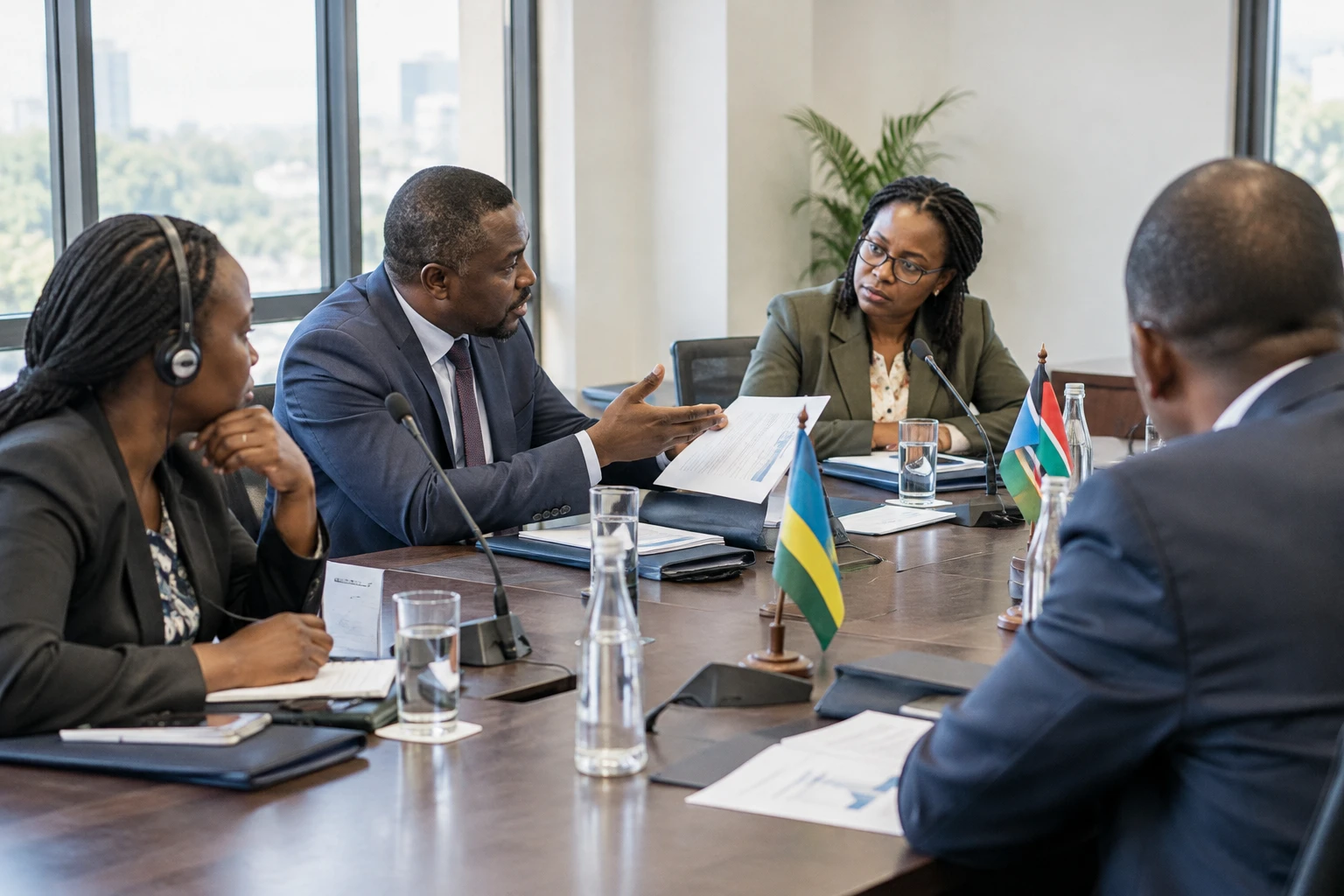
In Kenya, irrigation is no longer just about building canals. The question is also who decides on investments, how water is shared and whether small farms can access equipment and markets.
In Nairobi, the authorities are seeking to reduce the dependence of some agricultural production on rainfall, which has become less predictable. A new international funding package could support this shift. But financing discussions do not yet mean that the money has been approved or is available.
Funding still under negotiation
On 11 November 2026, Kenya’s Principal Secretary for Irrigation, Ephantus Kimotho, said the government was negotiating with the World Bank over funding presented as totalling $252 million. The amount would comprise $250 million from the International Development Association (IDA), the World Bank’s concessional lending arm, and a $2 million grant from the Global Water Security and Sanitation Partnership.
The sum would form part of the multi-year “Kenya CARES for Jobs” programme and support the Kenya Resilient Irrigation for a Sustainable Economy project, or K-RISE. The announcement concerns ongoing negotiations: in itself, it does not constitute final approval of the funding or the start of disbursements. The timetable and final terms therefore remain to be specified.
According to information provided by Kimotho, the project aims to shift irrigation policy. It would focus on farmer-led initiatives, institutional reforms, the use of private capital and data. A national irrigation information technology centre is also being considered to help plan investments, track results and manage water more effectively.
Ambitious national target, resources to manage
The project forms part of the National Irrigation Sector Investment Plan, or NISIP. Published in 2025, this framework aims to develop 1.5 million acres by 2030. Kenya’s Department of Irrigation estimates that about 21% of the country’s irrigation potential is currently being used. Its plan combines farmer-led development, improvements to public irrigation schemes, commercial irrigation, rehabilitation in arid and semi-arid areas and support for community-based schemes.
This ambition faces the challenge of heavy dependence on rainfall. In October 2026, Kimotho estimated that about 500,000 of Kenya’s 8.9 million registered farmers had access to irrigation. These figures, reported by the public Kenya News Agency, give an indication of the scale of the challenge, but do not by themselves show how many farms can afford pumps, energy, maintenance or the transport of their harvests.
Progress will also need to be assessed beyond the number of hectares equipped. Irrigation can stabilise harvests, but its effects depend on equitable access to water, reliable infrastructure and the ability to sell produce. For small farms, an expensive installation or irregular distribution can limit the benefits. Large commercial farms, meanwhile, often have more resources to invest and access markets.
Water governance at the heart of the project
The choice to prioritise farmer-led initiatives and private partnerships marks a shift away from an approach focused solely on public infrastructure. It could broaden funding sources and encourage solutions tailored to local needs. However, private-sector participation does not guarantee that services will be affordable for farms with the least capital. Pricing, maintenance and water-sharing rules will be decisive.
The proposed data centre could improve planning, provided that information is regularly updated and accessible to the relevant administrations, communities and farmers. In counties where water resources are contested or limited, decisions on abstraction must take account of domestic uses, livestock and ecosystem needs. NISIP itself links irrigation expansion to environmental sustainability.
Geography also matters. Arid and semi-arid areas need infrastructure capable of storing water and withstanding droughts. Elsewhere, the challenges may involve modernising existing networks, reducing losses or giving small-scale producers access to equipment. A national policy will therefore not have the same effects in every county.
An issue for East Africa
Kenya is a member of the East African Community (EAC), which brings several neighbouring countries together for economic and regional co-operation. Food security and resilience to climate shocks transcend borders: harvests, markets and supply chains are linked across the region. An expansion of irrigation in Kenya could contribute to a more regular agricultural supply, without resolving water-access or pricing constraints in neighbouring countries on its own.
Monitoring of K-RISE will therefore need to focus on concrete results: whether the funding is approved, the conditions attached to investments, the beneficiaries actually reached and how costs are shared between the state, investors and farmers. NISIP sets a target for 2030; the challenge will be to establish whether expanding irrigated areas also improves farm incomes and the sustainable management of water resources.
For the African Union and its members, Kenya’s experience illustrates a debate shared across the continent: how to finance agricultural infrastructure without deepening inequalities in access or placing natural resources under strain. In Kenya, the answer will depend as much on governance rules and the role given to producers as on the amount ultimately mobilised.