Algeria
 Egypt
 Libya
 Morocco
 Sudan
 Tunisia
 Benin
 Burkina Faso
 Cabo Verde
 Côte d'Ivoire
 Ghana
 Guinea
 Guinea-Bissau
 Liberia
 Mali
 Mauritania
 Niger
 Nigeria
 Senegal
 Sierra Leone
 The Gambia
 Togo
 Cameroon
 Central African Republic
 Chad
 DR Congo
 Equatorial Guinea
 Gabon
 Republic of the Congo
 São Tomé and Príncipe
 Burundi
 Comoros
 Djibouti
 Eritrea
 Ethiopia
 Kenya
 Malawi
 Mauritius
 Mozambique
 Rwanda
 Seychelles
 Somalia
 South Sudan
 Tanzania
 Uganda
 Angola
 Botswana
 Eswatini
 Lesotho
 Namibia
 South Africa
 Zambia
 Zimbabwe
In Antananarivo, military partnerships are about more than equipment. They also affect the diplomatic choices of a transitional government and the security of the sea routes bordering Madagascar. The recent US warning has brought these issues into focus, but it is also part of the contest for influence around the Indian Ocean.
A transition in search of partners
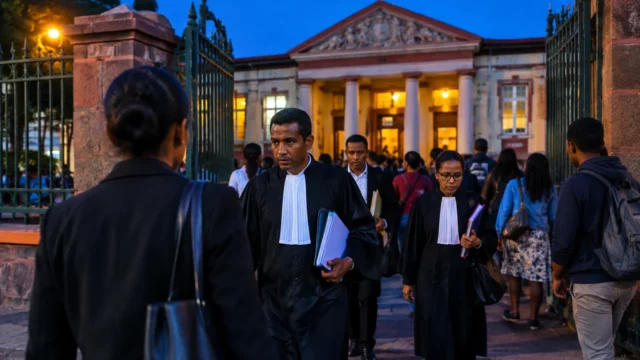
Michaël Randrianirina came to power in October 2025, after Andry Rajoelina was ousted amid protests led in particular by young Malagasy people. The African Union has called for a return to constitutional order. The Southern African Development Community (SADC), a regional organisation of which Madagascar is a member, has called for an inclusive transition and preparations for new elections. This situation gives every external partnership concluded by Antananarivo a political dimension.
Since taking power, the Malagasy authorities have strengthened their ties with Moscow. Russian equipment and instructors arrived in Madagascar in December 2025, according to several independent reports. In February 2026, Randrianirina travelled to Moscow and met Vladimir Putin. The rapprochement has therefore taken concrete form through military and diplomatic exchanges, rather than mere statements.
Washington warns, Antananarivo keeps its options open
On 11 November 2026, General John Brennan, deputy commander of the US Africa Command (AFRICOM), voiced Washington’s concerns about the expansion of Russian influence. He warned against replicating in Madagascar and Mozambique a security cooperation model similar to that seen in the Sahel. His remarks were reported by Africanews and Channel Africa.
The US comparison refers to Mali, Burkina Faso and Niger, where the authorities have curtailed military ties with Western partners and sought Russian support. Brennan believes this approach has failed to stem armed violence in the region. This is the assessment of a US official, made in a context of strategic competition; it is not, by itself, an independent evaluation of the results of the partnerships in question.
Washington’s position is all the more delicate because Antananarivo has not publicly responded to the warning. The general acknowledged that US partners could choose their alliances. For the Malagasy government, diversifying its relations may broaden access to training, equipment and diplomatic support. But military cooperation whose terms remain unclear can also raise questions about the commitments made, their cost and oversight by civilian institutions.
The Mozambique Channel, a concrete regional concern
Madagascar lies across the Mozambique Channel from Mozambique, along a maritime route in the Indian Ocean used by international trade. Washington describes protecting this route as a security concern. The United States is also concerned about the maritime capabilities of armed groups active in northern Mozambique, according to statements reported by Africanews. These concerns relate to both shores of the channel, not only to the Russian presence in Madagascar.
Maritime security also has everyday economic consequences. It affects ports, fishing, regional trade and activities linked to ocean resources. People in coastal areas and those working in fisheries do not experience these issues in the same way as military officials or shipping companies: for them, monitoring the waters must also protect livelihoods and Malagasy resources. The central question, therefore, is who sets security priorities, and who benefits from the agreements reached.
The United States is not a disinterested bystander. AFRICOM has also argued for strengthening defence cooperation and maritime surveillance with Madagascar and Mozambique. Its visit to Antananarivo and the naval base at Antsiranana focused on these issues, according to the Malagasy media outlet Midi Madagasikara. The warning against Moscow thus comes as Washington is also seeking to consolidate its own relations in the region.
Choices that reach beyond the island
This rivalry should not reduce Madagascar to a battleground for competition between powers. The country has its own interests: strengthening its armed forces, protecting its waters and negotiating partnerships without surrendering its ability to make decisions. But the political transition makes these choices particularly sensitive. SADC has called for a Malagasy-led national dialogue and a roadmap towards new elections. The African Union has also reaffirmed its commitment to a return to constitutional order.
What happens next will depend as much on the nature of military agreements as on their transparency and institutional oversight. The course of the transition, commitments made to Moscow and cooperation proposed by Washington will all need to be followed. In the Mozambique Channel, lasting security will not be measured solely by the number of pieces of equipment delivered or exercises held. It will also depend on the ability of the states bordering the channel to defend their interests and ensure their populations benefit from strategic choices.