
 Algeria
 Egypt
 Libya
 Morocco
 Sudan
 Tunisia
 Benin
 Burkina Faso
 Cabo Verde
 Côte d'Ivoire
 Ghana
 Guinea
 Guinea-Bissau
 Liberia
 Mali
 Mauritania
 Niger
 Nigeria
 Senegal
 Sierra Leone
 The Gambia
 Togo
 Cameroon
 Central African Republic
 Chad
 Equatorial Guinea
 Gabon
 Republic of the Congo
 São Tomé and Príncipe
 Burundi
 Comoros
 Djibouti
 Eritrea
 Ethiopia
 Kenya
 Madagascar
 Malawi
 Mauritius
 Mozambique
 Rwanda
 Seychelles
 Somalia
 South Sudan
 Tanzania
 Uganda
 Angola
 Botswana
 Eswatini
 Lesotho
 Namibia
 South Africa
 Zambia
 Zimbabwe
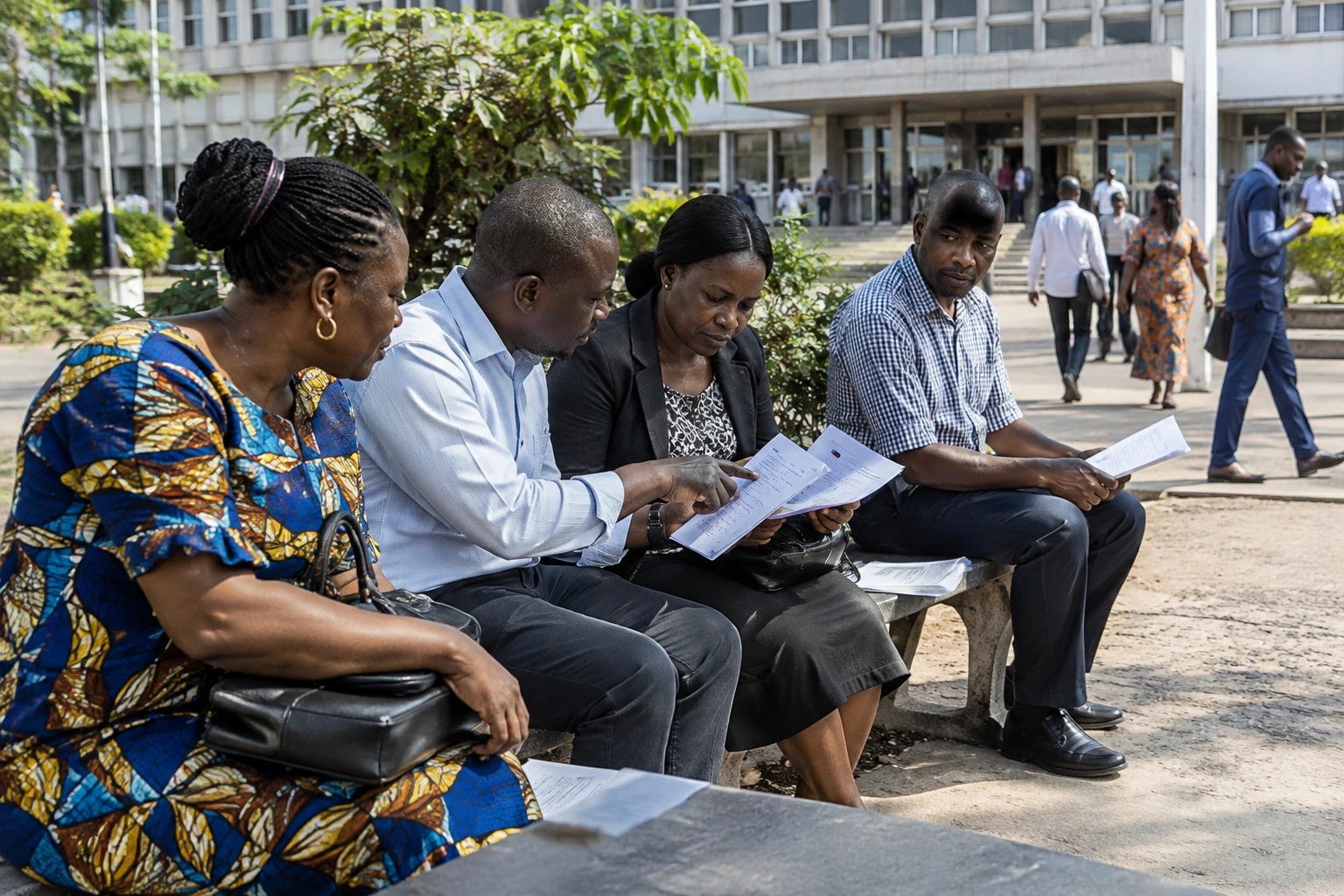
For a Congolese public-sector employee, pay equity is measured not only by the amount shown on a payslip. It also depends on allowances, the administration to which they are assigned and their place of work. In the Democratic Republic of the Congo (DRC), an agreement between the government and trade unions opens a new chapter, without yet guaranteeing the expected increase.
An agreement ahead of a government decision
In Kinshasa, the joint commission bringing together the government and trade union representatives concluded its work on 8 November 2026 with the signing of a protocol. The meeting, which opened on 6 November and was chaired by Jean-Pierre Lihau, Deputy Prime Minister in charge of the Civil Service, was to examine the principles of a common pay policy.
The text is a step in negotiations, not yet a new pay scale applied to salaries. The proposal must be submitted to the Council of Ministers. The unions also plan to explain the provisions to public-sector employees before implementation. No precise date for its entry into force has been confirmed in recent announcements.
The parties agreed on the principle of gradual progression and on pursuing the conclusions adopted during earlier talks in Sultani. Jean-Pierre Lihau described the resolutions as having been discussed and amended by both sides. He also stressed that disagreements should be settled through dialogue rather than a breakdown in relations. The Congolese account of the talks and protocol confirms the signing and the next step before the Council of Ministers.
Narrowing gaps and clarifying allowances
The reform launched in 2024 aims to harmonise pay across administrations. It also provides for clearer regulation of allowances and the cleaning up of the state payroll. The aim is to allocate the wage bill more effectively and make the rules more consistent for employees performing comparable duties.
The issue extends beyond basic pay alone. In May 2026, Jean-Pierre Lihau said that public-sector remuneration comprises base pay and various allowances, which are sometimes distributed by sector. He also referred to disparities between employees in Kinshasa and those in the provinces. The reform will therefore need to specify how roles, responsibilities and postings will be reflected in the common pay scale. Details given in May on the pay scale and regional disparities indicated that implementation was targeted for 2027, subject to government and budgetary steps.
For employees in the provinces, genuine harmonisation could narrow pay gaps with the capital. For administrations, it means clarifying job categories and the role of allowances. And for households that depend on a public-sector income, the central issue remains purchasing power: a fairer pay scale does not automatically mean an immediate increase in every salary.
A promise that must be reconciled with the budget
The cost of the reform is a major constraint. The 2026 citizen budget document puts planned spending on salaries and allowances at 12,800 billion Congolese francs, or about $4.4 billion at the exchange rate used in the document. This allocation represents 24% of general budget expenditure and is up 11.5% on 2025. The Budget Ministry’s citizen budget provides a way to verify these figures.
However, the initial figures are not the only ones available. The supplementary finance law adopted in August 2026 puts personnel expenditure at about 14,180 billion Congolese francs. This difference is a reminder that budget figures change as adjustments are approved during the financial year. To assess the room available in 2027, it will therefore be necessary to track the revised budget, revenues and appropriations actually spent, rather than relying on a single estimate.
The increase in the guaranteed interprofessional minimum wage, which rose to 21,500 Congolese francs a day in January 2026 according to the announced timetable, is fuelling expectations. But this minimum applies to workers covered by the Labour Code. It does not directly set civil servants’ pay, which falls under a separate framework. Conflating the two would amount to promising public-sector employees a pay rise that is not included in this measure.
A national issue with tangible expectations
In a country as vast as the DRC, applying a uniform pay scale will have to take account of services in the provinces as well as central administrations in Kinshasa. It will also need to be supported by a reliable payroll system: without checks on staffing levels and allowances actually paid, a common rule risks remaining theoretical or allocating resources poorly.
The challenge is also institutional. The protocol establishes common ground between the executive and the unions, but the Council of Ministers will have to turn the negotiated principles into decisions and appropriations. Employees, for their part, will judge the reform by observable results: regular payments, transparency over allowances and a reduction in unjustified gaps between services and regions.
At regional level, the issue forms part of debates in the Southern African Development Community (SADC), of which the DRC is a member, about the quality of public services and states’ ability to fund their administrations sustainably. The Congolese protocol does not set a common regional rule. Its significance lies instead in tracking its implementation: government approval, inclusion in the 2027 budget and a timetable for communicating its details. The agreement’s real scope will be tested at these stages.



