Algeria
 Egypt
 Libya
 Morocco
 Sudan
 Tunisia
 Benin
 Burkina Faso
 Cabo Verde
 Côte d'Ivoire
 Ghana
 Guinea
 Guinea-Bissau
 Liberia
 Mali
 Mauritania
 Niger
 Nigeria
 Senegal
 Sierra Leone
 The Gambia
 Togo
 Cameroon
 Central African Republic
 Chad
 Equatorial Guinea
 Gabon
 Republic of the Congo
 São Tomé and Príncipe
 Burundi
 Comoros
 Djibouti
 Eritrea
 Ethiopia
 Kenya
 Madagascar
 Malawi
 Mauritius
 Mozambique
 Rwanda
 Seychelles
 Somalia
 South Sudan
 Tanzania
 Uganda
 Angola
 Botswana
 Eswatini
 Lesotho
 Namibia
 South Africa
 Zambia
 Zimbabwe
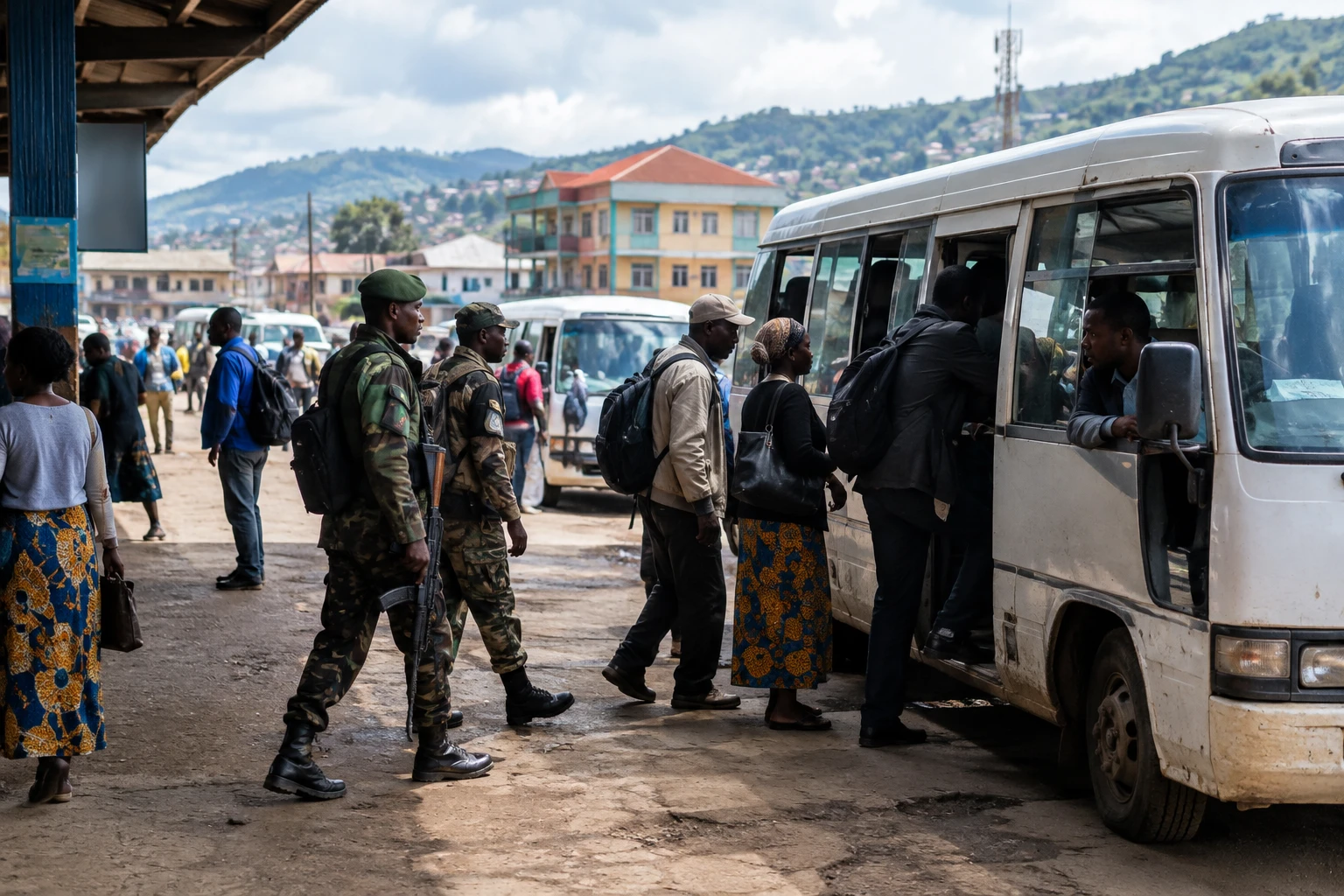
In Walikale, North Kivu, military discipline has become the subject of a trial with grave consequences. On 6 November 2026, a court sentenced 66 Congolese soldiers to death. The verdict raises a central question: how can cohesion in the armed forces be restored without weakening guarantees of justice, while fighting continues in the east of the Democratic Republic of the Congo?
A shifting front, units under pressure
Walikale is in a province where front lines and control of localities shift as offensives unfold. The Armed Forces of the DRC (FARDC) are fighting, among others, the AFC/M23, an armed coalition of which M23 is a component. Kinshasa accuses Rwanda of supporting the movement. Kigali and the group reject the accusations.
The war is part of a regional crisis. The DRC is a member of the East African Community (EAC) and the Southern African Development Community (SADC), two organisations involved in political and security efforts concerning the east of the country. But regional initiatives have not brought the fighting to an end. Rivalries between neighbouring states, the presence of numerous armed groups and weak public authority in some areas complicate any lasting response.
For residents, the stakes go beyond military positions. Fighting and shifts in control disrupt movement, access to services and economic activity. In rural areas, the security of roads and markets often depends on the local situation. In Kinshasa, the authorities must wage the war, preserve cohesion in the army and respond to concerns about the judicial treatment of soldiers.
A severe verdict, figures to clarify
The Goma garrison military court sat in Walikale. According to a statement by the 34th military region reported by the Congolese Press Agency, the soldiers sentenced belonged to the 3415th regiment. They were charged with cowardice, military revolt and refusal to obey. The court handed down the sentences on Friday 6 November, after 12 days of hearings.
The reported judicial outcome comprises 66 death sentences, a 10-year prison sentence for a sergeant and four acquittals. However, accounts differ on the exact number of defendants: the ACP reports that the 54 soldiers initially arrested were joined by 16 others, then mentions four acquittals and a sergeant sentenced to 10 years. Congolese media outlet Cable.cd, for its part, says there were 70 defendants, whereas the reported sentences and acquittals add up to 71 people. The total number of people tried therefore remains to be clarified.
The arrests date back to 20 October 2026. The soldiers were reportedly detained in Ngora, after incidents in Ntoto, in Walikale territory. Available accounts do not establish details of how events unfolded or the evidence considered against each defendant. The announced charges should therefore be distinguished from the verdict.
These sentences add to a series of military trials amid the withdrawal and redeployment of Congolese forces on several fronts. Soldiers have already been prosecuted in other cities for desertion, abandoning their posts or violating orders. A tally reported by Reporter.cd, citing figures from RFI, says at least 507 soldiers have been sentenced since the start of 2025, including 381 to death. This total should be understood as a media tally, rather than a consolidated official statistic.
The death penalty at the centre of the debate
In March 2024, the DRC announced the lifting of its moratorium on executions, citing, among other reasons, the fight against treason within the army. A moratorium suspends the application of a penalty without necessarily abolishing the law that provides for it. In January 2025, Amnesty International reported a sharp rise in death sentences handed down by military courts and noted that no executions had been recorded in the country since 2003. The information consulted does not report any executions of soldiers sentenced since the moratorium was lifted.
The authorities present prosecutions as a way to enforce the chain of command, which is essential to conducting operations. But a death sentence does not, on its own, resolve problems with equipment, pay, logistics and coordination that are regularly raised in connection with the army. Nor does it show whether proceedings established individual responsibility in each case.
The debate is therefore also about fair trials and proportionality of sentences. Amnesty International criticises the growing use of the death penalty and raises concerns about safeguards in military trials. This is the organisation’s position, while the Congolese authorities justify their policy on security grounds. In this case, the publicly available information does not detail the evidence examined or the avenues of appeal open to those sentenced.
A national question with regional repercussions
For soldiers deployed in the east, the verdict sends a severe signal about the possible consequences of abandoning a post or disobeying orders. For people living near the fighting, however, the priority remains effective and predictable protection. A more disciplined army can contribute to that security; trust also depends on its conduct towards civilians and on the justice system’s ability to establish the facts rigorously.
At the regional level, stability in North Kivu matters to neighbouring countries and the organisations in which Kinshasa participates. The next developments to watch are any appeals by those sentenced, clarification of the number of people tried and the evolution of the military situation in Walikale. How these cases are handled will show whether the state’s response is limited to punishing troops or is also accompanied by efforts to address command failures and support deployed units.
The verdict reported by the Congolese Press Agency and details from Cable.cd on the Walikale trial confirm the main sentences, while leaving a discrepancy over the total number of defendants. The broader tally of sentences is reported by Reporter.cd. The context of the death sentences is documented by Amnesty International.