
 Algeria
 Egypt
 Libya
 Sudan
 Tunisia
 Benin
 Burkina Faso
 Cabo Verde
 Côte d'Ivoire
 Ghana
 Guinea
 Guinea-Bissau
 Liberia
 Mali
 Mauritania
 Niger
 Nigeria
 Senegal
 Sierra Leone
 The Gambia
 Togo
 Cameroon
 Central African Republic
 Chad
 DR Congo
 Equatorial Guinea
 Gabon
 Republic of the Congo
 São Tomé and Príncipe
 Burundi
 Comoros
 Djibouti
 Eritrea
 Ethiopia
 Kenya
 Madagascar
 Malawi
 Mauritius
 Mozambique
 Rwanda
 Seychelles
 Somalia
 South Sudan
 Tanzania
 Uganda
 Angola
 Botswana
 Eswatini
 Lesotho
 Namibia
 South Africa
 Zambia
 Zimbabwe
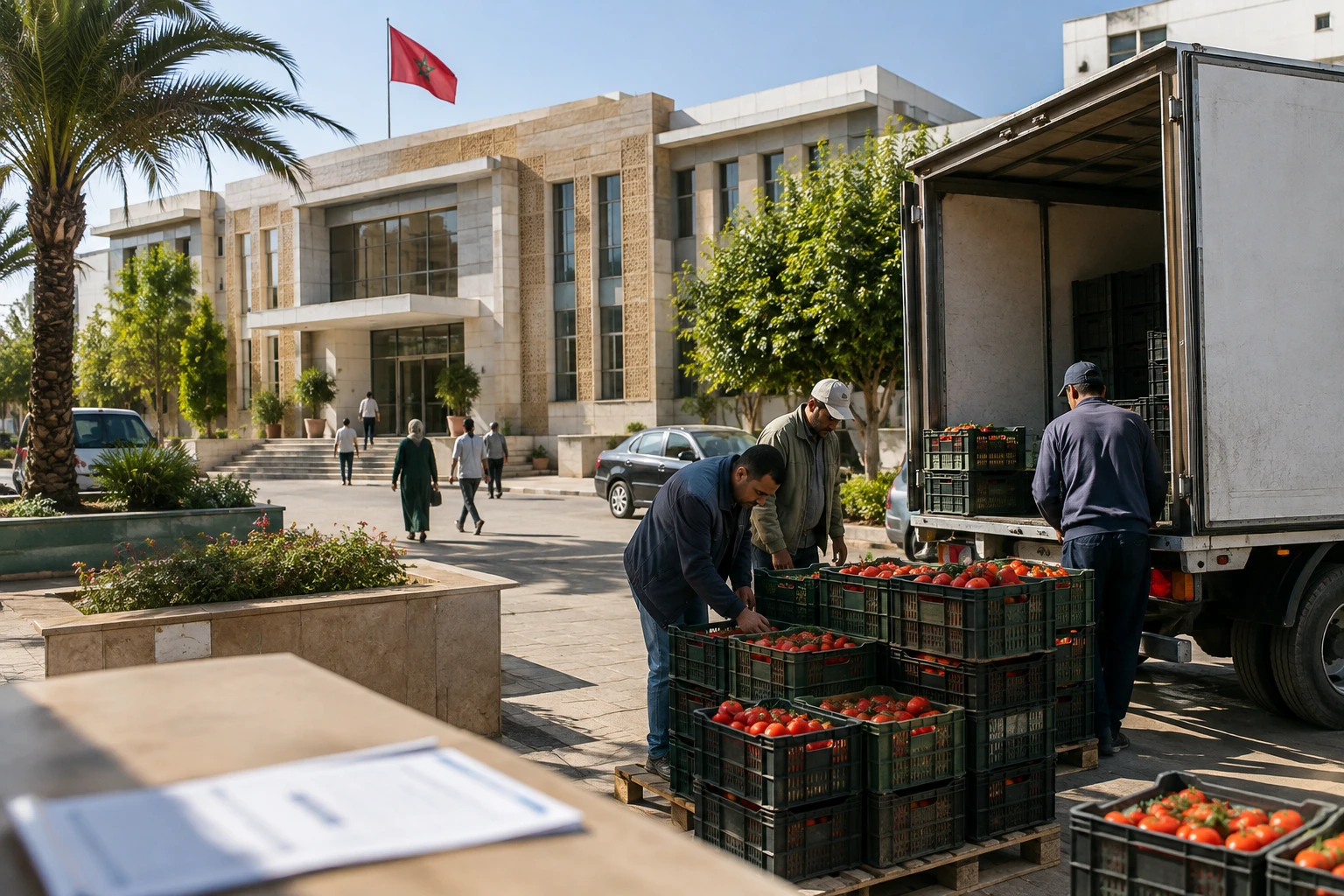
When a country protects its domestic market by curbing an agricultural export, the decision does not stop at its borders. In Morocco, the suspension of new permits for tomatoes destined for African markets puts household purchasing power, producers’ incomes and supplies to several neighbouring countries at stake.
A temporary measure in a strained market
On 5 November, the Moroccan authorities suspended the issue of new permits to export tomatoes to African markets. Lahoucine Aderdour, president of the Moroccan Interprofessional Federation for the Production and Export of Fruit and Vegetables (FIFEL), and a government source confirmed the measure. Shipments that had already been authorised could continue on their way, according to the information available.
The stated aim is to preserve domestic supply and help bring prices down. Rising fertiliser and fuel costs, production difficulties in Souss-Massa — the country’s main vegetable-growing region — and health problems affecting crops are among the factors cited as contributing to the strain. These factors have been reported by industry professionals and the media, but are not, in themselves, enough to measure the contribution of each cause to the price rise.
The situation is changing rapidly. On 8 November, Omar Hejira, the minister delegate responsible for foreign trade, spoke of a gradual resumption of permits for African markets, with volumes controlled and following a review of domestic supply. On the same day, press reports indicated that restrictions would remain in place for tomatoes, onions and potatoes. As of 9 November, the announcements therefore do not allow a conclusion that tomato exports have effectively and generally resumed.
West African markets exposed
Trade data for 2025 indicate the extent of some markets’ dependence. According to Moroccan declarations compiled by UN Comtrade and available through WITS, Mauritania received 34,154 tonnes of fresh or chilled tomatoes, with a declared value of $7.77 million. Data declared by Mauritania show a slightly different volume, 34,422 tonnes, and a value of $9.03 million. This discrepancy between exporter and importer declarations is a reminder that customs statistics do not always match.
Senegal is also among the major African customers: Moroccan data record exports of 11,540 tonnes in 2025, worth $2.92 million. The Gambia, Côte d’Ivoire, Guinea, Burkina Faso and Mali also appear in the trade flows, but at much lower volumes. These figures describe recorded trade, not necessarily final consumption or all commercial channels.
For operators, logistics are also at stake. The road corridor passing through El Guerguerat links Morocco to Mauritania and, beyond it, to West African markets. An interruption or reduction in cargoes can affect exporters, transporters and importers. The effects then spread to wholesalers and retailers, to an extent that depends on available stocks and substitution options.
A trade-off between the domestic market and foreign outlets
The decision highlights a difficult trade-off for Rabat: containing prices for Moroccan consumers without undermining agricultural sectors geared towards exports. In 2025, France imported 376,599 tonnes of tomatoes from Morocco, valued at $792.4 million, according to WITS. These figures show the importance of the French market, but do not, on their own, prove that every European shipment is more profitable than every African sale: varieties, contracts, costs and delivery periods differ.
The measure’s impact is therefore uneven. For Moroccan households, a sustained rise in prices reduces purchasing power, particularly when fresh produce accounts for a significant share of daily spending. For producers and exporters, the restriction may temporarily protect local supply, but can also complicate harvest and contract planning. In importing countries, the consequences will depend on stocks, other suppliers and how long the restrictions last.
The regional context also matters. Morocco belongs to the Arab Maghreb Union, a North African cooperation organisation whose economic integration remains limited. It joined the African Union in 2017, but is not a member of ECOWAS, the West African organisation that brings together the main markets concerned. The measure is therefore not a decision by this regional community: it nonetheless affects trade linking North Africa to West Africa, where supply security also depends on land corridors and national rules.
Duration and conditions for resumption in question
Beyond this episode, the issue is predictability. Restrictions announced without a clear timetable complicate the purchase and transport of perishable goods. The next decisions — particularly the criteria for issuing permits, the volumes concerned and the handling of cargoes already under way — will show whether the intervention remains temporary or becomes a regular regulatory tool.
For African markets, this sequence is a reminder that continental trade can depend on national decisions taken within days. For Morocco, it raises a practical question: how can prices be stabilised in the domestic market while maintaining reliable regional outlets? Announcements of a gradual resumption and reported restrictions on several vegetables leave that question open.



