Algeria
 Egypt
 Libya
 Morocco
 Tunisia
 Benin
 Burkina Faso
 Cabo Verde
 Côte d'Ivoire
 Ghana
 Guinea
 Guinea-Bissau
 Liberia
 Mali
 Mauritania
 Niger
 Nigeria
 Senegal
 Sierra Leone
 The Gambia
 Togo
 Cameroon
 Central African Republic
 Chad
 DR Congo
 Equatorial Guinea
 Gabon
 Republic of the Congo
 São Tomé and Príncipe
 Burundi
 Comoros
 Djibouti
 Eritrea
 Ethiopia
 Kenya
 Madagascar
 Malawi
 Mauritius
 Mozambique
 Rwanda
 Seychelles
 Somalia
 South Sudan
 Tanzania
 Uganda
 Angola
 Botswana
 Eswatini
 Lesotho
 Namibia
 South Africa
 Zambia
 Zimbabwe
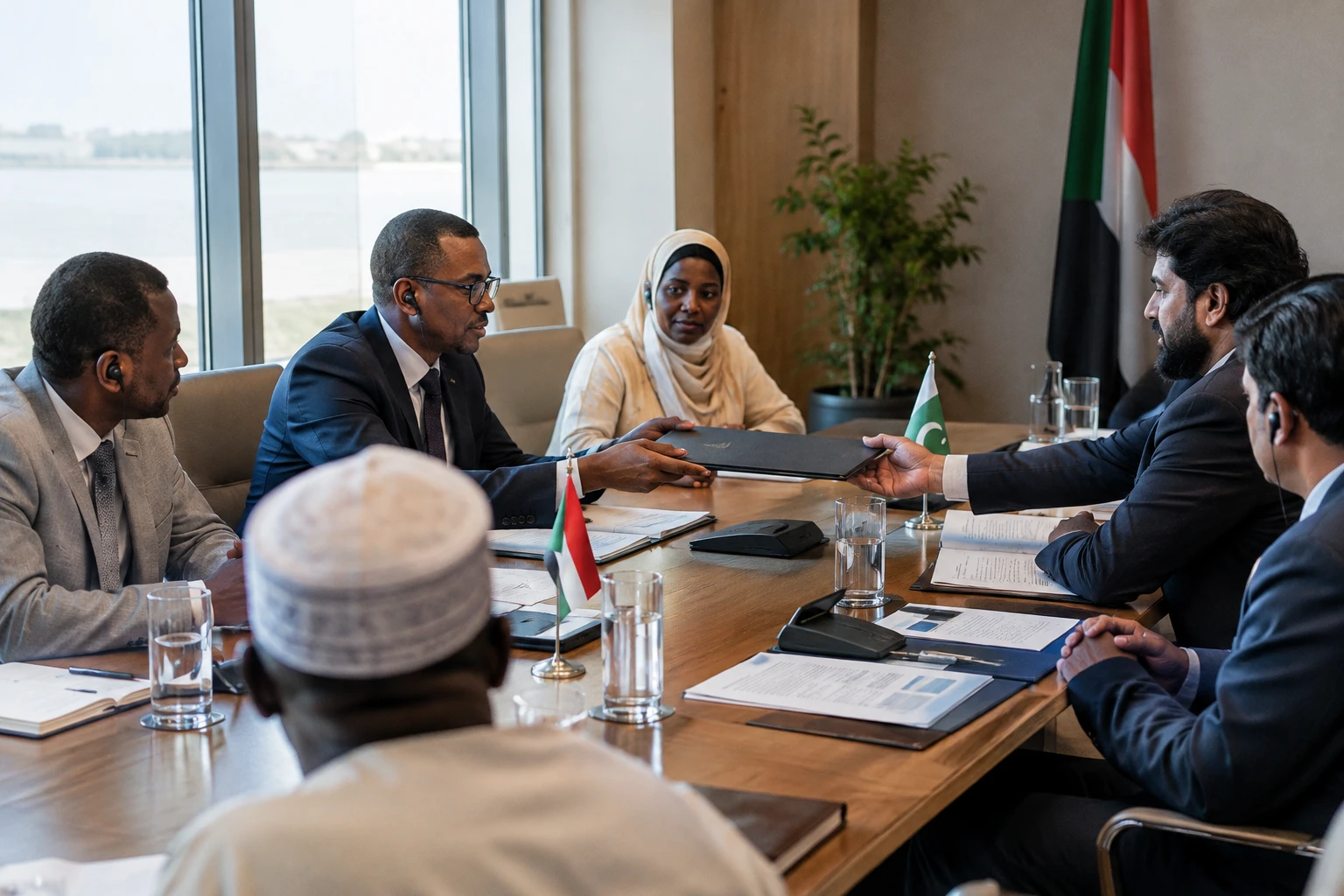
Can an agreement between business federations open up opportunities when Sudan’s trade routes, financing and economic activity remain weakened by war? The partnership with Pakistan is built on links between private-sector players. Its reach, however, will depend on their ability to turn intentions into concrete exchanges.
Business ties forged amid war
Sudan has been gripped by armed conflict since April 2023, weighing on businesses, trade and services. Khartoum, the country’s capital, has been one of the main centres of fighting. The economic fallout extends beyond the capital: it also affects producers, traders and small businesses that depend on disrupted roads and supply chains.
This context helps explain the focus on reviving the private sector. In Khartoum, Sudan’s Ministry of Finance and the United Nations Development Programme (UNDP) organised a dialogue on the issue from 21 to 23 September 2026. Sudan’s SUNA news agency reports that discussions focused on financing, trade, energy and improving the business climate. SUNA’s account of the dialogue’s conclusions confirms that the meeting took place and aimed to set economic priorities.
Regionally, Sudan is a member of the Intergovernmental Authority on Development (IGAD), which brings together countries in the Horn of Africa and East Africa. The war and logistical difficulties are complicating trade with neighbouring countries. The partnership with Pakistan offers an opening beyond the region, but does not replace the revival of domestic supply chains or nearby trade cooperation.
What the Sudan-Pakistan agreement provides
The Sudanese Businessmen and Employers Federation (SBEF) and the Federation of Pakistan Chambers of Commerce and Industry (FPCCI) signed a memorandum of understanding announced on 5 November 2026. According to a UNDP statement, the two organisations aim to facilitate trade and investment between businesses in the two countries. The UNDP statement on the memorandum says it provides, among other things, for the sharing of economic information, trade delegations, training and co-operation on the settlement of trade disputes.
The agreement takes effect upon signature and lasts for two years. According to the same statement, it will be automatically extended for a further two years unless either party gives notice of its intention to end it at least three months before it expires. The federations must also appoint liaison teams and meet regularly to monitor co-operation.
The UNDP presents the memorandum as an outcome of the September dialogue in Khartoum. Its deputy resident representative in Sudan, Surayo Buzurukova, said a “strong and well-connected” private sector is essential to the country’s recovery. The statement sets out the programme’s rationale; on its own, it does not guarantee new investment or jobs.
Opportunities, but also practical obstacles
For Sudanese businesses, being introduced to Pakistani partners could improve access to market information, buyers or suppliers. Trade missions and training could also help companies able to maintain their operations identify new opportunities. But a memorandum between federations does not mean that contracts have already been signed or capital committed.
Implementation will depend on more immediate constraints: security, access to finance, transport costs, energy availability and the functioning of infrastructure. These obstacles do not affect all players equally. Large companies can sometimes draw on networks or external resources; small businesses and informal traders generally have less room to absorb delays and additional costs. Producers far from the main trade routes may also be slower to benefit from closer international ties.
The September dialogue was intended precisely to link co-operation between businesses with the needs of the local economy. In another account, SUNA reports that its recommendations refer to access to finance, simplified procedures and support for women entrepreneurs and young people. The recommendations published by the Sudanese agency thus place external partnerships among several levers, rather than presenting them as a solution in isolation.
Results will be the real test
The memorandum’s impact will be measured by the exchanges that actually take place: participating businesses, orders, investments and training organised. It will also be important to see whether the benefits reach companies of different sizes and in different regions, rather than remaining concentrated among players already connected to international markets.
For Sudan, then, the stakes go beyond relations with Pakistan. The question is whether business networks can help restore productive activity despite the war and disruptions to trade. For IGAD and the African Union, this rapprochement is an example of South-South economic co-operation, but its regional impact will remain limited as long as trade cannot rely on more stable conditions for transport, financing and security.