Algeria
 Egypt
 Libya
 Morocco
 Sudan
 Benin
 Burkina Faso
 Cabo Verde
 Côte d'Ivoire
 Ghana
 Guinea
 Guinea-Bissau
 Liberia
 Mali
 Mauritania
 Niger
 Nigeria
 Senegal
 Sierra Leone
 The Gambia
 Togo
 Cameroon
 Central African Republic
 Chad
 DR Congo
 Equatorial Guinea
 Gabon
 Republic of the Congo
 São Tomé and Príncipe
 Burundi
 Comoros
 Djibouti
 Eritrea
 Ethiopia
 Kenya
 Madagascar
 Malawi
 Mauritius
 Mozambique
 Rwanda
 Seychelles
 Somalia
 South Sudan
 Tanzania
 Uganda
 Angola
 Botswana
 Eswatini
 Lesotho
 Namibia
 South Africa
 Zambia
 Zimbabwe
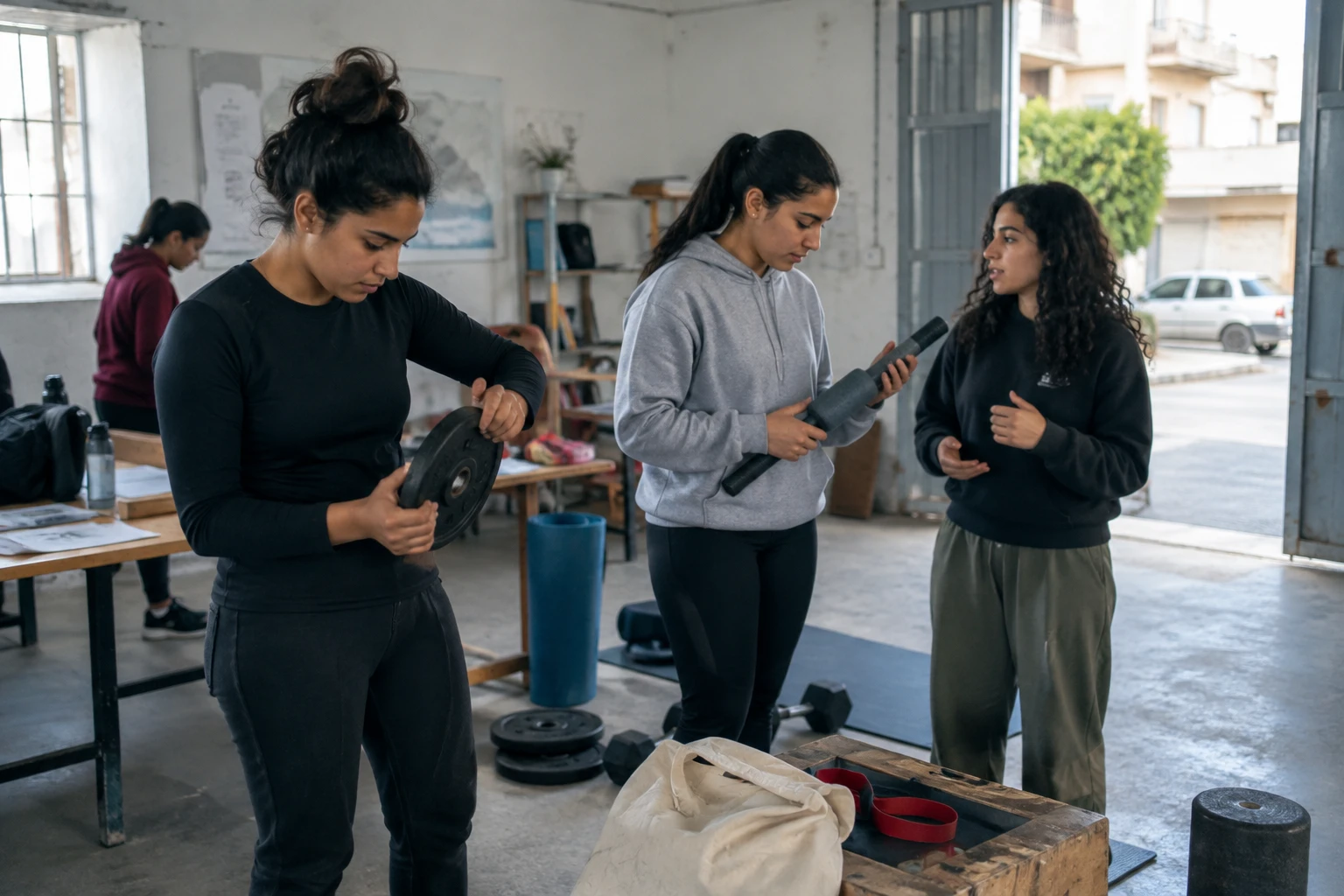
In Kram, near Tunis, a neighbourhood pitch becomes a stage where young women lift weights, play and occupy the space. The activity is sporting, but also public: it makes visible a simple question — who can do what, and where?
From vacant lot to shared space
In the neighbourhood’s everyday language, « bathaa » means an open space, used in particular by young people to meet. The « Les Faiseuses » project has set up workshops and performances there, combining sport and artistic disciplines. The idea is to shift the boundaries associated with boxing, football and weight training, often presented as men’s activities.
The Warcha collective, which launched the initiative, has worked for several years between the medina of Tunis and Kram. Its approach involves participatory workshops and cultural activities designed with residents. A local presentation of the « Ring Fel Batha » event confirms that the programme is aimed at women from Kram, La Goulette and the surrounding area, and combines physical expression with artistic creation. The presentation of the show and the Les Faiseuses project places this approach within a programme of residencies launched in November 2024.
According to the organisers, the work extended over a year and a half, through a series of themed residencies. Around 50 women, mainly from Kram, La Goulette and neighbouring districts, took part. Their backgrounds varied: some were interested in fine arts or design, while others came primarily for sport or neighbourhood life. These figures and scheduling details are attributed to the project’s organisers.
Cyrine Bouajaja, a participant who had been practising weight training for two years at the time of the testimony provided, says she wanted to develop her strength and build muscle. She also says she wants to show that women can take part in this activity. Her experience highlights a practical issue: representation matters, but so do access to facilities and equipment, and appropriate coaching.
Sport, access and social norms
The barriers are not limited to habits or people’s reactions. In working-class neighbourhoods, the available spaces, facilities, funding for activities and opening hours can also affect participation. Access to a shared pitch is not automatically equal: established patterns of use can leave little room for girls and women.
A study of sport in Tunisia, published on the website of the ministry responsible for sport, identifies differences between the disciplines chosen by women and men. It notes, in particular, that among women who exercise freely, 68% choose physical fitness and related activities, while fewer than 9% opt for team sports. These figures alone do not explain the causes of the differences, or describe the specific situation in Kram. They do, however, invite a distinction between individual preference and the practical conditions for access. The study on sports participation in Tunisia provides this national benchmark.
Here, artistic performance makes the discussion accessible without reducing it to an abstract debate. Theatre, dance and circus give participants other ways to inhabit space and present their movements. The stage also brings together residents who may not usually attend a sports club or a performance venue.
Baratou Jarri, a Warcha volunteer and neighbourhood resident, says the pitch is mainly used by young men. He describes the event as a way to remind people that women also have a place there. His remarks reflect a local perception; they are not enough to measure the scale of the issue across Kram as a whole.
A local initiative in a tense period
The project is taking place in Tunisia, where associations and cultural actors operate in a more constrained political climate than at the start of the decade. Human rights organisations have documented restrictions affecting public expression and civic action. In January 2025, for example, Human Rights Watch described a crackdown targeting critical voices and civil society organisations. This national context does not establish that Les Faiseuses itself has faced pressure. Rather, it is a reminder that local initiatives also depend on the freedom to organise and create. Human Rights Watch’s analysis of Tunisia’s civic space documents these concerns.
At the regional level, Tunisia is a member of the Arab Maghreb Union (AMU), which brings together five North African countries. The organisation is not a direct funding or co-ordination framework for the project. Its regional relevance lies instead in a shared question: how can cities give young women real access to facilities, cultural venues and sporting activities? The answers vary between countries and municipalities; there is no single model for the Maghreb as a whole.
Comparable cultural initiatives are also mentioned in Raoued, while the Twiza festival contributes to local life. Their existence does not replace permanent facilities or public policies. But they can create opportunities to participate, make women visible and open a practical negotiation over how a shared place is used.
What happens after the performance
The project’s measure of success is therefore not just whether the show succeeds. It will also depend on whether the workshops continue, whether participants can pursue their activities and how their presence in the neighbourhood is received. The available information does not establish these points, and they should not be taken for granted.
For local women, the immediate issue is access to regular activities and spaces where they feel they belong. For associations, it is about keeping projects going despite material constraints and a tense civic environment. For public officials, the question concerns local facilities and how they are shared, beyond one-off events.
In Kram, « Les Faiseuses » thus turns a sporting activity into a collective experience. The performance alone cannot resolve inequalities in access. It does, however, make a possible change visible: a familiar pitch can welcome different bodies, different uses and different ambitions.