Algeria
 Egypt
 Libya
 Morocco
 Sudan
 Tunisia
 Benin
 Burkina Faso
 Cabo Verde
 Côte d'Ivoire
 Ghana
 Guinea
 Guinea-Bissau
 Liberia
 Mali
 Mauritania
 Niger
 Nigeria
 Sierra Leone
 The Gambia
 Togo
 Cameroon
 Central African Republic
 Chad
 DR Congo
 Equatorial Guinea
 Gabon
 Republic of the Congo
 São Tomé and Príncipe
 Burundi
 Comoros
 Djibouti
 Eritrea
 Ethiopia
 Kenya
 Madagascar
 Malawi
 Mauritius
 Mozambique
 Rwanda
 Seychelles
 Somalia
 South Sudan
 Tanzania
 Uganda
 Angola
 Botswana
 Eswatini
 Lesotho
 Namibia
 South Africa
 Zambia
 Zimbabwe
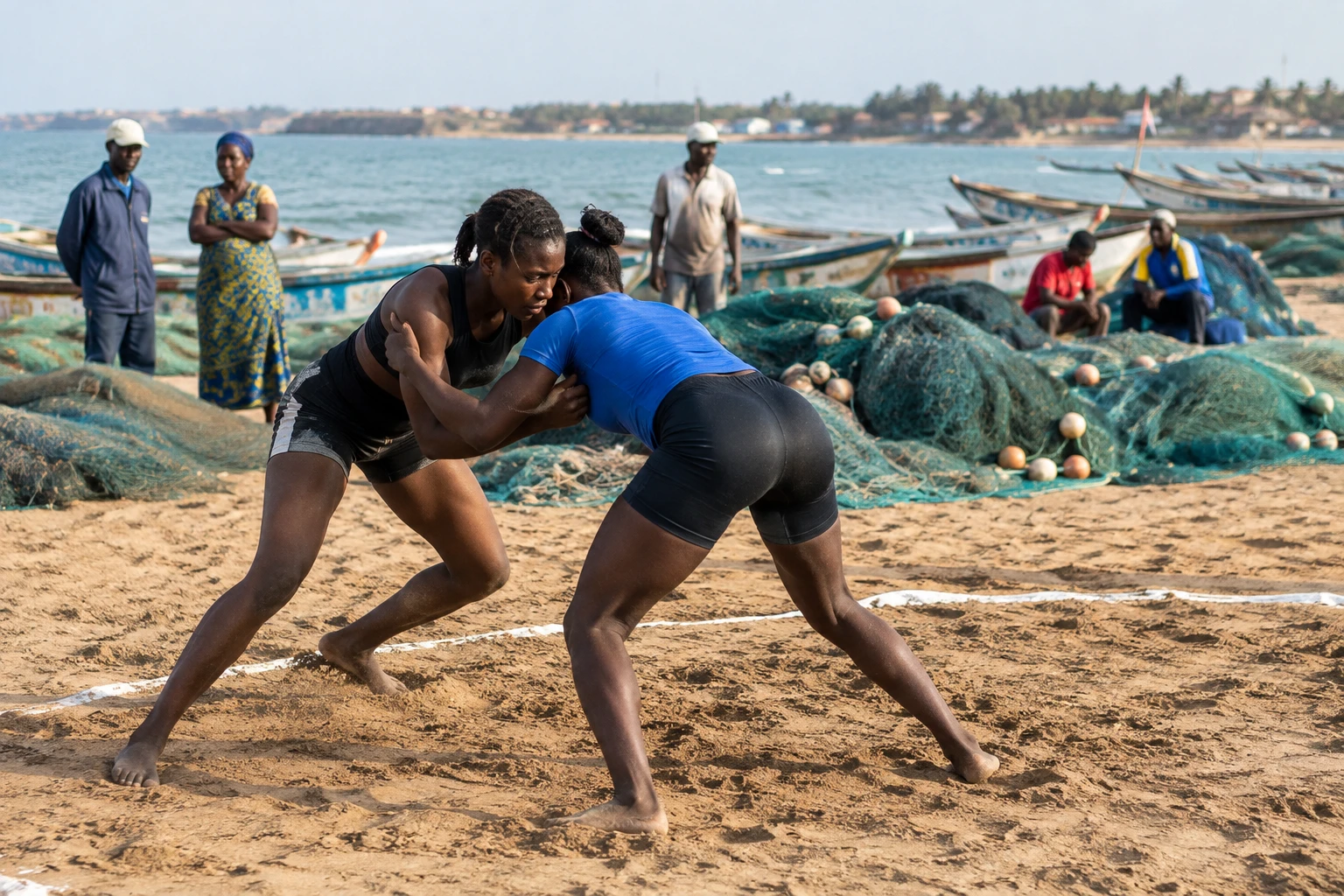
At Saly, the sand gave Senegal its first Olympic title. On 7 November 2026, Élisabeth Diatta won gold in beach wrestling at the Youth Olympic Games (YOG). Her success has a dual significance: it places a young athlete in the country’s sporting history and puts a discipline familiar to Senegalese people in the international spotlight.
A hard-fought final at Saly, in front of a Senegalese crowd
At 16, Élisabeth Diatta won the under-55kg category. In the final, she beat Japan’s Reisa Kojima. The event was held in Saly, one of the three host cities for the YOG, alongside Dakar and Diamniadio. The competition brings together athletes aged 14 to 17 from 31 October to 13 November 2026.
The medal is Senegal’s first gold at an Olympic competition. It is also one of two Senegalese gold medals won in beach wrestling that same day: Maguette Diop won the under-80kg category. Senegal’s APS news agency had announced both finals before the events. The results were subsequently reported by the Associated Press and Senegalese media outlets RTS and Le Soleil.
“I am so happy to have made history for Senegal,” Diatta said after her victory, according to the Associated Press. Her coach, Isabelle Sambou, a former Olympian and African wrestling champion, stressed the result’s collective significance: in her view, the team is paving the way for other Senegalese disciplines still competing.
Wrestling, a local tradition on the Olympic stage
In Senegal, wrestling is not confined to professional arenas. Laamb, the Wolof name for Senegalese wrestling, brings together sporting practices, local traditions and a large following. Beach wrestling, meanwhile, adapts the contest to the sand and the rules of its discipline. At the Dakar YOG, it is making its debut on the Olympic programme.
This meeting between a practice rooted in the country and an international competition gives the event particular significance. In Saly, spectators accompanied the bouts to the sound of sabar drums. Senegalese athletes also celebrated their victories by dancing, the Associated Press reports. These gestures reflect a cultural presence that does not fade as the sport reaches a wider stage.
Diatta is from Casamance, in southern Senegal. In this region, women traditionally wrestle alongside men. Her journey is a reminder that access to sport is not the same everywhere in the country. Local practices can nurture a career, but visibility and training resources remain practical challenges for young athletes.
An individual victory, with benefits still to be built
For Senegalese people, a medal won at home makes the YOG tangible. It gives a face to a competition taking place across several venues, not just in the capital. For young girls, Diatta’s success offers a visible example in a discipline often associated with men. The wrestler has also encouraged Senegalese girls to believe in themselves and pursue the sport.
But a title alone does not guarantee lasting facilities, regular coaching or sporting opportunities. The benefits may be unevenly distributed between Dakar, Diamniadio, Saly and the regions from which the athletes come. Clubs, coaches and families will play an essential role in turning the Games’ attention into concrete opportunities, particularly after the competition ends.
Isabelle Sambou’s journey also gives this victory a generational dimension. A former Olympian, she now guides a new generation. The passing on of an athlete’s experience through coaching young people shows how major competitions can strengthen local expertise, provided these gains are sustained by national sporting structures.
An African event beyond the medals
Dakar 2026 is the first Olympic sporting event to be held on African soil. For Senegal, the stakes therefore go beyond the medal table: the country is hosting events in Dakar, Diamniadio and Saly, while the continent is taking on a new place in the Olympic calendar. Diatta’s victory links this international significance to a discipline whose traditions are familiar to local audiences.
This recognition does not represent the whole of Africa: sporting realities and priorities vary from country to country. Nevertheless, it raises a question for organisers and African federations alike: how can a major event be turned into lasting support for athletes, clubs and local competitions? In Senegal, what follows the YOG and the legacy of the venues will be more reliable indicators than the emotion of a single day.
In Saly, Diatta’s title has already provided an immediate answer: Senegalese talent can succeed on the Olympic stage without abandoning its roots. The question remains whether the resources devoted to youth sport will match this visibility, in the capital and the regions alike.