Algeria
 Egypt
 Libya
 Morocco
 Sudan
 Tunisia
 Benin
 Burkina Faso
 Cabo Verde
 Ghana
 Guinea
 Guinea-Bissau
 Liberia
 Mali
 Mauritania
 Niger
 Nigeria
 Senegal
 Sierra Leone
 The Gambia
 Togo
 Cameroon
 Central African Republic
 Chad
 DR Congo
 Equatorial Guinea
 Gabon
 Republic of the Congo
 São Tomé and Príncipe
 Burundi
 Comoros
 Djibouti
 Eritrea
 Ethiopia
 Kenya
 Madagascar
 Malawi
 Mauritius
 Mozambique
 Rwanda
 Seychelles
 Somalia
 South Sudan
 Tanzania
 Uganda
 Angola
 Botswana
 Eswatini
 Lesotho
 Namibia
 South Africa
 Zambia
 Zimbabwe
Producing more does not guarantee selling more. That is the gap facing SUCRIVOIRE in Côte d’Ivoire: its 2025-2026 campaign delivered more sugar, but sales rose only slightly and stocks tied up a significant share of its cash.
The group has therefore chosen to postpone its agricultural and industrial expansion project by one campaign. The issue goes beyond its accounts: sugar is among the sectors the Ivorian state wants to strengthen in order to better meet domestic consumption and develop local processing.
A strategic sector, with local production and sales under pressure
The Ivorian sugar market is based mainly on two producers, SUCRIVOIRE and SUCAF, each of which operates two agro-industrial sugar complexes. Imports are regulated: their entry is prohibited, except where the state grants an exemption for sugar intended for certain industrial activities. This protection is intended in particular to support domestic production.
The sector has grown in recent years, without reaching self-sufficiency. According to the Ivorian economic portal, local production stood at 212 034 tonnes in 2024, against estimated national demand of 240 000 tonnes. Coverage then reached 88 %. The state has set sugar producers targets to increase production.
SUCRIVOIRE, a subsidiary of the SIFCA group and a company listed on the Regional Securities Exchange (BRVM), operates facilities in Zuénoula and Borotou-Koro, among other locations. The BRVM is the common stock exchange of the West African Economic and Monetary Union (UEMOA), which brings together eight countries in the region.
Production volumes outpacing market outlets
In its half-year report published on 2 November 2026, the company said its stocks stood at CFAF 49.27 billion on 30 June, compared with CFAF 31.58 billion a year earlier. This 56 % increase represents an additional CFAF 17.69 billion tied up. The report does not detail the composition of the stocks or the share already ready for sale.
The 2025-2026 sugar campaign, which ended in June, produced 91 626 tonnes, 16 % more than the previous campaign. Yet half-year sales rose by just 0.9 %, to 73 252 tonnes. They also include imported sugar resold by the company, so they do not correspond solely to volumes from its own factories.
Revenue in the first half fell by 1.4 %, to about CFAF 42.3 billion. SUCRIVOIRE attributes some of its difficulties to a slowdown in orders and competitors’ promotions. Management also reports the presence of sugar sold outside official channels. This explanation comes from the company and is not, by itself, an independent measure of the scale of such sales.
Between January and April, sales are reported to have fallen by 18 % year on year, according to data reported by the company. Discounts introduced from May then helped revive them, but the average price fell by 1.2 %. The company thus faces a familiar but costly trade-off: clearing its production more quickly may require it to cut prices.
Maintaining facilities before increasing capacity
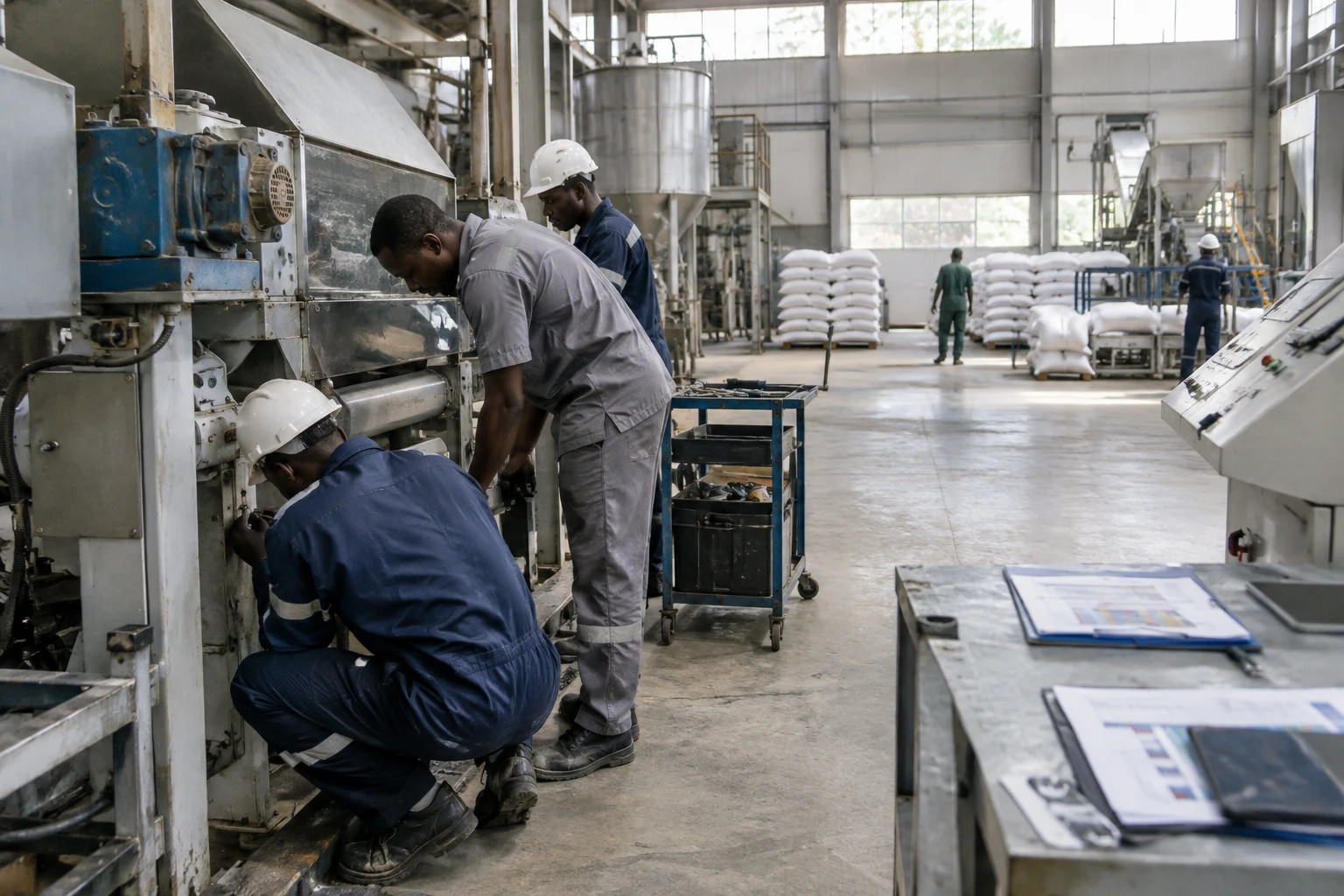
Postponing the expansion programme is intended to allow priority to be given to improving the reliability of existing facilities. Management has not announced a firm new timetable for the project. It had already made substantial equipment investments: purchases of fixed assets reached CFAF 25.16 billion in 2025, compared with CFAF 18.57 billion in 2024.
Self-financing capacity also remains under pressure. Cash flows from operating activities fell from CFAF 18.30 billion in 2024 to CFAF 10.38 billion in 2025, according to figures provided in the filing. In April 2025, SUCRIVOIRE also issued a CFAF 36 billion convertible bond to finance its investments. A convertible bond can be converted into shares under the terms set out at issuance.
The half-year net result remains negative, at CFAF 4.79 billion, but the loss is smaller than the CFAF 6.71 billion recorded a year earlier. This improvement is not enough to ease the strain on liquidity: a company can reduce its losses while running short of available cash when its production remains in stock.
On the ground, the harvest schedule also depends on the availability of cutting labour. SUCRIVOIRE said that a shortage of workers had lengthened the campaign. The issue therefore links the group’s financial choices to the practical organisation of production in its agricultural areas, although the published figures do not make it possible to measure the effects on local employment.
A test for the ambition of national coverage
The postponement raises a question of pace: how can production be increased without adding further to stocks when official outlets are not keeping pace? For SUCRIVOIRE, the immediate response is to secure its existing facilities and improve sales. For consumers, the availability and price of sugar will also depend on the balance between local supply, authorised imports and distribution practices.
The company’s trajectory is part of a broader Ivorian ambition: to develop agro-food industries and reduce dependence on imports. At regional level, the BRVM also gives investors in the UEMOA visibility into the results of an Ivorian company. But the expansion project’s timetable, the evolution of stocks and the growth in sales will be key to assessing whether higher production can translate sustainably into investment and local supply.
In the long term, SUCRIVOIRE retains the objective of raising its local production to 140 000 tonnes a year. However, no new timetable has been announced following the postponement. The next step will therefore depend less on the theoretical capacity of its factories than on the company’s ability to sell its output, fund maintenance of its facilities and generate the resources needed for expansion.
The half-year data and investment decision are presented by the company in its publications on the official SUCRIVOIRE reports page on the BRVM. The national context for the sector is documented by the Côte d’Ivoire economic portal.