Algeria
 Egypt
 Libya
 Morocco
 Sudan
 Tunisia
 Burkina Faso
 Cabo Verde
 Côte d'Ivoire
 Ghana
 Guinea
 Guinea-Bissau
 Liberia
 Mali
 Mauritania
 Niger
 Nigeria
 Senegal
 Sierra Leone
 The Gambia
 Togo
 Cameroon
 Central African Republic
 Chad
 DR Congo
 Equatorial Guinea
 Gabon
 Republic of the Congo
 São Tomé and Príncipe
 Burundi
 Comoros
 Djibouti
 Eritrea
 Ethiopia
 Kenya
 Madagascar
 Malawi
 Mauritius
 Mozambique
 Rwanda
 Seychelles
 Somalia
 South Sudan
 Tanzania
 Uganda
 Angola
 Botswana
 Eswatini
 Lesotho
 Namibia
 South Africa
 Zambia
 Zimbabwe
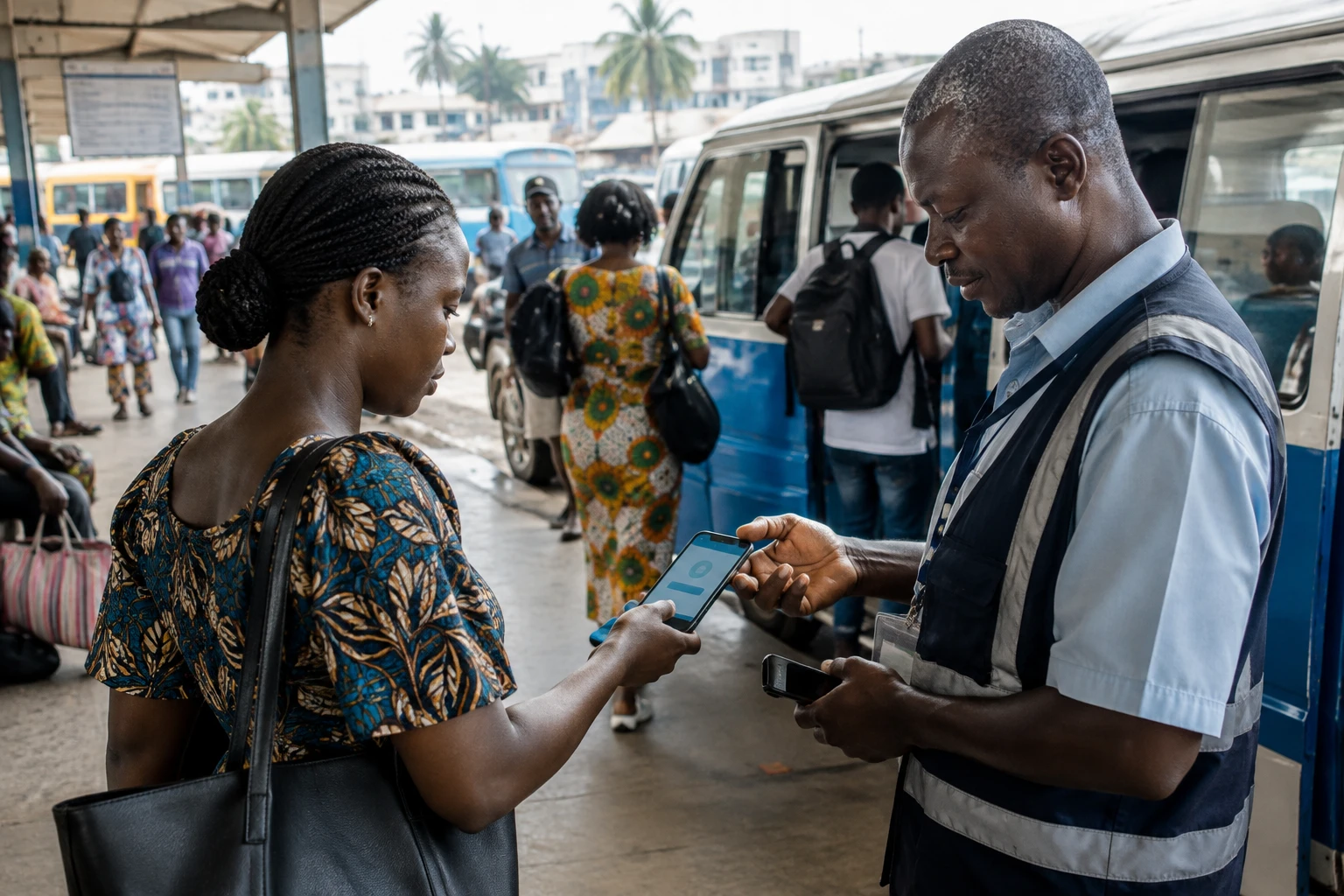
A mobile payment network can almost double in size without daily use keeping pace. In the West African Economic and Monetary Union (WAEMU), the gap between registered merchant points and those that are actually active now raises a practical question: how can equipment be turned into regular payments at merchants?
A common market, usage still to consolidate
The WAEMU brings together eight West African countries: Benin, Burkina Faso, Côte d’Ivoire, Guinea-Bissau, Mali, Niger, Senegal and Togo. The Central Bank of West African States (BCEAO) oversees their common monetary framework and tracks the development of digital financial services in the Union.
Mobile payments rely on provider networks that are not limited to banks. They allow users to send money, withdraw cash and pay for purchases from an electronic wallet. To pay directly at a shop, however, a point of sale must accept the payment and the system must actually be used.
This distinction lies at the heart of the 2025 data published by the BCEAO in its report on financial inclusion in the WAEMU. The central bank also notes the launch of the interoperable instant payment platform, designed to facilitate exchanges between banks, microfinance institutions and electronic money issuers.
Registrations grow faster than activity
In 2025, the number of merchant points registered to accept electronic money reached 6.99 million, up from 3.71 million in 2024. This 88% increase extends the rapid expansion of the previous year, which the BCEAO linked in particular to the roll-out of QR code payments. These solutions can make it easier to accept digital payments without costly equipment.
But a registered point is not necessarily a distinct business, or an active one. The same establishment may be listed with several providers. And, according to figures reported from BCEAO data, 2.97 million points were active in 2025, compared with 1.70 million a year earlier, an increase of 74.4%.
The share of active points among those registered therefore fell, from 45.95% to 42.52%. In other words, just over four in 10 points were considered active. The gap alone does not make it possible to conclude that the businesses concerned have ceased all activity: it indicates that their presence in the registers exceeds their use as measured by the indicator.
The rise in registrations and in active points is corroborated by several West African media reports drawing on the BCEAO dashboard, including L’Observateur and Afrimag. The figures describe the regional picture; they do not show how activity is distributed across countries or between city centres, small towns and rural areas.
Transactions rise, but uses vary
Financial transactions carried out by phone reached CFAF 219,151bn in 2025, compared with CFAF 156,889bn in 2024. The cumulative value thus rose by 39.7%. The number of transactions increased by 37.3%, to 16.37bn.
These totals cover several uses: person-to-person transfers, deposits, withdrawals and payments. They therefore do not measure only purchases paid for at a merchant. Nor do they correspond to operators’ revenue: the same amount may pass through several transactions. The increase points to greater activity via mobile services, but does not make it possible to isolate the precise share accounted for by proximity payments.
This distinction matters for small businesses. Taking mobile payments can reduce the need to keep cash on site or simplify some sales. However, aggregate data provide no information on fees, network reliability, ease of refunds in the event of an error, or the constraints merchants face in keeping their point active.
Interoperability, the next regional test
The BCEAO’s instant payment platform aims to connect providers that have until now operated on different networks. Interoperability means that these systems can communicate with one another. If it makes payments from one wallet to another easier, it could widen the choices available to customers and merchants. Its launch is not enough, however, to guarantee regular adoption: costs, network coverage and ease of use will also matter.
The issue concerns all eight countries in the Union, but results may vary according to commercial density, infrastructure and local practices. A regional average masks these differences. For the authorities, operators and merchants’ organisations, tracking points that are actually active is therefore just as important as monitoring registrations or cumulative amounts.
The next stage will be measured less by the number of businesses added to networks than by the frequency of payments accepted in everyday life. The BCEAO’s next reports will show whether the increase in equipment translates into more regular use, and whether the interconnection of services reduces barriers between providers. Only then can digital expansion take on a more tangible role in everyday exchanges, beyond regional totals alone.