Algeria
 Libya
 Morocco
 Sudan
 Tunisia
 Benin
 Burkina Faso
 Cabo Verde
 Côte d'Ivoire
 Ghana
 Guinea
 Guinea-Bissau
 Liberia
 Mali
 Mauritania
 Niger
 Nigeria
 Senegal
 Sierra Leone
 The Gambia
 Togo
 Cameroon
 Central African Republic
 Chad
 DR Congo
 Equatorial Guinea
 Gabon
 Republic of the Congo
 São Tomé and Príncipe
 Burundi
 Comoros
 Djibouti
 Eritrea
 Ethiopia
 Kenya
 Madagascar
 Malawi
 Mauritius
 Mozambique
 Rwanda
 Seychelles
 Somalia
 South Sudan
 Tanzania
 Uganda
 Angola
 Botswana
 Eswatini
 Lesotho
 Namibia
 South Africa
 Zambia
 Zimbabwe
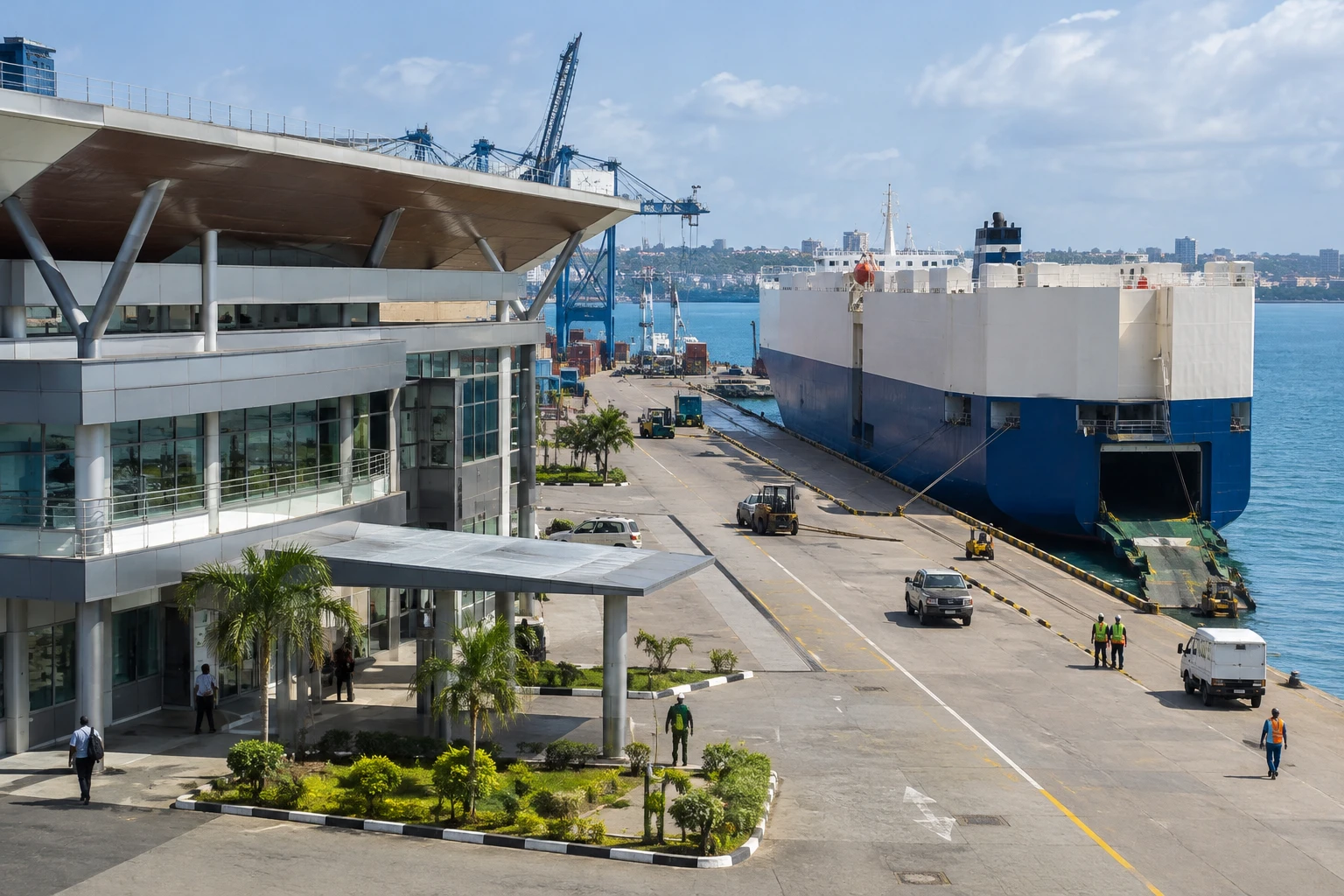
A ship can link Asian supply chains to consumers in several East African countries. But the arrival of a large car carrier in Mombasa is also a reminder that regional trade depends as much on inland roads, customs and ports as on ship capacity.
Mombasa, a gateway beyond Kenya
For Uganda, Rwanda, Burundi and eastern Democratic Republic of the Congo, access to imported goods often comes through neighbouring ports. Mombasa, on Kenya’s coast, is one such entry point. The port serves a vast hinterland through road and rail networks, while Dar es Salaam, in Tanzania, also plays a major role in regional trade.
The two ports are served by distinct but complementary inland corridors. The Northern Corridor links Mombasa to several inland markets, including Uganda and Rwanda. The Central Corridor starts in Dar es Salaam and serves Tanzania, Burundi, Rwanda and eastern DRC, among others. Goods must then cross borders and sometimes travel long distances before reaching businesses or buyers.
This geography gives port logistics regional economic weight. According to Kenya Ports Authority statistics for 2024, Uganda was the main destination for transit freight through Mombasa, ahead of South Sudan and the DRC. The volumes passing through the port are therefore not solely for Kenyan importers.
A new vessel on the Asia–East Africa route
On 29 October 2026, the Grande Egitto made its first call at Mombasa during its maiden voyage. The Kenya Ports Authority said the ship had unloaded 1,297 vehicles there for the Kenyan and regional markets. Maritime reports published after the call also cited this figure.
The vessel, delivered to Italian group Grimaldi on 21 September, is 220 metres long and has 15 decks. Its stated capacity is 9,800 CEU, a unit expressing capacity in car-equivalent units. It can carry electric, combustion-engine and compressed natural gas vehicles, as well as other rolling cargo.
For the maiden voyage, Grimaldi had announced that 4,150 cars and 6,200 linear metres of rolling freight would be loaded in Asia. This category includes excavators, buses and trucks, among other cargo. Loading was scheduled in Taicang, China, followed by Yokohama and Nagoya, Japan, before calls at Dar es Salaam and Mombasa.
The carrier operates a dedicated commercial service between Asia and East Africa. The shipowner says the route runs every 15 days and includes Mombasa and Dar es Salaam, among other ports. The rotation therefore links Asian port hubs with two major gateways to the region.
The challenge also lies on land
An additional port call or a higher-capacity vessel does not, by itself, guarantee fast delivery. Freight must be unloaded, cleared through customs and then transported to its destination. Transport costs and journey times also depend on the smooth running of port operations, the condition of road and rail links, and coordination between border authorities.
The effects vary among stakeholders. Importers and manufacturers may benefit from a regular service and increased capacity. Transport companies, customs clearance agents and port workers, meanwhile, depend on the volume of activity and the practical organisation of the logistics chain. For buyers, any potential gains do not automatically translate into lower prices: handling and inland transport costs, taxes and margins also play a part.
The KPA highlights Mombasa’s ability to accommodate modern vessels. This claim comes amid competition between East African coast ports, with Mombasa and Dar es Salaam seeking to attract regional cargo flows. Shipping operators’ choices matter, but performance also depends on inland services that move goods away from the quays.
An efficiency claim to scrutinise
Grimaldi says the Grande Egitto consumes 50% less fuel than car carriers of the previous generation. The company attributes this performance to the vessel’s equipment and design choices. This is a comparison provided by the shipowner, not an independent measurement of emissions across the entire logistics chain.
The vessel is also described as “Ammonia Ready”: its design would allow a future conversion to ammonia, subject to the necessary modifications and the availability of suitable fuel and infrastructure. This possibility does not mean the vessel currently runs on ammonia. In port, batteries and shore-side electricity connections can reduce local emissions when the necessary facilities are available.
The name Grande Egitto refers to Egypt, but the reported port call was in Kenya, and the route described links Asia to East Africa. The vessel was not announced as serving an Egyptian port on this rotation. For Egypt, a North African country whose capital is Cairo, the regional stakes lie instead in the role of its ports and the Suez Canal in maritime routes linking Asia, Africa and Europe.
Regional connectivity and what to watch next
The deployment of the Grande Egitto extends Grimaldi’s presence on this route, already served by the Grande Shanghai in 2025. It reflects shipping companies’ aim to offer substantial capacity on intercontinental routes. For landlocked countries, however, access to global trade will continue to depend on continuity between ship, port and inland transport.
At African Union level, improving these connections aligns with the trade integration goal of the African Continental Free Trade Area, which aims to facilitate exchanges between the continent’s economies. The immediate challenge is more practical: whether ports and corridors can handle the cargo, reduce delays and spread the benefits beyond shipping operators and major cities.
The next things to watch are the actual regularity of port calls, the volumes carried to inland markets and transit times after unloading. This is where the regional value of increased maritime capacity will be measured.