Algeria
 Egypt
 Libya
 Morocco
 Sudan
 Tunisia
 Benin
 Burkina Faso
 Cabo Verde
 Côte d'Ivoire
 Ghana
 Guinea
 Guinea-Bissau
 Liberia
 Mali
 Mauritania
 Niger
 Nigeria
 Senegal
 Sierra Leone
 The Gambia
 Togo
 Cameroon
 Central African Republic
 Chad
 DR Congo
 Equatorial Guinea
 Gabon
 Republic of the Congo
 São Tomé and Príncipe
 Burundi
 Comoros
 Djibouti
 Eritrea
 Ethiopia
 Kenya
 Madagascar
 Malawi
 Mauritius
 Mozambique
 Rwanda
 Seychelles
 Somalia
 South Sudan
 Tanzania
 Uganda
 Angola
 Botswana
 Eswatini
 Lesotho
 Namibia
 South Africa
 Zimbabwe

For a landlocked economy, getting copper, crops and everyday goods to markets depends as much on railways as on roads. In Zambia, the challenge is now to move several rail projects from political timetables to construction sites, without disrupting links that are already operating.
Appointment linked to a logistics challenge
President Hakainde Hichilema has appointed Charles Lubasi Milupi as Minister of Transport and Logistics. He was sworn in at State House in Lusaka on 29 October 2026. The presidency asked him to accelerate rail projects and economic corridors, according to its official statement. The appointment is also recorded by Zambia’s National Assembly.
Milupi already knows the workings of government: he headed the Ministry of Infrastructure, Housing and Urban Development. A graduate engineer of University College Cardiff, he has also served on the board of Copperbelt Energy Corporation. Elected MP for Luena in 2006 and re-elected in 2010, he returned to parliament as a nominated MP in 2021.
The announced roadmap covers three routes: the Lobito Corridor railway link, the upgrading of TAZARA — the railway connecting Tanzania and Zambia — and the rehabilitation of Zambia Railways, the national network. The stated aim is to increase freight by rail and ease pressure on roads.
Export network heavily reliant on roads
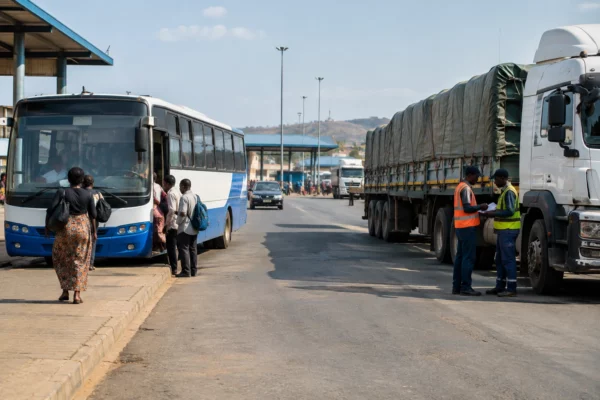
Available data confirm the imbalance, with a caveat about the period covered. For January-July 2026, the Zambia Statistics Agency says road transport carried 79.7% of export volumes, compared with 0.3% by rail. These figures cover the first seven months, not January-August as stated in the initial summary.
This concentration leaves trade flows vulnerable to the costs and constraints of road transport. A reliable railway network could provide additional capacity for mines and agricultural producers. But the impact on prices, employment or regional incomes will depend on tariffs, train frequency and whether production areas are effectively served. The appointment alone does not resolve these issues.
Lobito and TAZARA: two openings, two timelines
The Zambia-Angola rail link project entered a new phase on 27 October. The Africa Finance Corporation, the project developer, selected preferred consortia to build the Zambian and Angolan sections of the new line, which will be about 830 kilometres long. Contract negotiations are due to begin in November 2026 and could last eight to 12 weeks. The selection therefore does not mean construction has started: agreements remain to be concluded.
The line is intended to connect Zambia’s Copperbelt to the Benguela network and Angola’s Atlantic port of Lobito. It could provide an additional route for minerals, agricultural products and regional trade. Its reach will also depend on connecting infrastructure, border procedures and the ability to expand local processing, rather than merely facilitating the export of raw materials.
TAZARA serves a different purpose: restoring an existing link to Dar es Salaam on the Indian Ocean. The Tanzanian and Zambian governments have launched a modernisation concession, while the railway authority plans an operational transition period. Its 2026-27 budget provides for $20.45 million in government subsidies. This figure highlights the cost of maintaining services during rehabilitation. Medium-term freight forecasts remain targets, not achieved results.
Regional coordination will be decisive
These projects form part of the strategy of SADC, the Southern African Development Community, which is seeking to improve links between its trade corridors. In January 2026, Zambia signed agreements at the SADC secretariat concerning the North-South Corridor and the Beira Corridor. The latter can complement connections to Lobito and provide outlets on both the Atlantic and Indian Ocean coasts.
For mining companies, reliable links can make it easier to transport large volumes. For farmers and smaller operators, the benefits will depend on access to terminals, handling costs and services beyond the main routes. Lusaka and the Copperbelt are therefore not the only areas concerned: rural areas will need connections and suitable services to benefit from the network.
Milupi’s mandate will be judged by delivery: finalising contracts for the Lobito Corridor, coordinating work on TAZARA and Zambia Railways, and publishing measurable milestones. For Zambia and its SADC partners, the test will be to turn these corridors into networks that serve regional trade and the domestic economy, while maintaining services during construction.