Algeria
 Egypt
 Libya
 Morocco
 Sudan
 Tunisia
 Benin
 Burkina Faso
 Cabo Verde
 Ghana
 Guinea
 Guinea-Bissau
 Liberia
 Mali
 Mauritania
 Niger
 Nigeria
 Senegal
 Sierra Leone
 The Gambia
 Togo
 Cameroon
 Central African Republic
 Chad
 DR Congo
 Equatorial Guinea
 Gabon
 Republic of the Congo
 São Tomé and Príncipe
 Burundi
 Comoros
 Djibouti
 Eritrea
 Ethiopia
 Kenya
 Madagascar
 Malawi
 Mauritius
 Mozambique
 Rwanda
 Seychelles
 Somalia
 South Sudan
 Tanzania
 Uganda
 Angola
 Botswana
 Eswatini
 Lesotho
 Namibia
 South Africa
 Zambia
 Zimbabwe
A farm machine cannot transform a value chain on its own. It must also be suited to the plots, accessible to producers and supported by seeds, maintenance and market access. This is the scale at which the interest shown by Chinese group Sinomach Hainan in rice and maize in Côte d’Ivoire will be measured.
A need for productivity that goes beyond buying tractors
For Ivorian farms, mechanisation can reduce some arduous tasks and speed up work during periods when the agricultural calendar leaves little room for manoeuvre. But its effects depend on access to equipment: an expensive tractor that is difficult to repair or poorly suited to small plots may remain beyond the reach of many producers.
The diagnosis in the National Development Plan (PND) 2026-2030 puts the level of equipment at about 4.3 tractors per 1,000 hectares of cultivable land. It also notes average yields of 2.5 tonnes per hectare for rice and 2 tonnes for maize, well below the higher potential of intensive systems. These indicators shed light on needs, without by themselves summing up the diversity of the country’s farms. The agricultural diagnosis in Côte d’Ivoire’s PND links productivity gaps to several constraints, including access to inputs and limited irrigation.
The national programme also aims to strengthen local processing and food security. For rice, the challenge is therefore not limited to producing more: storage, milling and processing need to improve, while producers must be linked to markets. The food pact presented to the African Development Bank had already highlighted mechanisation across the rice value chain, seeds and hydro-agricultural infrastructure.
An investment intention, not yet a firm project
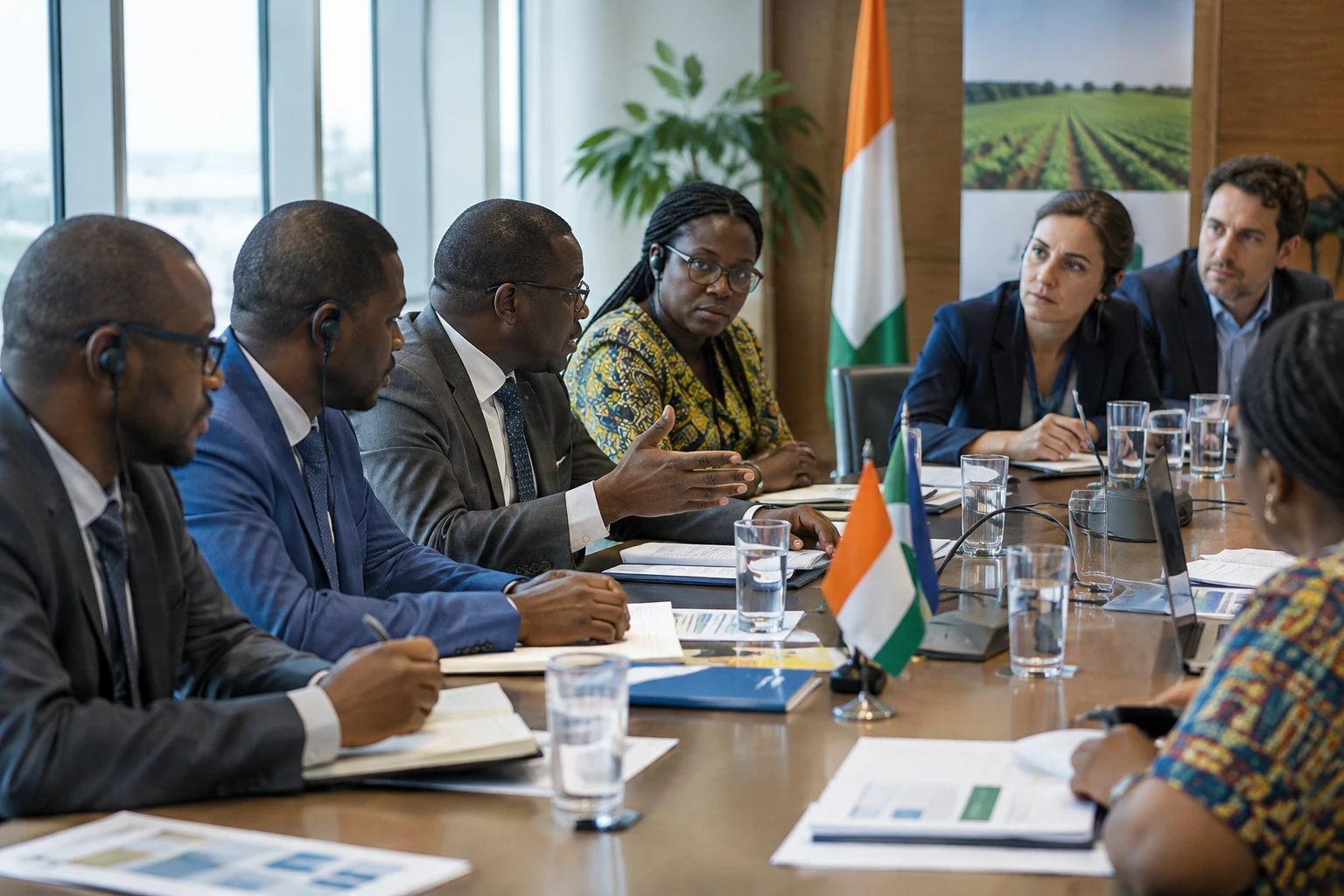
Côte d’Ivoire’s agriculture ministry reports that Bruno Nabagné Koné received a Sinomach Hainan delegation in Abidjan on 27 October 2026. According to the official account published the following day, the group is considering investment in seed production, agricultural mechanisation and rice processing, in the rice and maize sectors. Côte d’Ivoire’s agriculture ministry sets out the purpose of the meeting.
At this stage, no sum, implementation timetable or list of equipment has been made public. The ministry describes an intention to establish operations: this is not yet an announcement of a finalised investment. The next concrete steps — studies, agreements, financing, sites and local partners — will clarify the project’s scope.
This distinction matters to producers and the authorities alike. Machinery can be offered in several ways: through sales, rentals, mechanised farming services or shared-service arrangements. These models have different costs and effects on small farms. The reported meeting does not yet indicate which Sinomach Hainan would favour.
African precedents offer reference points, not guarantees
Sinomach Hainan has already promoted its equipment on the continent. In April 2025, the company and YTO, another Sinomach group company, delivered a Dongfanghong tractor to the China-Zambia Friendship Farm. The Chinese company said it wanted to monitor the machine’s performance in order to adapt it better to local needs. This experience is a precedent, but it does not prove that the same model would be chosen in Côte d’Ivoire. Sinomach described the delivery in Zambia.
In Madagascar, a memorandum announced in February 2025 covered agricultural projects including pilot parks, a processing plant and technician training, according to a Malagasy media outlet. Here too, the signing of a cooperation framework is not enough to establish that all the proposed projects were carried out. These experiences illustrate Sinomach’s interest in several African markets, but their results must be assessed country by country. The Malagasy press reported on the memorandum.
Success will depend on services and processing
The availability of spare parts, the training of operators and mechanics, and the cost of repairs will matter as much as the initial price of the equipment. In remote rural areas, access to a workshop or rental service can determine whether a machine is genuinely usable. Cooperatives and agricultural service providers could act as intermediaries if they are involved in the project’s structure.
Benefits will also depend on how value is distributed. Imported equipment can increase production capacity, but local rice processing, technical training and local employment will determine a more lasting share of the benefits. As for seeds, their availability must be accompanied by a choice of varieties suited to conditions in the different growing areas.
Côte d’Ivoire places these priorities in a regional framework: it belongs to ECOWAS, the Economic Community of West African States, which brings together markets and sub-regional cooperation policies. Local maintenance, distribution and processing capacity could therefore matter beyond the national market, although the current announcement does not yet establish an export project.
The government is also pursuing national initiatives. In June 2026, it announced an allocation of tractors and equipment for rice producers, deployed notably in Boundiali, Daloa and Yamoussoukro. This action shows that mechanisation is already a public-sector undertaking, while the Sinomach prospect raises the question of a contribution from a foreign private company. The planning ministry outlined this allocation for rice production.
The next indicator will therefore be not the number of announcements, but the conclusion of verifiable commitments: financing, suitable equipment, an after-sales service network, training and links with Ivorian processors. These are the conditions under which the interest expressed in Abidjan could support productivity without leaving producers to bear the costs and risks alone.