Algeria
 Egypt
 Libya
 Morocco
 Sudan
 Tunisia
 Benin
 Burkina Faso
 Cabo Verde
 Côte d'Ivoire
 Guinea
 Guinea-Bissau
 Liberia
 Mali
 Mauritania
 Niger
 Nigeria
 Senegal
 Sierra Leone
 The Gambia
 Togo
 Cameroon
 Central African Republic
 Chad
 DR Congo
 Equatorial Guinea
 Gabon
 Republic of the Congo
 São Tomé and Príncipe
 Burundi
 Comoros
 Djibouti
 Eritrea
 Ethiopia
 Kenya
 Madagascar
 Malawi
 Mauritius
 Mozambique
 Rwanda
 Seychelles
 Somalia
 South Sudan
 Tanzania
 Uganda
 Angola
 Botswana
 Eswatini
 Lesotho
 Namibia
 South Africa
 Zambia
 Zimbabwe
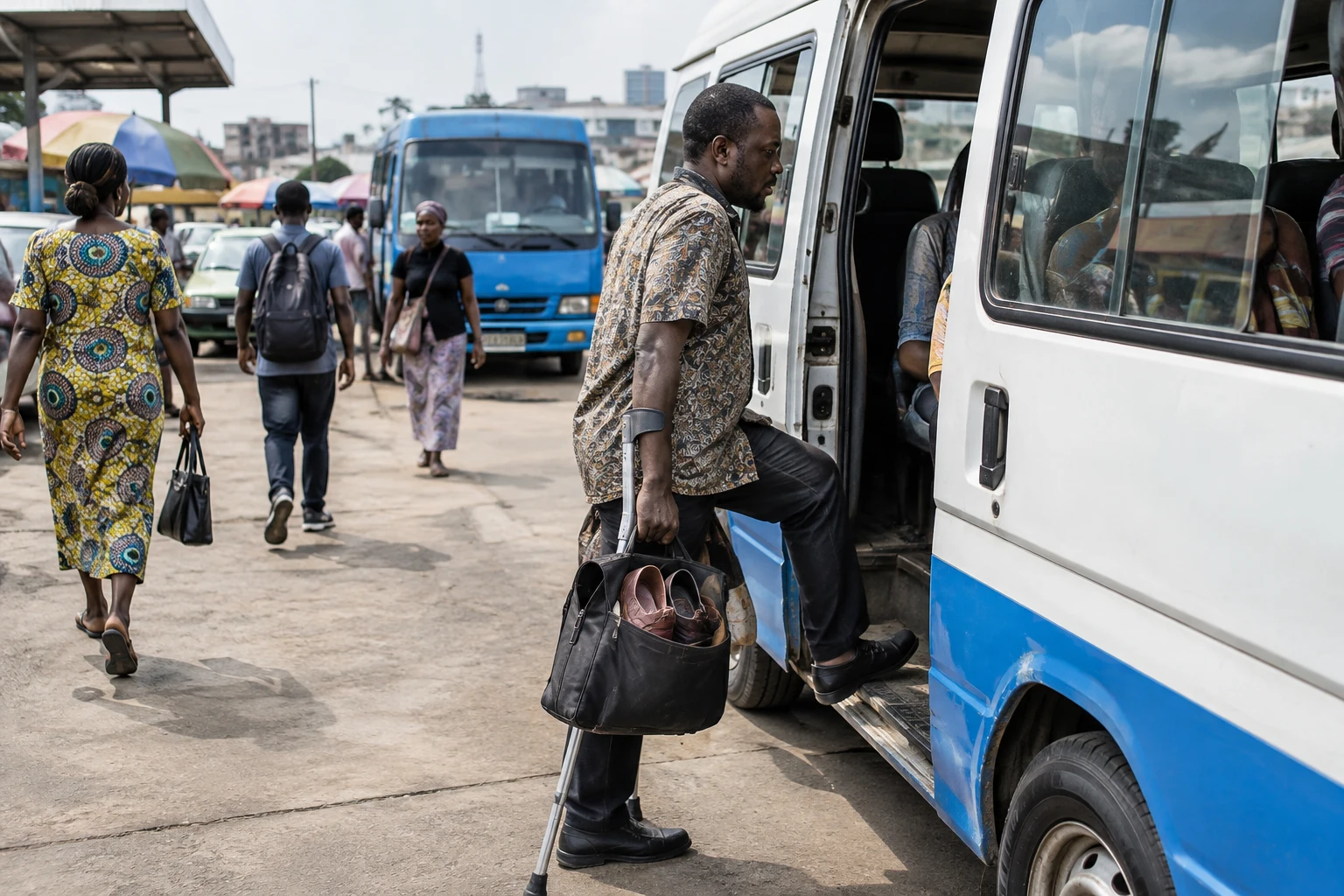
Learning a trade does not in itself guarantee an income. For people with disabilities in Ghana, training must also be backed by adapted equipment, accessible funding and tangible job opportunities. The path from the workshop to the market is what still needs to be strengthened.
In Accra, a request for support raises the question of market access
On 26 October 2026, Ghana’s Minister for Gender, Children and Social Protection, Agnes Naa Momo Lartey, received a delegation from the Future Life for Disabled Rehabilitation and Training Center. The organisation trains people with disabilities in several trades: shoemaking, leatherwork, furniture-making, information technology, beadwork, soap-making and fashion design. The meeting was reported by the ministry the following day and covered by several Ghanaian media outlets.
The delegation asked for training equipment and computer equipment. It also wants products made by trainees to find buyers more easily and for the centre to be able to accommodate more people. The minister welcomed the potential economic contribution of people with disabilities. However, available reports mention no funding awarded, equipment delivered or timetable for action.
This distinction matters. An institutional meeting opens a discussion; it does not prove that funding or equipment has been allocated. For trainees, the outcome will be measured in concrete follow-up: available tools, places, skills acquired and opportunities to sell products or practise a trade.
Public funds are available, but access must be clear
Ghana has several support mechanisms. The Ghana Skills Development Fund, administered by the Commission for Technical and Vocational Education and Training (CTVET), funds skills development that meets the needs of businesses in both the formal and informal sectors. But the public information reviewed does not make clear whether a specialised centre can apply directly, or what rules apply to this type of organisation.
Another funding mechanism is the District Assemblies Common Fund (DACF), a shared fund for local authorities. Part of its allocation supports people with disabilities, including through equipment, training and income-generating activities. The government has announced that this share will rise from 3% to 5% from 2026. Projections reported in Ghana put the corresponding national allocation at about 438.5 million cedis in 2026, up from 225.3 million in 2025.
These figures refer to a planned allocation, not the amount received by each organisation or the sums actually paid to training centres. The fund is administered through metropolitan, municipal and district assemblies. Access therefore also depends on local procedures, the information available and organisations’ ability to submit eligible applications. The Ghana News Agency has reported that beneficiaries in some districts received equipment to develop their activities. This local account shows that the fund can have an impact, but does not establish that all regions or organisations benefit equally.
Equipment determines the quality of training
The CTVET’s 2026 report, based on a 2025 survey of technical and vocational training institutions, gives an indication of the needs. According to its findings, 33.5% of institutions surveyed said they lacked equipment adapted to learners with special needs. A further 42.1% said they faced significant difficulties in supporting them.
These figures concern all the institutions surveyed in Ghana, not just centres specialising in disability. They therefore do not directly describe the situation at Future Life. They nonetheless show that the obstacles go beyond enrolment: unsuitable tools can limit practical learning, independence and preparation for employment.
Needs vary according to the person and the trade. A shoemaking or carpentry workshop must provide physical access to workstations and tools. Digital training requires usable computer equipment and accessible learning materials. An effective inclusion policy must therefore fund solutions tailored to learners, rather than distribute identical equipment without regard to how it will be used.
From skills to income: the market link
Future Life’s request also highlights what happens after training. A product made during training only generates income if it finds customers. Access to public or private markets, sales networks and business support can therefore matter as much as workshop equipment.
The results will not be the same for everyone. Centres near Accra may be better placed to connect with public authorities, businesses or buyers. Organisations in less-connected districts may depend more on their local assemblies and nearby sales channels. Similarly, someone setting up a small business has different needs from a trainee seeking salaried employment. Clear public criteria and local monitoring are essential to ensure announced funding reaches real needs.
The issue forms part of a broader trajectory in Ghana: the country is seeking to expand technical and vocational education while strengthening inclusion. It also matters across West Africa, where vocational skills, youth employment and the informal economy play a major role. ECOWAS, the regional economic community, provides a framework for co-operation between neighbouring countries, but the implementation of training and disability policies remains primarily a national and local responsibility.
The next step will be to see whether the 26 October meeting leads to a defined support package, and on what terms. The effective use of the DACF’s 5% share, centres’ access to training funds and outcomes for trainees will also need to be monitored. The reach of the public commitment will be measured across this chain: funding, equipment, learning and market access.