Algeria
 Egypt
 Libya
 Morocco
 Sudan
 Tunisia
 Benin
 Burkina Faso
 Cabo Verde
 Côte d'Ivoire
 Ghana
 Guinea
 Liberia
 Mali
 Mauritania
 Niger
 Nigeria
 Senegal
 Sierra Leone
 The Gambia
 Togo
 Cameroon
 Central African Republic
 Chad
 DR Congo
 Equatorial Guinea
 Gabon
 Republic of the Congo
 São Tomé and Príncipe
 Burundi
 Comoros
 Djibouti
 Eritrea
 Ethiopia
 Kenya
 Madagascar
 Malawi
 Mauritius
 Mozambique
 Rwanda
 Seychelles
 Somalia
 South Sudan
 Tanzania
 Uganda
 Angola
 Botswana
 Eswatini
 Lesotho
 Namibia
 South Africa
 Zambia
 Zimbabwe
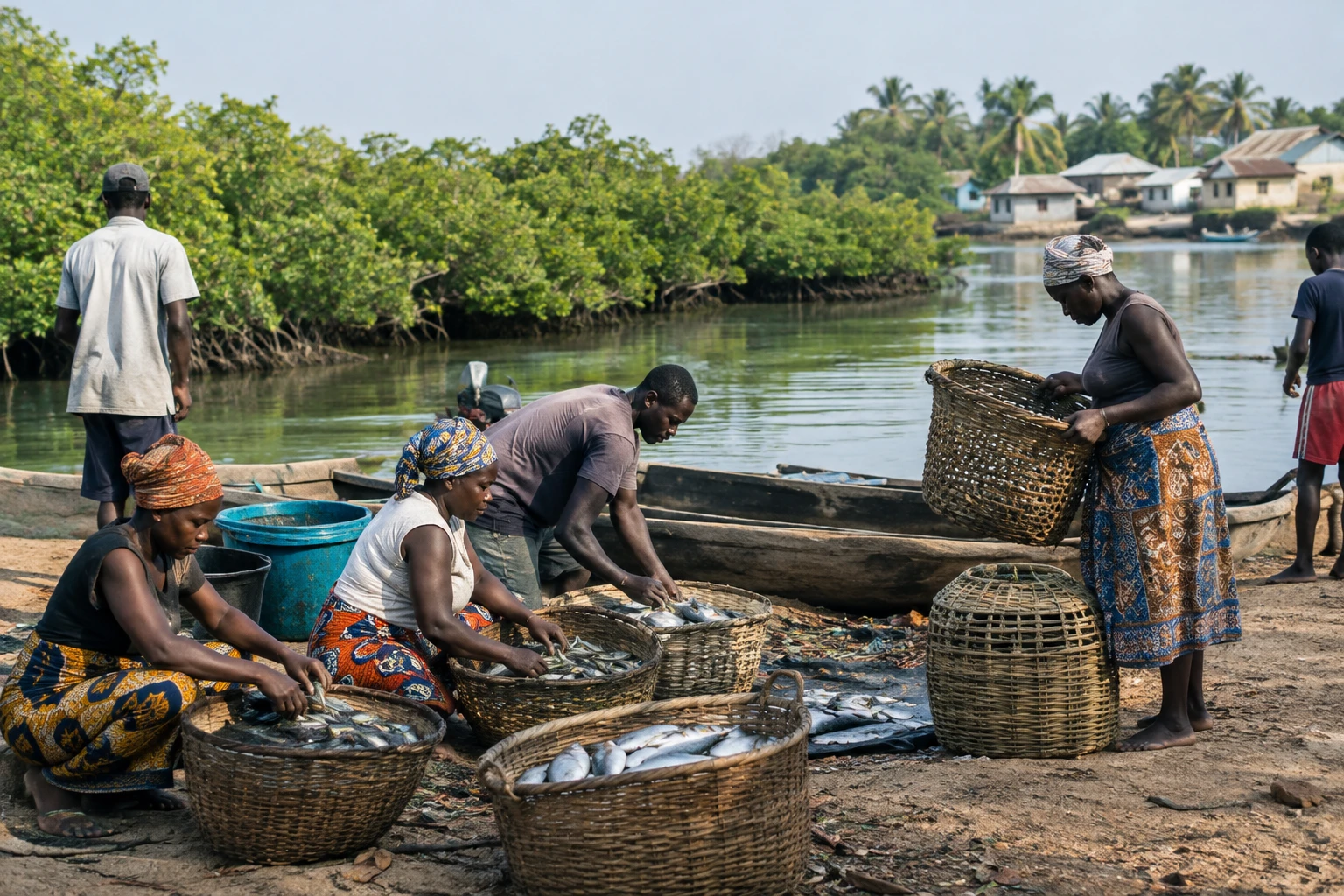
In the Bijagós archipelago, nature conservation also depends on local rules and the ways communities use the land and sea. This approach is now recognised globally. Guinea-Bissau’s challenge will be to build on that recognition without turning the islands into a tourist destination alone.
An island territory shaped by the tides
Off the coast of Bissau, the 88 islands and islets of the Bijagós form a network of channels, mangroves, mudflats and beaches. Twice a day, the tides expose and then cover vast expanses. These habitats sustain fish and provide homes for numerous marine and migratory species.
In 1996, UNESCO recognised the Bolama-Bijagós archipelago as a biosphere reserve. In 2025, it inscribed the archipelago’s coastal and marine ecosystems on the World Heritage List under the name Omatí Minhô. The designation highlights both the site’s ecological richness and the management practices that help preserve it. UNESCO’s page on the Bijagós ecosystems sets out the details of this recognition.
The listing does not start from scratch. João Vieira and Poilão National Marine Park, Orango National Park and the community-managed Urok Islands Marine Protected Area already form a network of protected sites. UNESCO notes that these areas were established between 2000 and 2005, and that an integrated management plan for the biosphere reserve was adopted in 2023.
Habitats vital to people and wildlife
The Bijagós are not an empty space set aside for conservation. Communities live there through fishing, rice cultivation and other activities linked to the archipelago’s resources. The Ramsar Convention, which lists wetlands of international importance, also describes their role in local livelihoods and cultural practices.
Mangroves and mudflats provide breeding and feeding grounds for wildlife. Sea turtles, manatees and dolphins are among the species found there. The archipelago is also a stopover for migratory birds using the East Atlantic Flyway, which links breeding grounds in northern Europe and Asia with wintering sites in Africa.
The often-cited figure of more than 870,000 waders — birds that feed, among other places, on mudflats — refers to observations made in 2001, not a recent count. Ramsar cites this survey to illustrate the site’s importance. Guinea-Bissau’s national biodiversity plan also gives high estimates for the presence of waterbirds, while showing that figures vary according to the period and counting methods. The old figure should therefore not be presented as a current population count.
Local rules at the heart of conservation
Conservation also rests on customary norms and community organisation. National authorities and protected-area managers draw on these rules alongside legal frameworks. UNESCO says this combination of local management and public action contributes to the site’s conservation status.
This approach requires a delicate balance. Fishing supports households, but greater pressure on resources can undermine ecosystems. Tourism can generate income, but it can also increase demand for transport, water and infrastructure. In a scattered archipelago, the effects are not the same for residents of more accessible islands as for those in more remote communities.
International recognition can raise the profile of the Bijagós and support the protection of its habitats. It does not, however, guarantee sufficient funding or an equitable distribution of benefits. Decisions about permitted activities, access to sites and the management of revenues will have direct consequences for communities, fishers and conservation authorities.
Social traditions: avoiding generalisations
Bijagós societies are often described in terms of their matrilineal structures, in which family membership is passed down through the maternal line. But this does not mean that practices are identical throughout the archipelago, or that women have the same responsibilities everywhere.
An ethnographic study of Caravela island describes, in particular, a tradition in which women take the initiative in choosing a spouse. Published in 1984, the study documents a specific, historical context. It is not enough to establish that the same practice applies today across all the islands. Customs evolve, and the relationships between residence, kinship and marriage cannot be reduced to a generalised notion of “matriarchy”.
Describing these practices accurately matters as much as protecting the landscapes. Residents are not cultural scenery for visitors: their decisions and knowledge contribute to the day-to-day management of the islands. Recognising them means acknowledging diverse, changing societies rather than freezing their traditions in time.
A challenge for Guinea-Bissau and the region
For Guinea-Bissau, a coastal country in West Africa, the Bijagós bring together questions of biodiversity, economic activity and local governance. The management of fisheries and marine habitats also extends beyond administrative borders: migratory species and currents link the islands to other coastal areas in the region.
The 2025 listing gives international standing to a heritage whose preservation also depends on national and community-level choices. What happens next will depend on implementing the management plan, regularly monitoring species and finding ways to reconcile local incomes with habitat protection. For the people of Guinea-Bissau, the challenge is not simply to make the Bijagós known, but to maintain the conditions that allow communities and ecosystems to endure there.