Algeria
 Egypt
 Libya
 Morocco
 Sudan
 Tunisia
 Burkina Faso
 Cabo Verde
 Côte d'Ivoire
 Ghana
 Guinea
 Guinea-Bissau
 Liberia
 Mali
 Mauritania
 Niger
 Nigeria
 Senegal
 Sierra Leone
 The Gambia
 Togo
 Cameroon
 Central African Republic
 Chad
 DR Congo
 Equatorial Guinea
 Gabon
 Republic of the Congo
 São Tomé and Príncipe
 Burundi
 Comoros
 Djibouti
 Eritrea
 Ethiopia
 Kenya
 Madagascar
 Malawi
 Mauritius
 Mozambique
 Rwanda
 Seychelles
 Somalia
 South Sudan
 Tanzania
 Uganda
 Angola
 Botswana
 Eswatini
 Lesotho
 Namibia
 South Africa
 Zambia
 Zimbabwe
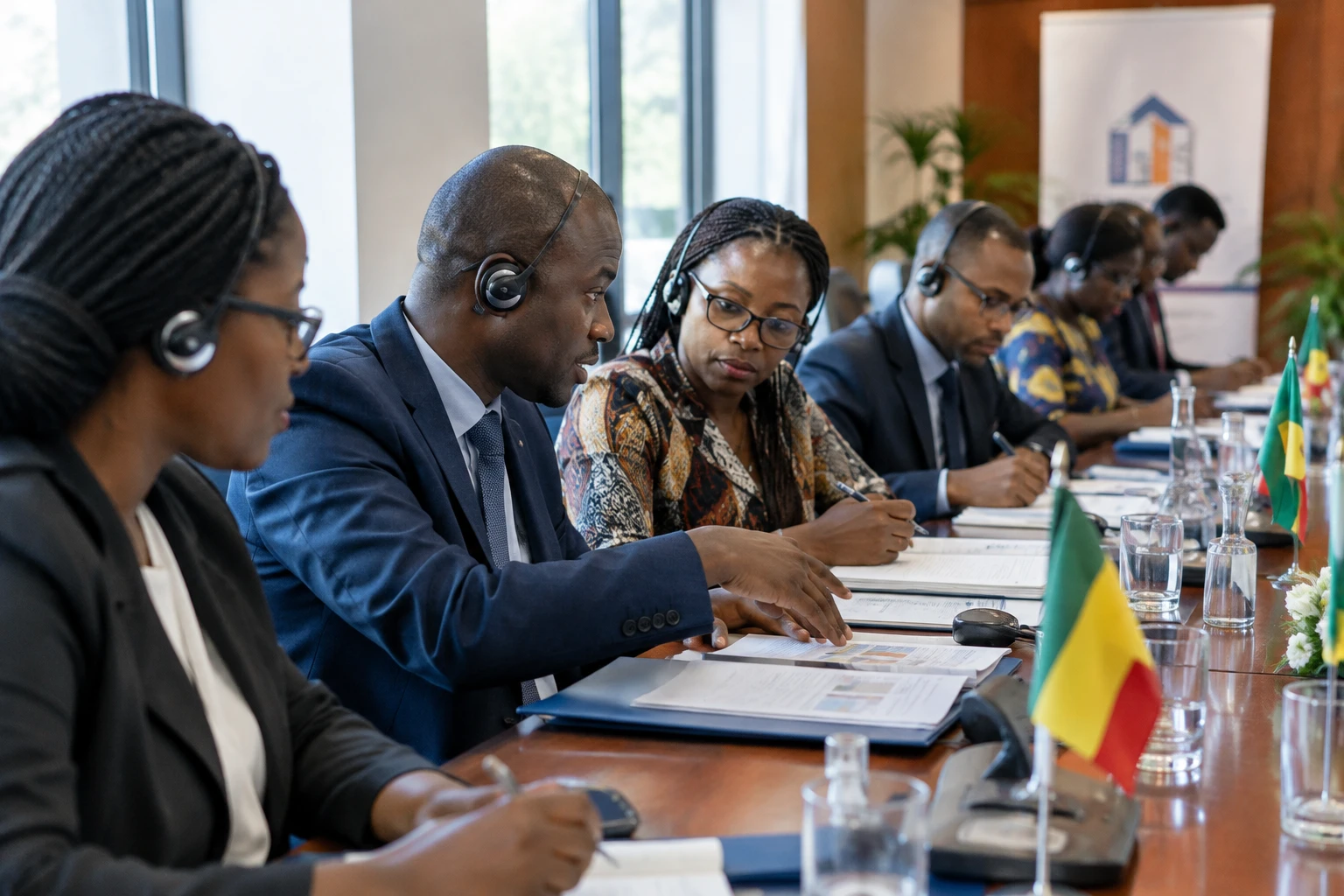
In Benin, raising funds to build homes is not enough: households must also be able to borrow and buy. A new operation on the regional market is making resources available to banks, but does not in itself resolve the question of the cost of credit.
Regional financing rooted in Benin’s needs
Benin’s property market is developing amid sustained urbanisation. In 2025, 53% of the population lived in cities, according to World Bank data based on United Nations estimates. Pressure is concentrated particularly around Cotonou and Abomey-Calavi, while Porto-Novo remains the country’s capital.
Housing needs are substantial, but their scale varies according to the methods used to calculate them. The Centre for Affordable Housing Finance in Africa estimated the deficit at about 300,000 units in 2024. Higher figures sometimes cited in Benin should therefore be presented as estimates, rather than as a single established tally.
In this context, the public programme plans 20,000 social and affordable homes across 14 cities. The site at Ouèdo, in the commune of Abomey-Calavi, is due to accommodate 10,849. However, on 7 October 2026, the government broadened the eligibility criteria for social housing after identifying marketing difficulties and concluding that the target group was too narrow.
How the ZAKA operation works
BSIC Benin raised CFAF 15bn through a securitisation operation, the closing of which was presented in Cotonou on 26 October 2026, on the sidelines of the Capital Reach Forum. The subscription took place from 20 to 31 July. Beninese and regional investors took part.
Securitisation involves transferring receivables — in this case, loans — to a specialised fund. The fund then issues securities that are bought by investors. The bank thereby obtains cash before the loans have been fully repaid and can create new lending capacity.
The FCTC ZAKA BSIC Benin 2026-2033 issue is structured in four tranches. The senior tranche amounts to CFAF 10bn, with an interest rate of 7%. The mezzanine tranche totals CFAF 3bn, paying 9%. The two junior tranches total CFAF 2bn: one has a rate of 9%, while the other carries a zero coupon, according to the transaction documentation.
This issue is the third under the ZAKA programme and its first social bond. Developed by AFINHAB, formerly CRRH-UEMOA, and BOAD Titrisation, the programme has now raised CFAF 30bn. Proceeds from the Beninese operation are intended for affordable housing, with a stated priority for first-time buyers and homes priced at no more than CFAF 150m.
The challenge: turning capital into affordable loans
For BSIC, the benefit lies in diversifying its funding and better matching its duration to that of mortgage loans, which are often repaid over several years. The structure also spreads the financing among several categories of investors, from banks to individuals.
But funding available to the bank does not automatically translate into lower rates for households. The final cost also depends on credit risk, the guarantees required, loan duration and borrowers’ ability to repay. Access to credit may therefore remain difficult for salaried employees, self-employed workers and households with irregular incomes.
The adjustment to the social housing criteria highlights another limitation: housing needs do not always match purchasing power or eligibility conditions. The challenge is not only to build homes, but to make their purchase affordable in relation to household incomes, including those of people working in the informal economy.
A test for the WAEMU financial market
The operation links the financing of housing in Benin to regional savings. WAEMU, the West African Economic and Monetary Union, comprises eight countries that share, among other things, a common currency and a regional financial market. Investments of this kind can broaden banks’ sources of funding beyond deposits and short-term resources.
The impact of ZAKA will now depend on how the funds are actually used: the number of loans granted, the profiles of beneficiaries, the terms offered and the share that effectively reaches low-income households or first-time buyers. It is at this stage that the “social” label will take on concrete meaning.
For Benin, as for other WAEMU markets, the issue highlights a shared equation: mobilising long-term capital without confusing financing capacity with effective access to housing. The programme’s results and changes to eligibility criteria for public projects will show whether this new resource genuinely brings households closer to home ownership.