
 Algeria
 Egypt
 Libya
 Morocco
 Sudan
 Tunisia
 Benin
 Burkina Faso
 Cabo Verde
 Côte d'Ivoire
 Ghana
 Guinea
 Guinea-Bissau
 Liberia
 Mali
 Mauritania
 Niger
 Nigeria
 Senegal
 Sierra Leone
 The Gambia
 Togo
 Cameroon
 Central African Republic
 Chad
 DR Congo
 Equatorial Guinea
 Gabon
 Republic of the Congo
 São Tomé and Príncipe
 Burundi
 Comoros
 Djibouti
 Eritrea
 Ethiopia
 Kenya
 Madagascar
 Malawi
 Mauritius
 Mozambique
 Rwanda
 Seychelles
 Somalia
 South Sudan
 Tanzania
 Uganda
 Angola
 Botswana
 Eswatini
 Lesotho
 Namibia
 Zambia
 Zimbabwe
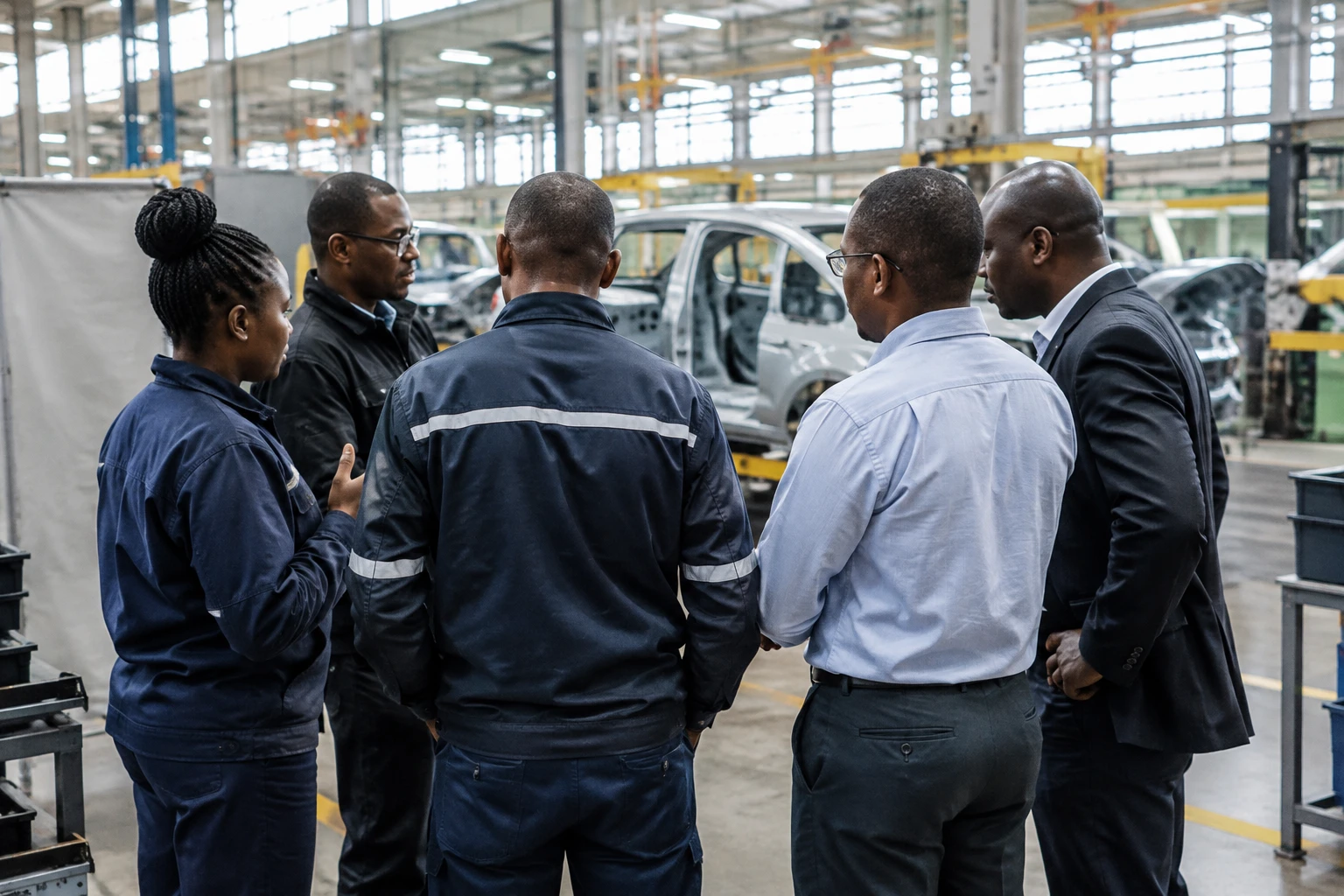
Electric cars raise an industrial as well as an environmental question: who will manufacture the vehicles, batteries and charging equipment, and where will the associated jobs be created? In South Africa and Morocco, two economies already embedded in global automotive supply chains, public policies seek to attract these activities without losing existing production capacity.
Two industrial bases, two priorities
South Africa, whose administrative capital is Pretoria, assembles vehicles for its domestic market and for export. In 2025, its automotive exports reached a record level, according to the public agency InvestSA, which is attached to the Department of Trade, Industry and Competition. A significant share is destined for the European Union and the United Kingdom. This reliance on overseas markets makes adapting to new technologies particularly pressing.
Morocco, too, draws on an export-oriented automotive industry. Its proximity to Europe and its industrial infrastructure place it at the heart of production chains linking European and African markets. For Rabat, the challenge is to consolidate this position while attracting the manufacture of electric components and batteries.
These trajectories form part of a continental trend that remains uneven. The United Nations Economic Commission for Africa (ECA) notes that policies and infrastructure are advancing in several countries, but that electric vehicle adoption remains at an early stage. Access to reliable electricity, technical skills and financing remains crucial.
Pretoria backs factory conversion
South Africa’s strategy aims to evolve its industrial base without causing a sudden break. Since 1st March 2026, a 150% tax deduction may apply to certain eligible investments in buildings, equipment and machinery intended for the production of battery-electric or hydrogen vehicles. The scheme is set to run for ten years.
This is a tax deduction calculated on eligible expenditure, not an automatic 150% refund to companies. The incentive is intended to encourage manufacturers and their suppliers to adapt their production facilities locally. It complements support already included in South Africa’s automotive development programmes.
The policy responds to a tangible risk: if export markets shift towards low-emission vehicles, South African factories that cannot keep pace could lose orders. But the tax incentive alone does not guarantee that new models will be produced locally. Manufacturers’ decisions, demand and infrastructure will also weigh in the balance.
Morocco seeks to shorten the supply chain
In Morocco, the measures reported in the ECA roadmap prioritise reducing certain import costs and expanding the industrial ecosystem. The document refers to customs duties cut to 2.5% for electric vehicles and components, as well as green financing. The precise effects depend, however, on the products concerned and the rules that apply: this rate should not be interpreted as a uniform total tax on all imports.
The roadmap links these measures to manufacturing and infrastructure targets. It sets a target of 258,000 electric vehicles on the road by 2030 and nearly 25,800 public and private charging points. These are projections and targets, not results already achieved. The International Energy Agency also records Morocco’s target of 258,000 electric cars by 2030, but reports a target of about 30,000 charging points covering several categories of vehicle.
This difference shows why planning figures must be read in context. The number of charging points may vary depending on whether the count includes only cars or also two-wheelers and buses. For drivers, the challenge will be the actual availability of equipment, its distribution beyond major routes and the cost of charging.
Local value beyond sales
Competition between the two countries will not be decided solely by the number of electric cars sold. It will hinge on the share of value created locally: parts manufacturing, assembly, skills, maintenance, recycling and the processing of raw materials. The ECA roadmap refers, for South Africa, to reducing reliance on imported components. For Morocco, it highlights targets for local content in charging equipment and the production of battery components. These figures remain targets attributed to the document, not achieved results.
The benefits will not be the same for everyone. Large companies and industrial zones may capture the first investments, while supplier SMEs will need financing, accessible standards and skilled staff to join value chains. Residents of major cities could benefit from charging infrastructure sooner. In less well-served areas, its usefulness will depend on the expansion of electricity networks and solutions suited to public transport and everyday travel.
The transition also has a regional dimension. South Africa can draw on supplies within the Southern African Development Community (SADC), which brings together several countries in southern Africa. Morocco, in North Africa, is seeking to serve European and African markets. Compatible standards and regional trade in components could reduce dependence on distant supply chains.
Implementation will be the test
In April 2026, African ministers responsible for transport and energy adopted a continental framework on electric vehicle development within the African Union. It focuses in particular on local production, regional value chains, electricity grid readiness, skills and the harmonisation of standards. In September, a forum held in South Africa stressed the need to turn commitments into concrete investment.
This common framework does not erase differences between countries. Rather, it underlines that national policies would benefit from being connected: shared technical standards, industrial cooperation and training can expand the market beyond national borders. For Pretoria and Rabat, the next indicator will therefore not be only the scale of the incentives announced. It will be whether they lead to adapted factories, competitive local suppliers, available electricity and genuinely affordable vehicles.
The ECA roadmap on electric mobility in Africa presents national targets as planning tools. Comparing it with data from the International Energy Agency and information from InvestSA helps distinguish these ambitions from measures already in force. The ability to turn incentives into sustainable production will show whether the two countries can retain a place in a reshaping automotive industry.



