
 Algeria
 Egypt
 Libya
 Morocco
 Sudan
 Tunisia
 Benin
 Burkina Faso
 Cabo Verde
 Ghana
 Guinea
 Guinea-Bissau
 Liberia
 Mali
 Mauritania
 Niger
 Nigeria
 Senegal
 Sierra Leone
 The Gambia
 Togo
 Cameroon
 Central African Republic
 Chad
 DR Congo
 Equatorial Guinea
 Gabon
 Republic of the Congo
 São Tomé and Príncipe
 Burundi
 Comoros
 Djibouti
 Eritrea
 Ethiopia
 Kenya
 Madagascar
 Malawi
 Mauritius
 Mozambique
 Rwanda
 Seychelles
 Somalia
 South Sudan
 Tanzania
 Uganda
 Angola
 Botswana
 Eswatini
 Lesotho
 Namibia
 South Africa
 Zambia
 Zimbabwe
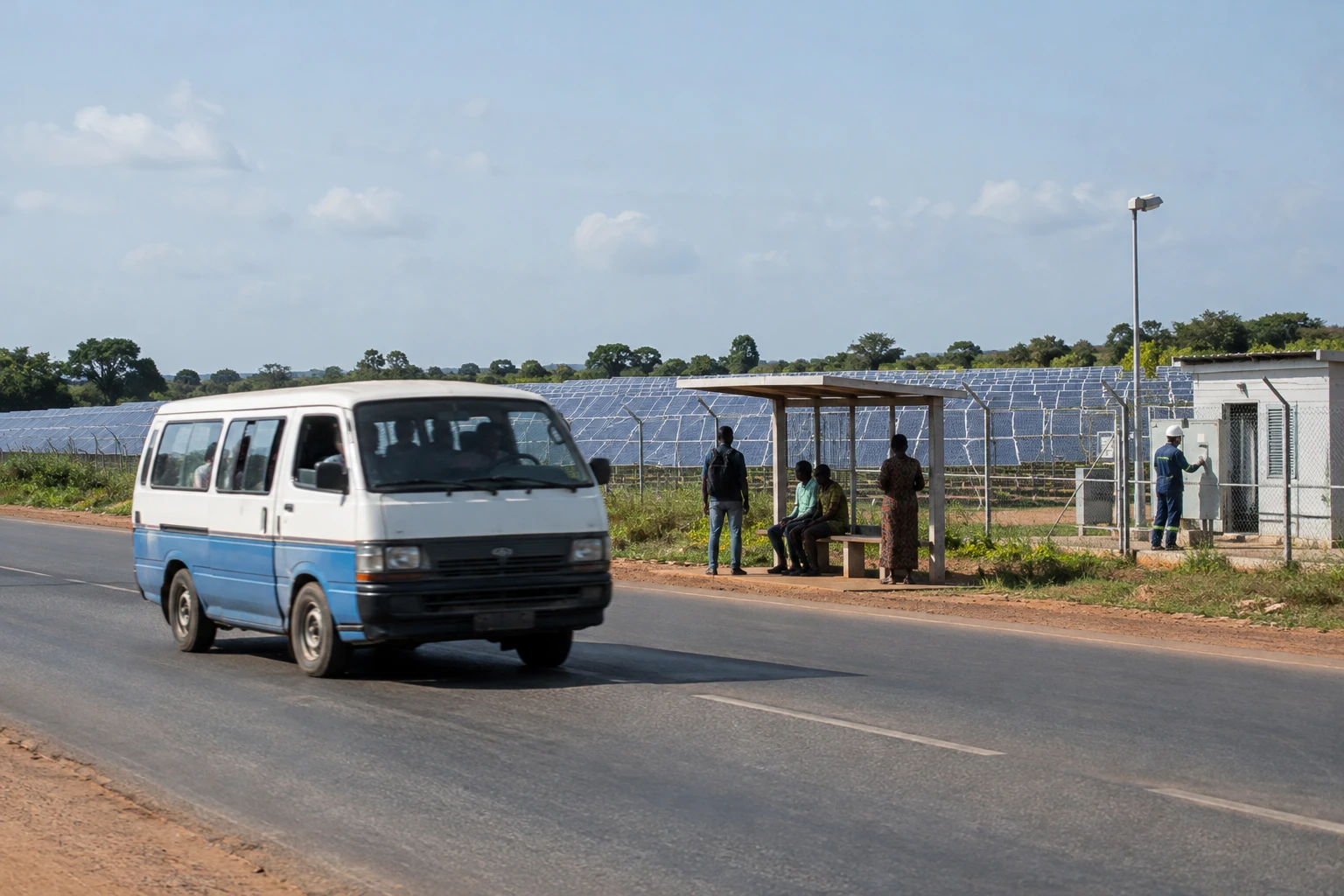
In northern Côte d’Ivoire, energy issues also play out far from major urban centres: connecting new households, supporting local activity and strengthening a grid under pressure from growing demand. The Tongon solar project is part of this equation. But its benefits will depend as much on its construction as on the electricity actually delivered to users.
A project in the north, a national strategy
On 23 October 2026, the Minister of Mines, Petroleum and Energy, Mamadou Sangafowa-Coulibaly, launched a project for a 52-megawatt-peak (MWp) photovoltaic plant in Tongon, in the department of M’Bengué, in the Poro region. Megawatt-peak measures the theoretical maximum power of panels under standard conditions.
The plant is part of a policy to diversify Côte d’Ivoire’s electricity generation. The country remains engaged in electricity exchanges in West Africa, notably within the Economic Community of West African States (ECOWAS). At national level, it is seeking to meet rising demand while expanding access to energy.
In January 2025, the government adopted a National Energy Compact covering the period 2025-2030. Its funding is estimated at $6.56 billion, or about 3,980 billion CFA francs. Its goals include universal access to electricity and a 45% share of renewable energy in the energy mix by 2030. These targets provide the framework for Tongon, but do not in themselves guarantee that they will be achieved. Côte d’Ivoire’s Ministry of Planning sets out the objectives and funding of the National Energy Compact.
Jobs and electricity expected
The announced investment in Tongon amounts to 33 billion CFA francs. The project is being developed by Tongon Solaire SAS, a company described by the ministry as being wholly owned by Ivorian capital. The construction site is expected to support nearly 500 jobs, according to the authorities. The plant is due to begin operating by mid-2028 at the latest.
Covering about 50 hectares, the plant is expected to meet the electricity needs of around 30,000 households, or approximately 300,000 people. Estimates published by the authorities put annual output at nearly 90 gigawatt-hours and emissions avoided at about 39,000 tonnes of CO₂ a year. These figures are projections: they will depend in particular on the construction schedule, the plant’s operation and its connection to the grid.
The distinction between generating capacity and actual access is essential. A power plant feeds electricity into the grid; it does not automatically mean that every nearby household has a connection or that supply will be continuous. Local benefits will also depend on transmission and distribution infrastructure, as well as on how jobs and contracts linked to the construction site benefit businesses and workers in M’Bengué.
Both the Ivorian Press Agency and the Ministry of Energy have reported the launch, cost, capacity and main projections for the project. The agency says construction work itself is scheduled to begin in 2027. The Ivorian Press Agency’s report on Tongon and the Ministry of Energy’s presentation agree on these points.
The challenge: turning announcements into reliable capacity
The government has announced around 15 solar plants under development or planned before 2030, with a target combined capacity of 1,262 MWp. Tongon follows the launch of the Katiola project. Other sites, including Bondoukou, Tengréla, Kong, Touba, Odienné and Soubré, feature in announcements or project portfolios. Their progress and schedules are not all the same, however: an announcement is neither secured financing nor an operational plant.
There is also a financial challenge. The minister acknowledged that the necessary investment cannot rely entirely on public funds and called on technical and financial partners to maintain their commitment. For Tongon, the wholly Ivorian ownership announced by the authorities signals a greater role for domestic players in energy projects. It does not remove questions about financing, construction risks, long-term maintenance and integrating output into the grid.
Results already seen provide a point of comparison, but figures for connected capacity vary according to the dates and definitions used. The authorities cite Boundiali and Ferkessédougou as the first major solar projects connected to the grid. The challenge in the coming years will be to increase generation without undermining the system’s balance, as it must also manage variable sunshine and coordinate thermal and hydroelectric contributions.
An Ivorian issue that reaches beyond its borders
For Côte d’Ivoire, Tongon’s success will therefore be measured on several fronts: meeting the schedule for commissioning in 2028, the quality of grid connections, jobs actually created and electricity supplied to users. The benefits will differ for construction companies, connected households, local economic activities and residents who remain far from the grid.
Across West Africa, increased Ivorian generation also matters because the country takes part in regional electricity exchanges. Additional capacity can strengthen available supply, provided national and cross-border grids can transmit it. The next concrete measure will therefore be not the number of projects announced, but the number of plants completed, connected and actually generating electricity.



