Algeria
 Egypt
 Libya
 Morocco
 Sudan
 Tunisia
 Benin
 Burkina Faso
 Cabo Verde
 Côte d'Ivoire
 Ghana
 Guinea
 Guinea-Bissau
 Liberia
 Mali
 Mauritania
 Niger
 Senegal
 Sierra Leone
 The Gambia
 Togo
 Cameroon
 Central African Republic
 Chad
 DR Congo
 Equatorial Guinea
 Gabon
 Republic of the Congo
 São Tomé and Príncipe
 Burundi
 Comoros
 Djibouti
 Eritrea
 Ethiopia
 Kenya
 Madagascar
 Malawi
 Mauritius
 Mozambique
 Rwanda
 Seychelles
 Somalia
 South Sudan
 Tanzania
 Uganda
 Angola
 Botswana
 Eswatini
 Lesotho
 Namibia
 South Africa
 Zambia
 Zimbabwe
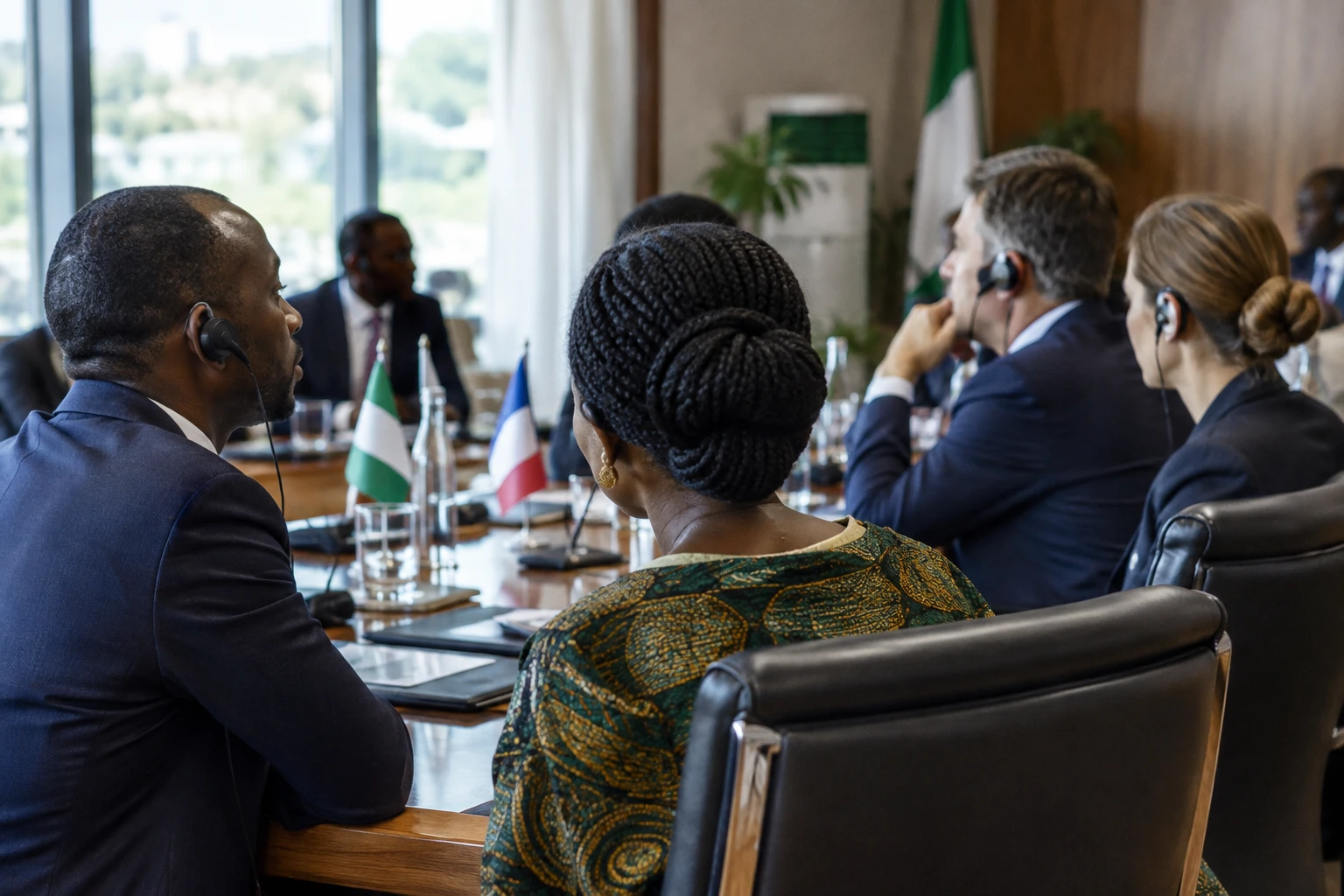
When the naira loses value, the effects do not stop at Nigeria’s borders. For companies that produce locally and sell abroad, lower costs in local currency can improve competitiveness. For those that import, repatriate profits or pay suppliers in foreign currencies, by contrast, it complicates the calculations. It is against this backdrop that economic ties between Abuja and Paris are drawing closer.
A major market, but exposed to exchange-rate risk
Nigeria is France’s largest trading partner in sub-Saharan Africa. Around a hundred French companies operate there, in sectors such as energy, maritime transport, insurance, agrifood and healthcare. They operate alongside Nigerian and international groups already established in the country, while Nigerian companies are also seeking business opportunities and investment in France. The French Ministry for Europe and Foreign Affairs describes these relations as particularly active in the economic and cultural fields.
But the size of the market does not eliminate the risks. After severe turbulence in the naira, the currency has stabilised further, without dispelling uncertainty about its future course. Foreign-exchange market reforms have sought in particular to bring rates closer together and make transactions more transparent. The Central Bank of Nigeria has also introduced an electronic system for matching foreign-exchange transactions. The International Monetary Fund has likewise noted the currency’s stabilisation and a return of portfolio investment, while stressing that the balance remains vulnerable to shocks. The Central Bank of Nigeria and the IMF report on the Nigerian economy document these developments.
For an investor, the exchange rate operates on several levels: it changes the cost of imported equipment, the value of revenue converted into euros or dollars, and sometimes the ability to transfer profits out of the country. An export-focused company may benefit from lower local costs. A company dependent on imported raw materials or contracts denominated in foreign currencies may, in turn, see its expenses rise. The outcome therefore depends on the sector, financing and the share of revenue earned in Nigeria.
The Dangote refinery, a transformative factor
Business leaders quoted in bilateral discussions take a long-term view. Maxime Bouan, a partner at Seedstars Africa Ventures, believes the reforms are heading in the right direction and that the Dangote refinery could change the country’s economic equation. Kolawole Owodunni, of the Nigeria Sovereign Investment Authority, notes that groups such as MTN and Airtel have grown despite several episodes of currency volatility. These assessments shed light on investors’ views, but do not guarantee that exchange-rate risks are now under control.
The refinery, located in Lagos, could reduce Nigeria’s reliance on imports of refined fuel and, consequently, ease some of the demand for foreign currency. It does not, however, address the import needs of other sectors or the difficulties all companies face in accessing dollars. The IMF considers that the refinery’s domestic production could support the country’s external position, while noting that its effects depend on the facility ramping up production and on economic policies as a whole. Its analysis of Nigeria’s sector therefore urges a distinction between a potential improvement and an immediate solution.
These changes do not have the same impact on everyone. Large companies generally have more tools at their disposal to manage international payments or foreign-exchange exposure. SMEs, importers and informal economy operators often have less room to absorb rising costs. And while increased local production can curb some imports, its day-to-day impact also depends on selling prices, distribution and household purchasing power.
Trade in its regional context
Nigeria does not engage with France solely as a national market. Its demographic and economic weight makes it a major player in West Africa and ECOWAS, the regional community that aims to strengthen economic co-operation among its members. Increased industrial production, particularly in refining, could therefore have effects beyond Nigeria’s borders if volumes are available and regional trade channels are in place. Conversely, pressure on foreign currencies and import costs can hinder trade between suppliers and customers across the region.
Trade statistics also show that French-Nigerian relations remain unbalanced and concentrated in certain products. Hydrocarbons account for a large share of French imports from Nigeria. The question, therefore, is whether there can be genuine diversification: more industrial partnerships, services, local processing and reciprocal investment, rather than flows linked solely to raw materials. Nigerian companies also have a place in this relationship, particularly when they invest or develop activities in France.
Political milestones will weigh on confidence
The political calendar adds another dimension to investment decisions. Nigeria’s Independent National Electoral Commission has set 16 January 2027 for the presidential and legislative elections. In France, the first round of the presidential election is scheduled for 18 April 2027 and the second for 2 May. These elections do not automatically determine trade, but they can affect government priorities, co-operation projects and perceptions of risk. The Nigerian electoral commission’s calendar and the dates announced by the French authorities set out these milestones.
Emmanuel Macron’s state visit to Nigeria, planned for late October 2026, has been postponed. The French and Nigerian authorities have not yet set a new date. The postponement is not enough to conclude that economic relations are deteriorating: trade and investment also depend on companies, contracts and financial institutions. It is, however, a test of the continuity of political dialogue as the two countries approach separate election cycles.
For Nigerian and French economic actors, the next indicator will therefore not be the naira’s exchange rate alone. They will need to monitor effective access to foreign currencies, local production capacity, trade diversification and the predictability of the rules. The promise of a mutually beneficial partnership will be measured by these tangible results, for large groups as well as local businesses and consumers.