
 Algeria
 Egypt
 Libya
 Morocco
 Sudan
 Tunisia
 Benin
 Burkina Faso
 Cabo Verde
 Ghana
 Guinea
 Guinea-Bissau
 Liberia
 Mali
 Mauritania
 Niger
 Nigeria
 Senegal
 Sierra Leone
 The Gambia
 Togo
 Cameroon
 Central African Republic
 Chad
 DR Congo
 Equatorial Guinea
 Gabon
 Republic of the Congo
 São Tomé and Príncipe
 Burundi
 Comoros
 Djibouti
 Eritrea
 Ethiopia
 Kenya
 Madagascar
 Malawi
 Mauritius
 Mozambique
 Rwanda
 Seychelles
 Somalia
 South Sudan
 Tanzania
 Uganda
 Angola
 Botswana
 Eswatini
 Lesotho
 Namibia
 South Africa
 Zambia
 Zimbabwe
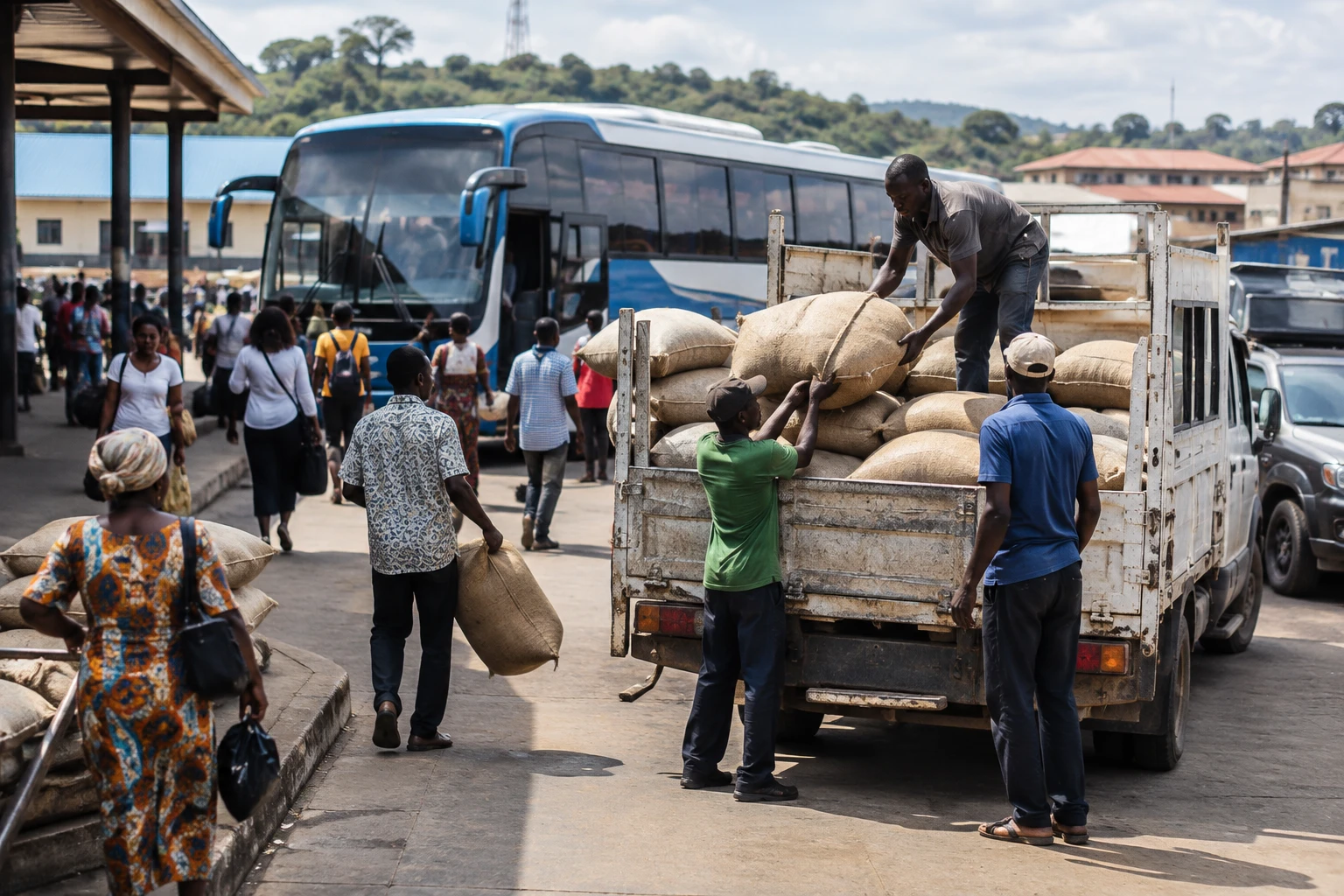
Cocoa remains a pillar of Ghanaian exports, but Ghana’s place in the global market increasingly depends on its ability to renew its orchards and secure growers’ incomes. Ecuador, meanwhile, is increasing its volumes. The comparison reveals two agricultural models, but also shared vulnerabilities to disease and climate disruption.
Competition is also playing out in the fields
Ghana and its West African neighbour Côte d’Ivoire have long dominated global cocoa production. Ghana is a member of ECOWAS, the economic community bringing together countries in West Africa. Ecuador, meanwhile, is in South America: its advance is broadening competition beyond Africa’s main cocoa-growing region.
Estimates from the International Cocoa Organization (ICCO) give a measure of how close the two countries have become. For the 2024/2025 season, the organisation estimates Ghanaian production at 600,000 tonnes and Ecuadorian production at 570,000 tonnes. These are crop-year estimates and may be revised. On their own, therefore, they are not enough to establish a definitive ranking for subsequent seasons. The ICCO’s 2024/2025 annual report nevertheless confirms the narrow gap.
The change is notable compared with earlier figures. The ICCO estimated Ecuador’s harvest at 419,000 tonnes in 2023/2024, before its sharp increase the following year. This growth has accompanied an expansion in cultivated area and the adoption of productive varieties. It makes Ecuador a more direct competitor for West African producers, without diminishing Africa’s collective weight: according to the ICCO’s estimate for 2024/2025, the continent still supplies almost seven-tenths of the world’s cocoa.
High yields, but different production choices
In Ecuador, the CCN-51 variety helps deliver large volumes. It is sought after for its yield and relative resistance to certain diseases, although its flavour profile differs from that of fine cocoa associated with the Nacional variety. Ecuador’s agriculture ministry describes the distribution of certified seedlings, including CCN-51, as part of its plantation renewal programmes. The Ecuadorian ministry’s information on traceability and orchard renovation outlines this approach.
Yield figures often cited for Ecuador are higher than those in West Africa. But comparisons vary according to region, farming practices and how productive areas are calculated. Nor do they tell the whole story: quality, input costs, access to credit and the share of the global price that goes to the grower all affect profitability as much as tonnage does.
The 2024 price surge increased cocoa’s economic appeal in both regions. However, producers are not equally exposed to international fluctuations. In Ghana, COCOBOD, the public body responsible for the sector, plays a central role in purchasing and marketing. Its system of setting prices in advance can protect growers from a sudden fall, but the timing of price-setting affects how quickly they benefit when prices rise. In Ecuador, prices are more closely linked to the market. This mechanism can pass on an increase more quickly, but also exposes farmers to reversals.
In Ghana, the recovery in volumes does not resolve underlying weaknesses
Ghana’s harvest rebounded in the 2025/2026 season. Reports published in September 2026, attributed to a COCOBOD report seen by Reuters, put output at about 771,000 tonnes, above the initial forecast of 650,000 tonnes. This result also exceeds the ICCO’s estimate for 2024/2025, but the periods being compared are not the same. It would therefore be misleading to infer a lasting trend from a single season.
Structural difficulties remain severe. Swollen shoot, a viral disease that weakens cocoa trees, can force farmers to uproot affected trees. Replacing them takes time: young seedlings do not immediately produce a commercial harvest. The ageing of some orchards, the cost of fertilisers and treatments, and episodes of irregular rainfall also weigh on yields.
Pressure on land further complicates the recovery. In some areas, illegal gold mining, known in Ghana as galamsey, degrades soil and competes with crops. For farming households, the choice between tending cocoa trees whose income takes time to arrive and seeking a more immediate mining income is not simply a question of yield: it also depends on costs, risks and local employment opportunities.
Ghanaian officials have announced measures to rehabilitate and support plantations, including the distribution of inputs. Their effectiveness will depend on implementation, producers’ access to them and the time needed to renew the trees. A one-off increase in volumes does not automatically make up for years of underinvestment or the loss of agricultural land.
A challenge for African supply chains and the global market
The narrowing gap between Ecuador and Ghana is not simply a race to become the world’s second-largest producer. It raises a more practical question: who can sustain regular production while ensuring growers a viable income? Ghana has long experience in organising its cocoa sector and remains a major force in the cocoa trade. Ecuador shows how quickly higher yields and expanded cultivation can shift the balance of supply.
For ECOWAS, the challenge also concerns added value and the resilience of agricultural economies. Cocoa supports rural incomes and export earnings, but it leaves producing countries vulnerable to disease, climate shocks and global fluctuations. Côte d’Ivoire and Ghana remain essential to international supply; their ability to adapt will therefore have an impact far beyond their borders.
The next comparison will need to take account of harvests actually marketed, rather than forecasts alone. The condition of plantations, prices received by producers and the effects of weather in each growing region will also need to be monitored. The ICCO also notes that production in the Americas increased in 2024/2025, driven in particular by Ecuador. This development is a reminder that the market is diversifying, without diminishing Africa’s central role in global production.



