Algeria
 Egypt
 Libya
 Morocco
 Sudan
 Tunisia
 Benin
 Burkina Faso
 Cabo Verde
 Ghana
 Guinea
 Guinea-Bissau
 Liberia
 Mali
 Mauritania
 Niger
 Nigeria
 Senegal
 Sierra Leone
 The Gambia
 Togo
 Cameroon
 Central African Republic
 Chad
 DR Congo
 Equatorial Guinea
 Gabon
 Republic of the Congo
 São Tomé and Príncipe
 Burundi
 Comoros
 Djibouti
 Eritrea
 Ethiopia
 Kenya
 Madagascar
 Malawi
 Mauritius
 Mozambique
 Rwanda
 Seychelles
 Somalia
 South Sudan
 Tanzania
 Uganda
 Angola
 Botswana
 Eswatini
 Lesotho
 Namibia
 South Africa
 Zambia
 Zimbabwe
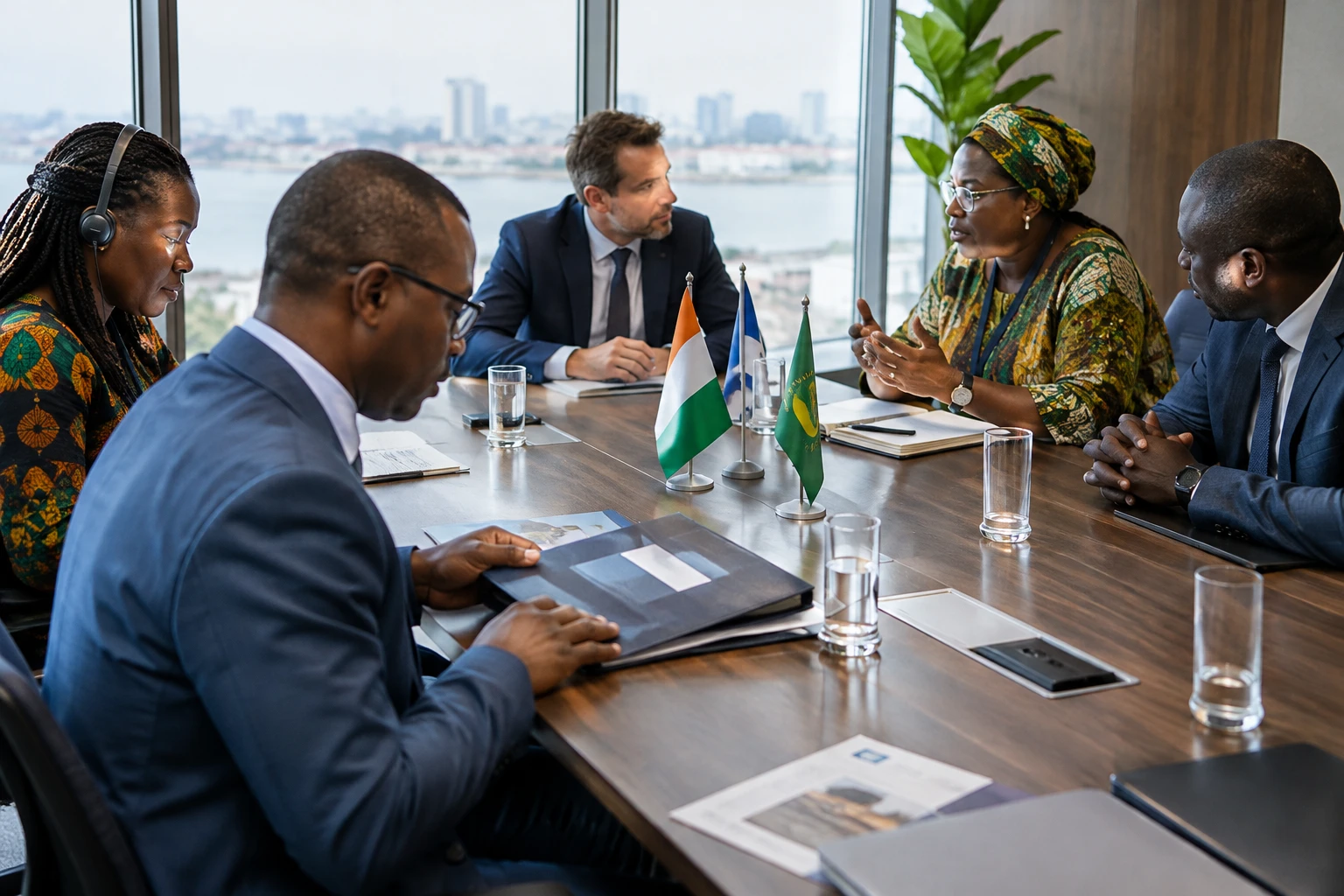
For a small Ivorian business, securing credit can determine whether it invests, hires or pursues an energy project. A new financing line for NSIA Banque Côte d’Ivoire puts this question at the heart of a €100m package announced on 6 August 2026 by FinDev Canada.
International financing for local lending
The syndicated facility — a loan funded by several institutions — is led by Citibank. FinDev Canada is contributing €40m, and KEXIM Global (Singapore) Ltd. is also participating. FinDev Canada’s transparency register states that Citi is providing €20m and KEXIM €40m. It says the Canadian loan can run for up to six years.
These details are confirmed by two FinDev Canada publications: its announcement of 6 August and its transparency database, which dates the loan signing to 8 May 2026. However, detailed information on the planned allocations comes from the announcement of the transaction; it describes commitments, not yet measured results.
NSIA Banque is to channel some of the funds into loans for small and medium-sized enterprises (SMEs), companies owned or led by women, and energy-transition investments. According to the stated targets, 50% of the resources are to support SMEs, while 30% of targeted financing is to go to businesses led or owned by women. Some funding is also intended for photovoltaic installations on commercial, industrial and office buildings.
In the published information, the bank has not specified the disbursement schedule or the precise breakdown between these different uses. The 30% figure applies to targeted financing and should not be interpreted as 30% of the entire facility without further clarification of the scope.
The challenge: turning the credit line into accessible loans
In Côte d’Ivoire, where the political capital is Yamoussoukro and economic activity is heavily concentrated in Abidjan, access to finance remains an issue for businesses investing or seeking to grow. However, a facility granted to a bank does not mean that entrepreneurs or SMEs have already received loans. The terms, collateral requirements, interest rates and geographical distribution will determine who can actually benefit.
Data from the BCEAO, the central bank shared by the countries of the West African Monetary Union (WAMU), provide a regional benchmark. In the first quarter of 2024, micro, small and medium-sized enterprises accounted for 50.1% of credit granted to legal entities in the Union, down 3.1 percentage points from the previous quarter. The average interest rate applied to them was 7.29%, compared with 6.33% for large companies. These figures cover WAMU, not Côte d’Ivoire alone, but they shed light on the credit environment in which the bank operates.
Bank financing can support formal businesses able to provide accounts and collateral. It is harder to reach small businesses without these, particularly outside major urban centres. The programme’s implementation should therefore be judged by the beneficiaries actually financed, loan maturities and accessibility, not solely by the announced amount.
The gender dimension is also tangible. Reserving a share of financing for women-led businesses can broaden their access to capital. But the impact will depend on eligibility criteria, the amounts granted and the bank’s ability to identify the projects concerned. Women entrepreneurs in agriculture, trade and services do not all have the same risk profile or needs.
Photovoltaics: from bank loans to energy savings
The energy component is aimed in particular at solar panels installed on business premises. For a company, this type of investment can reduce exposure to electricity costs, but its value depends on the upfront cost, loan terms, equipment quality and maintenance. The announcement does not yet specify how much is earmarked for solar or how many projects are expected.
This focus reflects a broader shift in Côte d’Ivoire’s energy sector. The Boundiali solar power plant, commissioned in stages, illustrates efforts to diversify electricity generation. Financing panels at private sites operates on a different scale: it addresses businesses’ own needs and does not replace investment in grids or power plants.
The energy transition can therefore have different effects for different stakeholders. An equipped business can gain autonomy and reduce some costs. For banks, these projects require the assessment of equipment and future savings, rather than conventional property collateral. The collective benefits will depend on whether installations are completed and remain operational over time.
A transaction in a regional context
Côte d’Ivoire is a member of ECOWAS, a West African economic and political cooperation organisation, and WAMU. The package brings together an Ivorian bank, a US arranger, a Canadian development finance institution and an entity linked to South Korea’s state-owned export-import bank. It illustrates the role of local banks as intermediaries between international capital and businesses in the region.
This model is not unique. The International Finance Corporation has also announced a risk-sharing facility with NSIA Banque Côte d’Ivoire to support loans to very small and medium-sized enterprises. This example highlights a persistent obstacle: banks can limit their exposure to risk through guarantees, but businesses still have to meet lending criteria.
The key measure will therefore be the conversion of the facility into verifiable results: the number and profile of SMEs financed, the share actually allocated to women-owned businesses, loan terms and completed photovoltaic projects. At this stage, the €100m represents announced lending capacity. Its reach for Ivorian businesses will depend on how it is actually distributed, in cities and across the country’s other regions.