
 Algeria
 Egypt
 Libya
 Morocco
 Sudan
 Tunisia
 Benin
 Burkina Faso
 Cabo Verde
 Côte d'Ivoire
 Ghana
 Guinea
 Guinea-Bissau
 Liberia
 Mali
 Mauritania
 Niger
 Nigeria
 Senegal
 Sierra Leone
 The Gambia
 Togo
 Cameroon
 Central African Republic
 Chad
 Equatorial Guinea
 Gabon
 Republic of the Congo
 São Tomé and Príncipe
 Burundi
 Comoros
 Djibouti
 Eritrea
 Ethiopia
 Kenya
 Madagascar
 Malawi
 Mauritius
 Mozambique
 Rwanda
 Seychelles
 Somalia
 South Sudan
 Tanzania
 Uganda
 Angola
 Botswana
 Eswatini
 Lesotho
 Namibia
 South Africa
 Zambia
 Zimbabwe
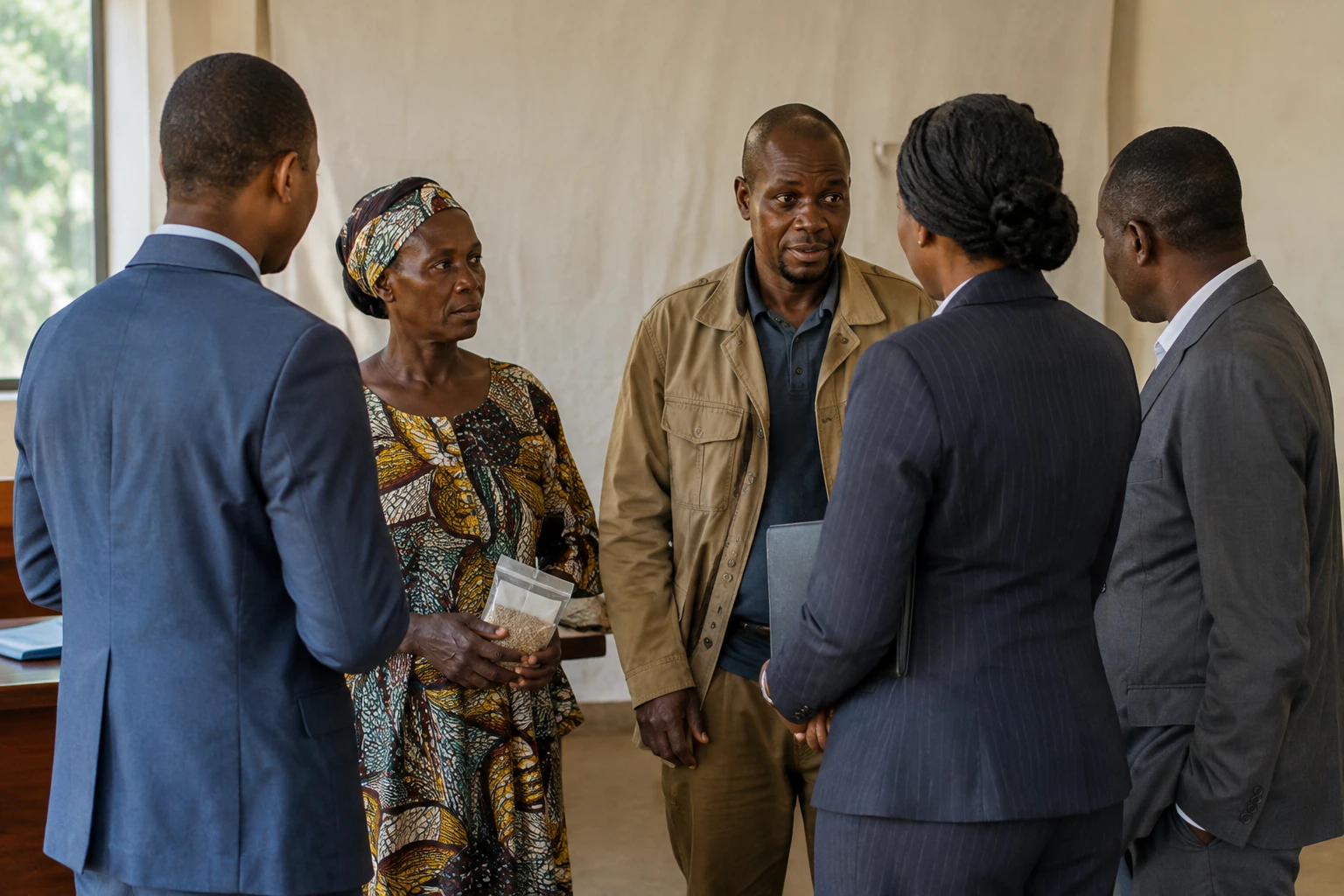
After a poor harvest, the next season is often decided in its first few weeks: without money to buy seeds, a smallholder can lose several production cycles. In Kasaï-Central, agricultural insurance is intended to help thousands of families get through this difficult period.
A targeted response in Kasaï-Central
The National Agricultural Development Programme (PNDA) launched a compensation operation in October 2026 for farmers affected by climate disruption. The Congolese Press Agency reported on 12 October that the launch was due to begin in Dibaya territory. Radio Okapi later said the scheme covered 17,180 farmers in Demba, Dibaya, Luiza and the areas around Kananga.
The reported losses affected maize, groundnuts and beans in particular, during agricultural seasons A 2025 and B 2026. According to information provided by the PNDA, unusual fog is said to have persisted for nearly a month after the first rains following the dry season. The programme attributes crop desiccation to this phenomenon. The figure of 17,180 beneficiaries was reported by Radio Okapi; a local media outlet, however, published a slightly different count of 17,186 people.
The payment amounts — $35 for moderate drought, $70 for extreme drought and $30 in the event of excessive rainfall — were reported in local coverage of the launch. These rates have not been independently confirmed in the public information consulted. They should therefore be treated as attributed figures, not as a verified schedule for each beneficiary.
Payments based on climate indices
The scheme is based on index-based, also known as parametric, insurance. Rather than assessing each field individually after a loss, the insurer triggers a payment when climate indicators specified in the contract reach certain thresholds. According to the PNDA newsletter, the Congolese product, launched in January 2025, relies on satellite data.
This method can speed up payments and reduce the need for inspections on each farm. It also has a limitation: the index used does not always accurately reflect the losses experienced by a particular farmer. A plot may suffer heavy damage without the contractual threshold being reached, or the reverse. Transparency over the data, trigger criteria and appeals process therefore matters as much as the speed of payment.
For this phase, premiums are funded through the programme, with support from the World Bank and the Climate Risk Financing Facility (GRiF). The farmers concerned therefore do not pay the premium directly. The insurance is part of a total $300mn funding package for the PNDA, comprising a $280mn credit from the International Development Association and a $20mn GRiF grant, according to a World Bank restructuring document.
From compensation to the next season
Compensation cannot replace an entire harvest. It can, however, help towards the purchase of seeds and inputs, or rebuild household cash reserves. The issue is particularly tangible for rural households, whose incomes depend on agricultural production and sales. In towns, the effects are also transmitted through market supplies and food prices.
The PNDA combines this cover with other tools to support productivity and market access. The World Bank said the programme’s restructuring had reduced its target for direct support to 300,000 farmers in the selected provinces, from the 1.4mn initially planned. The project is to focus its agricultural activities in Kasaï, Kasaï-Central and Kwilu, while Kongo Central is among the provinces covered by rural infrastructure work.
This reduction in the target is a reminder that the reach of a pilot should be measured by the beneficiaries actually covered, not just by announced ambitions. The insurance is currently backed by public and partner funding. In the longer term, its expansion will depend on the cost of premiums, the reliability of the indices and farmers’ confidence that payments will be made. Any microinsurance paid for by farmers will only be accessible if the cover is understood and suited to their incomes.
A test of agricultural resilience in Central Africa
Kasaï-Central is far from Kinshasa’s decision-making centres, but the experience has implications beyond the province. It tests the DRC’s ability to turn climate-risk management tools into practical support for farmers. For the authorities, the challenge is to protect production; for farmers, it is whether assistance arrives in time and reflects the losses suffered.
The DRC is a member of the Economic Community of Central African States (ECCAS), which brings together countries facing climate risks affecting agriculture in different ways. The success of the Congolese scheme could inform regional discussions on insurance and protection for smallholders. The next developments to watch are the effective coverage of beneficiaries, the regularity of payments and the programme’s ability to maintain its support until the end of its pilot phase, scheduled for September 2027 according to programme information.



