Algeria
 Egypt
 Libya
 Morocco
 Sudan
 Tunisia
 Benin
 Burkina Faso
 Cabo Verde
 Côte d'Ivoire
 Ghana
 Guinea
 Guinea-Bissau
 Liberia
 Mali
 Mauritania
 Niger
 Nigeria
 Senegal
 Sierra Leone
 The Gambia
 Togo
 Cameroon
 Central African Republic
 Chad
 DR Congo
 Equatorial Guinea
 Gabon
 Republic of the Congo
 São Tomé and Príncipe
 Burundi
 Comoros
 Djibouti
 Eritrea
 Ethiopia
 Kenya
 Malawi
 Mauritius
 Mozambique
 Rwanda
 Seychelles
 Somalia
 South Sudan
 Tanzania
 Uganda
 Angola
 Botswana
 Eswatini
 Lesotho
 Namibia
 South Africa
 Zambia
 Zimbabwe

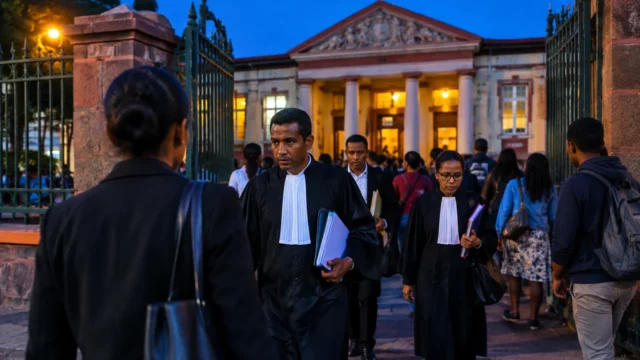
In Madagascar, the fight against corruption is also running up against a procedural question: which court can try former leaders? The answer matters as much for the cases as for public confidence in institutions, as the political transition that began in 2025 has put accountability at the heart of citizens’ expectations.
Sensitive cases, disputed jurisdiction
The Anti-Corruption Pole (PAC), the specialist court for corruption cases, has suspended proceedings in several cases involving former president Andry Rajoelina, former prime minister Christian Ntsay and two former ministers. It has referred the matter to the High Constitutional Court (HCC), asking it to clarify whether it can try these figures. While it awaits a response, the proceedings concerned are on hold, reports Malagasy media outlet 2424.mg.
Three cases are among those affected: the disappearance of more than 36 kilos of gold and precious stones from the vault of the directorate-general of Mines; suspicions linked to public contracts for school desks and benches; and the management of the Malagasy Sovereign Fund. These are matters to be investigated, not established guilt. The people implicated are presumed innocent.
The figure of 36 kilos refers to a public announcement made in 2022 by the mines minister at the time. The announcement concerned 36.433 kilos of gold and precious stones missing from the ministry’s vault. It establishes that a disappearance was reported, but is not enough to establish who was responsible. The press reported the minister’s announcement.
At the heart of the impasse is the boundary between two courts. The Constitution provides for a High Court of Justice (HCJ) to try certain acts committed by the president and members of the government in the exercise of their duties. However, the case can be referred to this court only if the National Assembly votes to impeach, by a two-thirds majority. The PAC is therefore asking whether this special procedure applies to the matters before it.
A constitutional precedent, but no general answer
The debate is not starting from scratch. In March 2026, the HCC ruled on the case of a former minister facing prosecution before the PAC. It distinguished acts directly linked to ministerial duties from those unrelated to them. In that case, the Court found that being a former minister was not, by itself, enough to automatically remove someone from the jurisdiction of the ordinary courts. The decision is available on the High Constitutional Court’s website.
The decision concerned a former transport minister, not a former head of state. The question now being asked is therefore different: can the reasoning be extended to Andry Rajoelina? The answer will have to take account of the status of those concerned, as well as the precise nature of the alleged acts. The HCC cannot be presumed to have ruled on a case it has not yet considered.
The High Court of Justice, meanwhile, cannot be approached like an ordinary court: a parliamentary impeachment is required. The national anti-corruption body has already flagged cases involving public officials that have remained blocked in the Assembly, according to reports in the press. This raises a concrete institutional question: can a procedure designed to protect public office, in the absence of an effective mechanism, indefinitely delay the examination of cases?
A test for the transition and public confidence
Since Andry Rajoelina’s fall in October 2025, Madagascar has been governed by a transitional authority that came to power in a military takeover, following protests led by young people and joined by members of the military. The demonstrations had expressed, among other things, rejection of poor governance and corruption. The Institute for Security Studies Africa, a research centre based on the continent, notes that the change has also left SADC, the Southern African Development Community, facing a difficult choice over its institutional response to Madagascar.
In this context, suspending prosecutions can be understood as a legal precaution: a court is seeking to avoid ruling without certainty about its jurisdiction. But delay comes at a cost. For those concerned, legal uncertainty remains. For the public, a prolonged pause could fuel the perception that the rules differ according to political rank. Conversely, a clear and reasoned decision could help establish transparent boundaries between courts.
The effects are not the same for everyone. Institutions need predictable procedures to handle cases involving public resources and state-funded contracts. Residents, meanwhile, are affected by how those resources are used and by the ability of public services to account for their decisions. In cases involving school contracts, for example, the stakes extend beyond political figures: they concern the transparency of public procurement and the delivery of equipment expected by schools.
Regional attention turns to the rule of law
Madagascar belongs to SADC, which monitors political developments in its member states, and to the African Union. How the authorities handle these prosecutions will therefore have implications beyond Antananarivo: it will show whether the transition can respond to demands for transparency without turning the courts into political instruments. The ISS notes that the regional response to the change of power in Madagascar differs from the suspension adopted after the 2009 crisis.
The next decisive step will be the HCC’s response to the PAC’s request. It will have to clarify whether the status of former president changes which court has jurisdiction, and how that jurisdiction relates to the parliamentary impeachment provided for by the Constitution. Until this clarification is published, allegations must remain attributed and responsibilities unproven.