Algeria
 Egypt
 Libya
 Morocco
 Sudan
 Tunisia
 Benin
 Burkina Faso
 Cabo Verde
 Côte d'Ivoire
 Ghana
 Guinea
 Guinea-Bissau
 Liberia
 Mali
 Mauritania
 Niger
 Nigeria
 Senegal
 Sierra Leone
 The Gambia
 Togo
 Cameroon
 Central African Republic
 Chad
 DR Congo
 Equatorial Guinea
 Gabon
 Republic of the Congo
 São Tomé and Príncipe
 Burundi
 Comoros
 Djibouti
 Eritrea
 Ethiopia
 Kenya
 Malawi
 Mauritius
 Mozambique
 Rwanda
 Seychelles
 Somalia
 South Sudan
 Tanzania
 Uganda
 Angola
 Botswana
 Eswatini
 Lesotho
 Namibia
 South Africa
 Zambia
 Zimbabwe
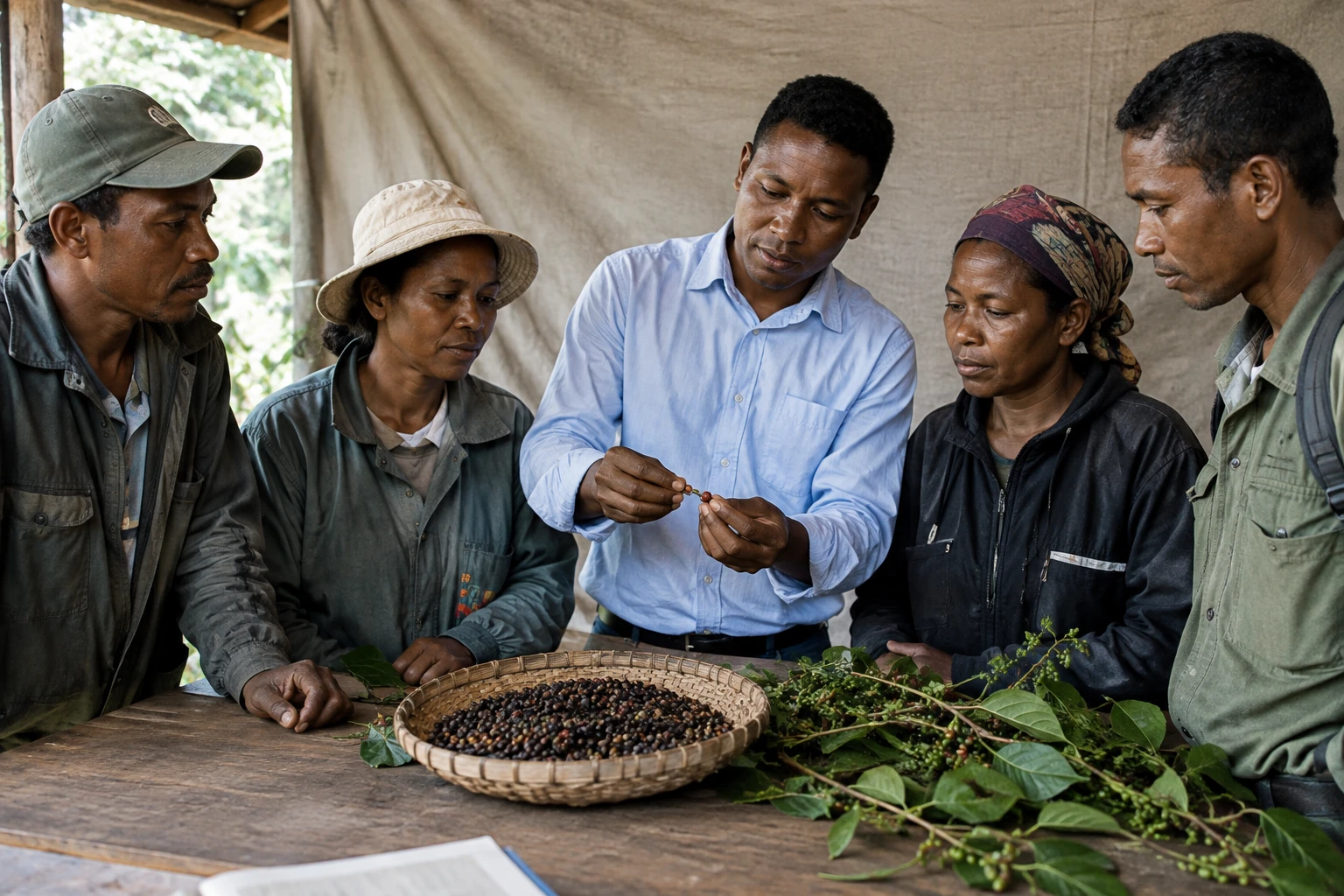
In Madagascar, a spice picked in the eastern humid forests poses a very practical economic question: how can more be sold without destroying what makes it rare? Voatsiperifery supports pickers’ livelihoods and attracts foreign buyers. But harvesting methods and pressure on forests are already putting its future at risk.
A rare spice at the heart of a fragile supply chain
Voatsiperifery, also known as tsiperifery, grows wild on long vines that climb trees. Its berries, with their small woody tail, are sought after for their woody, fruity and slightly spicy aromas. They are harvested in Madagascar’s natural eastern forests, then usually pass through collectors before being processed and exported.
International demand grew sharply around 2010. A study presented by Cirad, the French agricultural research organisation working with Malagasy partners, notes that the difficulty of harvesting has not prevented overexploitation. Pickers may pull up the vine or fell the tree supporting it to reach clusters in the canopy. Cirad also says collectors capture a significant share of the supply chain’s value, while pickers do the most dangerous work.
Pressure on habitat goes beyond the pepper trade alone. According to data from the FAO’s Global Forest Resources Assessment 2025, Madagascar lost about 27% of its forest area between 1990 and 2025, or nearly 3.8 million hectares. Agricultural clearance, fires and charcoal production are among the factors associated with this trend.
The high export price does not tell the whole story of the benefits for communities. Exporters cited in information published on 21 October 2026 mention a price of €150 to €200 per kilogram on the French market. This range, which relates to one particular market, does not by itself indicate how much pickers earn or how regular the harvests are.
The dilemma between commercial value and volume
Those involved in the supply chain do not all advocate the same path. Mima Chateauneuf, co-founder of export company Jacarandas, believes quantities remain limited and warns against a race to increase production. In her view, turning a rare spice into a commonplace one could undermine its quality and encourage excessive harvesting.
By contrast, Olivier Ramaherison, operations manager at Essentialys and an exporter, sees commercial potential in tsiperifery comparable to that of vanilla. This ambition highlights the stakes for Madagascar in terms of income and market access. However, it faces a biological constraint: a wild resource cannot be developed like a crop that is already well understood without harvesting rules, knowledge and monitoring.
The issue is also social. Picking provides income for people living near forests, particularly between agricultural harvests, during the lean season when household resources may be under strain. Banning or sharply reducing collection could therefore shift the cost of conservation on to communities. Conversely, allowing destructive practices to continue threatens both the resource and future incomes.
Research by FOFIFA, Madagascar’s national centre for applied research in rural development, and Cirad is exploring the domestication of the vine and cultivation practices. The aim is to reduce reliance on forest harvesting. Domestication does not solve everything, however: it will be necessary to check that the aromatic quality is maintained, that producers are paid and that cultivated supplies are not used to disguise unsustainable wild harvesting.
Rules to be developed with communities
For the Malagasy authorities, the challenge is to link forest policy, rural development and foreign trade. Harvesting rules can limit the uprooting of vines and protect the trees that support them. But enforcement will also depend on traceability of batches, training for pickers and a fairer distribution of value among producers, collectors, processors and exporters.
The international framework offers a useful principle: the Nagoya Protocol provides for the fair and equitable sharing of benefits arising from genetic resources. Applying it in practice to a supply chain such as tsiperifery requires clarity on who represents communities, how income is tracked and what local benefits are expected. Without these mechanisms, the premium paid by specialist markets may not fund ecosystem protection.
Regionally, Madagascar is a member of the Southern African Development Community (SADC), an organisation for co-operation among countries in southern Africa and the Indian Ocean. The management of its forests and endemic products is part of wider debates on biodiversity, rural incomes and the place of African producers in global value chains. For the continent, the lesson is not to give up on exports, but to determine who sets volumes, who bears the environmental costs and who benefits from the value created.
The next challenge will be to assess whether cultivation and responsible harvesting initiatives can move from research programmes into everyday practice. For voatsiperifery, success will not be measured only in kilograms exported or price per kilogram. It will also depend on the survival of the vines, the condition of the forests and the share of income that goes to Malagasy people living near harvesting areas.