Algeria
 Egypt
 Libya
 Morocco
 Sudan
 Tunisia
 Benin
 Burkina Faso
 Cabo Verde
 Côte d'Ivoire
 Guinea
 Guinea-Bissau
 Liberia
 Mali
 Mauritania
 Niger
 Nigeria
 Senegal
 Sierra Leone
 The Gambia
 Togo
 Cameroon
 Central African Republic
 Chad
 DR Congo
 Equatorial Guinea
 Gabon
 Republic of the Congo
 São Tomé and Príncipe
 Burundi
 Comoros
 Djibouti
 Eritrea
 Ethiopia
 Kenya
 Madagascar
 Malawi
 Mauritius
 Mozambique
 Rwanda
 Seychelles
 Somalia
 South Sudan
 Tanzania
 Uganda
 Angola
 Botswana
 Eswatini
 Lesotho
 Namibia
 South Africa
 Zambia
 Zimbabwe
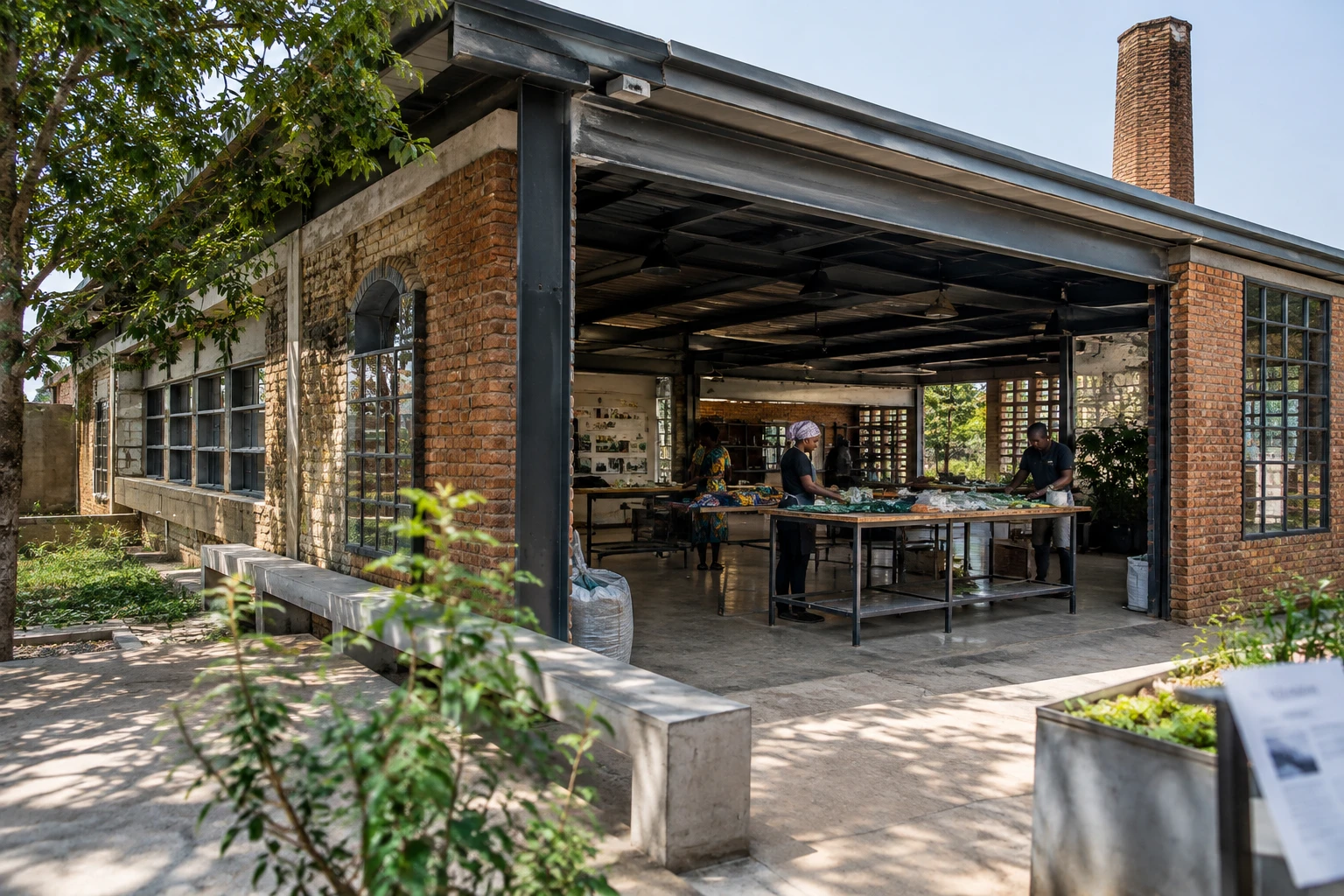
In Tamale, contemporary art is not confined to displaying works: it takes up residence in buildings, objects and workplaces once thought beyond saving. Led by Ibrahim Mahama, this approach connects artistic creation with Ghana’s industrial memory and the lives of its communities.
On 22 October 2026, the Ghanaian artist opens “The Time of Harvest” in Paris, an exhibition running at the Fondation Cartier until 28 February 2027. Its scale also stems from its collective nature: nine African artists and collectives are involved. But the Paris project has its roots in northern Ghana, where Mahama founded three cultural spaces in Tamale.
In Tamale, art spaces rooted in local life
Since 2019, the Savannah Centre for Contemporary Art, Red Clay and Nkrumah Volini have formed a network dedicated to creation, learning and exchange. These spaces are not conceived as mere showcases for an internationally renowned artist. They offer places where works, skills and encounters can endure over time.
This choice shifts the cultural centre of gravity. Accra, Ghana’s capital, accounts for a significant share of the country’s institutions and activities. Tamale, in the north, becomes a hub for production and knowledge-sharing, connected to artistic networks in Ghana and beyond. KNUST in Kumasi, where Mahama studied, also underscores the role of education and exchanges between cities in this trajectory.
This approach is part of a broader dynamic across the continent. Institutions such as doual’art in Douala, RAW Material Company in Dakar and the Nairobi Contemporary Art Institute have developed models tied to their local environments. Their diversity does not amount to a single “African” formula; rather, it shows that artists and communities are devising their own ways of producing, preserving and sharing art.
A relocated factory, memory brought back into circulation
At the heart of the Paris exhibition, the installation “Things Fall Apart” reassembles a former Ghanaian glass-bottle factory. Ibrahim Mahama acquired the abandoned site and then moved elements of it to Tamale, transforming them into an artwork and a place of learning. The building and its materials tell a story of production: bottles made in Ghana circulated in several sub-Saharan African countries, and sometimes as far as Europe.
The gesture, then, is not simply about preserving a ruin. It raises a practical question: what becomes of the knowledge accumulated by workers and communities when a factory closes? By reusing its elements, the artist makes visible a memory of labour often absent from accounts focused on finished objects and their consumption. He also sets industrial abandonment against the possibility of a new cultural use.
This reflection also runs through the materials. Jute sacks, textiles, glass and fragments of archives recur in Mahama’s work. They evoke the movement of goods and colonial legacies, but they are also objects handled, repaired and passed on. Their history is not only one of global trade: it also encompasses the everyday gestures of those who made or used them.
A parliament of seats, and the promises of independence
Another major work, “Parliament of Ghosts”, takes the form of a circular assembly made up of Ashanti wooden seats. Visitors can sit in them. The work evokes a parliament emptied of its representatives and echoes the overthrow of President Kwame Nkrumah on 24 February 1966, as well as the dissolution of the government of the First Republic.
These seats carry family histories: some have been used, damaged and then repaired. Their presence turns a political institution into a space of memory and encounter. Rather than freezing the past in a tribute, the installation invites visitors to question unfulfilled political promises and citizens’ place in institutions.
In Paris, the work takes on particular resonance. It is shown in a country whose republican history is linked to colonisation, notably in West Africa. Mahama brings these histories together without conflating them: the Ghanaian objects on display are not mere illustrations of a European narrative. They carry their own uses and meanings, while opening a dialogue about colonial legacies and national narratives.
Creation as collective work
The involvement of nine associated artists and collectives broadens the exhibition’s scope. The Congolese Plantation Workers Art League, for example, links artistic practice with agricultural labour. Other participants explore archives, textiles, personal accounts or material heritage. The exhibition thus becomes a meeting place for distinct approaches rather than a homogeneous overview of African art.
This collective dimension also raises questions about the circulation of works and resources. Cultural projects can attract international attention, but their roots also depend on local partnerships, accessible spaces and resources to pass on skills. In Tamale, Mahama’s model of cultural centres focuses on proximity to communities. In Paris, its presentation puts that model in dialogue with a major European cultural institution.
Ghana is a member of ECOWAS, the Economic Community of West African States, which aims, among other things, to strengthen regional integration. The exhibition is not part of an ECOWAS programme, but it is a reminder that West African cultural exchanges extend beyond national borders. In the years ahead, the challenge will be to see how these networks of artists and centres can sustainably support creation and knowledge-sharing across the continent, without making their recognition dependent on a presence in Europe’s cultural capitals.
Through the glass of a factory, Ashanti seats and archives, Ibrahim Mahama brings the past and future into dialogue. The Paris exhibition highlights a practice already established in Ghana: starting with concrete places and objects to make art a collective, locally rooted space, open to multiple narratives.
The Fondation Cartier’s presentation of the Ibrahim Mahama exhibition · KNUST’s profile of Ibrahim Mahama · Official information on ECOWAS · Historical reference points from Ghana’s Audit Service