Algeria
 Egypt
 Libya
 Morocco
 Sudan
 Tunisia
 Benin
 Burkina Faso
 Cabo Verde
 Côte d'Ivoire
 Guinea
 Guinea-Bissau
 Liberia
 Mali
 Mauritania
 Niger
 Nigeria
 Senegal
 Sierra Leone
 The Gambia
 Togo
 Cameroon
 Central African Republic
 Chad
 DR Congo
 Equatorial Guinea
 Gabon
 Republic of the Congo
 São Tomé and Príncipe
 Burundi
 Comoros
 Djibouti
 Eritrea
 Ethiopia
 Kenya
 Madagascar
 Malawi
 Mauritius
 Mozambique
 Rwanda
 Seychelles
 Somalia
 South Sudan
 Tanzania
 Uganda
 Angola
 Botswana
 Eswatini
 Lesotho
 Namibia
 South Africa
 Zambia
 Zimbabwe
Turning bauxite into alumina, then aluminium, requires far more than an investment announcement. It takes capital, reliable energy, infrastructure and markets. In Ghana, the government wants to build this value chain. Guinea, where two refinery projects have already reached the start of construction, offers a tangible point of comparison — but not yet proof that industrialisation is assured.
Two West African paths, one industrial challenge
Bauxite is the ore from which alumina is refined, a raw material then used to produce aluminium. Extracting and exporting the ore generates revenue. Processing it locally can also create industrial jobs, skills and activity in transport, energy and maintenance. But these benefits depend on whether plants are built and the conditions in which they operate.
In Guinea, a West African country whose capital is Conakry, the authorities have made local processing central to their dialogue with mining companies. Two construction projects were officially launched in 2025: that of State Power Investment Corporation (SPIC), in Boffa, on 26 March, followed by that of Winning Consortium Alumina Guinea (WCAG), in Dobali, in Boké prefecture, on 12 December. Guinea’s Ministry of Mines estimates WCAG’s investment at about $1 billion. These announcements mark progress, but the start of construction does not mean a refinery is operational.
Ghana is taking a different path. According to Ghana’s public information agency, President John Dramani Mahama reaffirmed on 19 October 2026, at the opening of the Mining in Motion summit in Accra, the goal of modernising the state-owned Volta Aluminium Company Limited (VALCO) smelter and developing domestic refining. The government wants to link extraction, alumina production, smelting and the manufacture of finished products. It has also set a target of ending exports of unprocessed minerals by 2030.
In Ghana, the announced value chain remains to be assembled
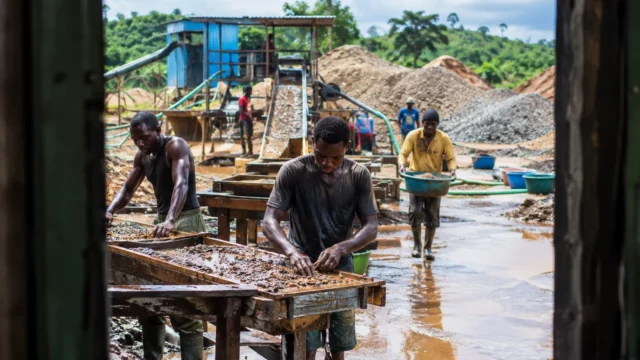
The contrast with Guinea lies first in the stage the projects have reached. Ghana does not yet have an alumina refinery. Its operating bauxite mine, at Awaso, therefore supplies ore for export. The Ghana Integrated Aluminium Development Corporation (GIADEC), a public body tasked with structuring the state’s interests in the sector, aims to develop extraction, refining and aluminium processing.
At Awaso, operator Ghana Bauxite Company has announced a pre-feasibility study. It is intended to determine whether a refinery project is economically and technically viable. At this stage, no construction timetable has been set in the available information. A $60 million financing agreement between GIADEC and Metalloid Resources Investment, meanwhile, relates to the development of the Nyinahin deposits. The public information reviewed does not establish that this sum directly finances a refinery. Projects under discussion must therefore be distinguished from confirmed investment decisions.
The industrial link already exists in the form of VALCO, a state-controlled aluminium smelter commissioned in 1967. But it imports the alumina it needs for production. GIADEC presents local refining and the modernisation of the plant as complementary projects: a refinery could supply the smelter, which would then provide aluminium to manufacturing activities. The public body says the government wants to begin modernising VALCO in 2026 and raise its output to at least 200,000 tonnes a year by the end of 2028. These are targets, not achieved results.
Infrastructure and local benefits will be decisive
Alumina refining requires, among other things, large amounts of energy and water, as well as suitable transport infrastructure. In his speech on 19 October, Mahama stressed that legislation alone would not be enough: infrastructure, electricity and investment coordination also matter. Roads, railways, ports and energy networks will weigh on the projects’ viability as much as the availability of ore.
The effects will not be the same for everyone. A plant can generate direct jobs, as well as business for local construction, transport and service companies. These benefits are not automatically shared between the capital, mining regions and communities near the sites. For the areas concerned, the issues also include access to water and electricity, land use, workplace safety and the transparency of social and environmental commitments.
Comparing the investments also highlights the gap between ambition and funding. The two announced projects in Guinea each exceed $1 billion, according to the Guinean authorities. In Ghana, the $60 million associated with Nyinahin cannot be presented as the cost of a refinery: its precise allocation has not been established. The amount alone therefore cannot be used to assess the feasibility of the proposed integrated value chain.
A challenge for ECOWAS and regional industrialisation
Guinea and Ghana are members of ECOWAS, the Economic Community of West African States. Their projects form part of a regional question: how can more value be captured from mineral resources, rather than relying solely on ore exports? The answer will depend on national decisions, but also on energy trade, cross-border infrastructure and the ability of regional companies to supply industrial goods and services.
Guinea’s example shows that construction can begin after years of announcements. It guarantees neither completion nor profitability. Ghana, for its part, has a dedicated public body and an existing smelter, but still needs to confirm funding, complete studies and begin refinery construction. The next tangible indicator will therefore be the move from the Awaso study to a verifiable investment decision, alongside the announced steps for VALCO. In Accra as in Conakry, local processing will be judged less by speeches than by completed plants, their supplies and the benefits actually seen on the ground.
Sources consulted: Ghana’s public information agency, GIADEC on the refinery and VALCO modernisation projects, Ghana News Agency, Guinea’s Ministry of Mines on the WCAG project and Guinea’s presidency on the SPIC project.