Algeria
 Egypt
 Libya
 Morocco
 Sudan
 Tunisia
 Benin
 Burkina Faso
 Côte d'Ivoire
 Ghana
 Guinea
 Guinea-Bissau
 Liberia
 Mali
 Mauritania
 Niger
 Nigeria
 Senegal
 Sierra Leone
 The Gambia
 Togo
 Cameroon
 Central African Republic
 Chad
 DR Congo
 Equatorial Guinea
 Gabon
 Republic of the Congo
 São Tomé and Príncipe
 Burundi
 Comoros
 Djibouti
 Eritrea
 Ethiopia
 Kenya
 Madagascar
 Malawi
 Mauritius
 Mozambique
 Rwanda
 Seychelles
 Somalia
 South Sudan
 Tanzania
 Uganda
 Angola
 Botswana
 Eswatini
 Lesotho
 Namibia
 South Africa
 Zambia
 Zimbabwe
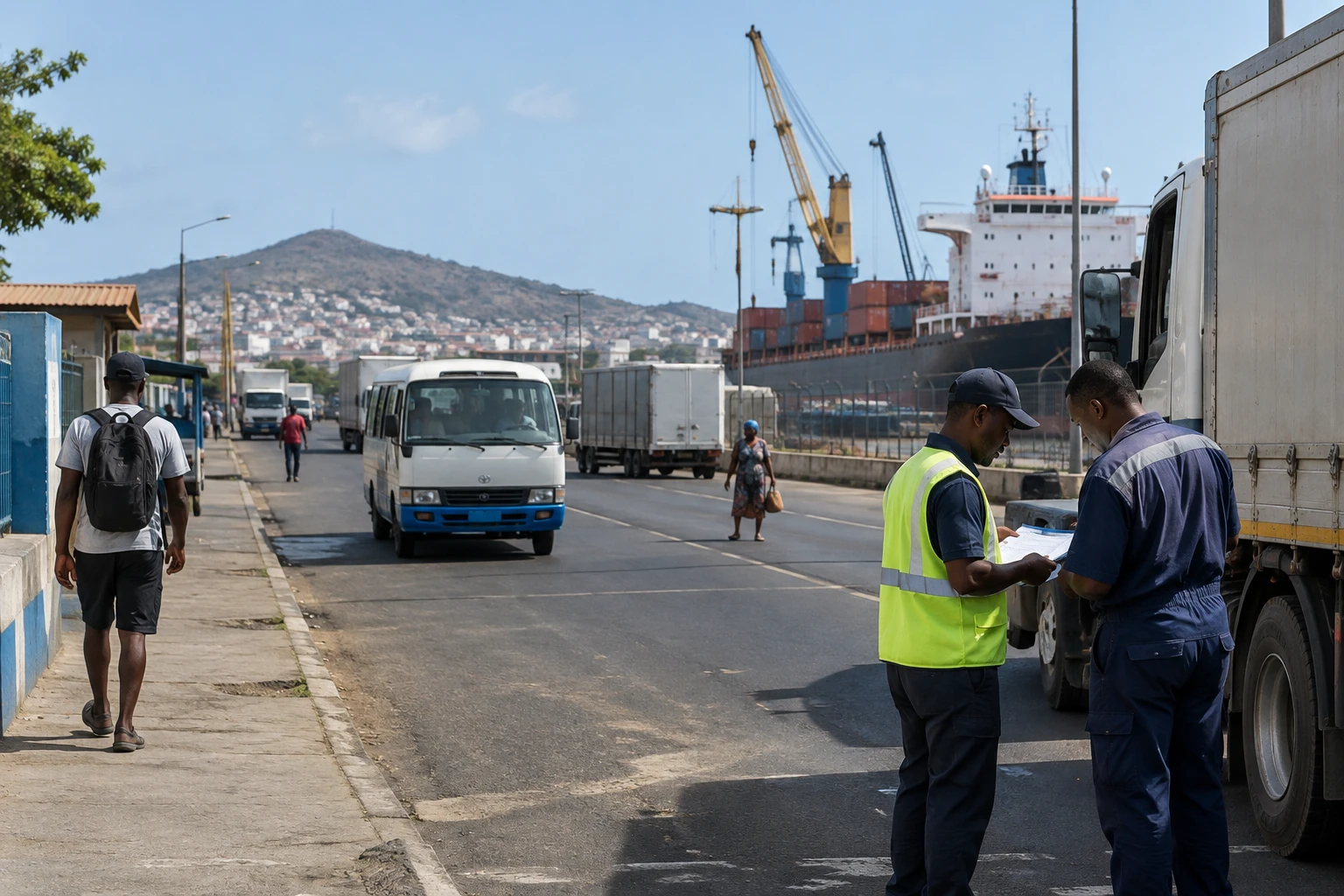
For an archipelago that brings in most of what it consumes by sea, customs and agricultural production have a direct impact on the cost of living and the security of supplies. Praia and Brasília are seeking to turn this reality into an area for cooperation, although no operational agreement has yet been announced.
Closer ties discussed in Bangkok
Cabo Verde is a member of the Economic Community of West African States (ECOWAS), the regional bloc that organises part of West Africa’s economic integration. Its status as an archipelago, however, gives particular importance to ports, maritime links and the smooth processing of trade formalities.
On 16 October 2026, a Cabo Verdean delegation met Mathias de Alencastro, secretary for international affairs at Brazil’s Ministry of Finance. The meeting took place in Bangkok, on the sidelines of the annual meetings of the International Monetary Fund and the World Bank, held from 12 to 18 October. The Cabo Verdean government reported on the meeting.
Discussions covered possible cooperation on customs, agriculture and climate. The two sides discussed technical assistance, the transfer of expertise and the sharing of tools developed in Brazil. At this stage, these discussions outline possible areas of work; they do not amount to an announcement of a funded programme or an implementation timetable.
Customs at the heart of public revenue
In Cabo Verde, customs efficiency matters to importing businesses, ports and public finances alike. The Ministry of Finance says customs revenue reached 31.014 billion Cape Verdean escudos in 2025, up 12.5% on 2024. This increase has also come amid rising imports.
The country has already begun digitising several operations. It uses SYDONIA World for customs clearance, is developing a port single window and offers electronic payment of duties and taxes. Cooperation with Brazil could complement these efforts through training, exchanges of expertise on goods inspections or better integration of digital tools. These are possibilities to be confirmed, not measures already agreed.
Faster, more predictable procedures could reduce delays for operators and facilitate the movement of goods between the islands. But modernisation will also need to take account of local administrations and small businesses, which do not all have the same resources to adapt to new systems. The challenge is to improve inspections without turning the move to digital processes into an additional obstacle.
Agricultural cooperation and the archipelago’s constraints
Cabo Verde’s agricultural production remains limited by low rainfall, recurring droughts and the small amount of land available for cultivation. According to the FAO, more than 80% of food needs are met by imports. Cargo arrives by sea and then has to be redistributed among the islands, making supplies sensitive to transport costs and disruptions to trade.
Brazil could share expertise on irrigation, farming techniques suited to dry areas and agro-processing. Such transfers cannot simply be copied wholesale: solutions must suit the availability of water, the soils and the scale of Cabo Verdean farms. Their value will be measured by their ability to support local producers and reduce certain vulnerabilities, rather than to replace imports in the short term.
This thinking aligns with Cabo Verde’s priorities on food security and climate resilience. It affects stakeholders in different ways: administrations may gain tools and skills, while farmers will need practical access to technology, training and water. For households, the impact will also depend on production and transport costs, as well as the regularity of maritime links between the islands.
A bilateral issue with regional reach
For ECOWAS, smoother trade and stronger customs capacity form part of a broader goal: facilitating regional trade and developing African value chains. Cabo Verde can also highlight the specific needs of small island states, whose access to markets depends heavily on ports and maritime connections.
The significance of the meeting will now depend on whether it leads to specific actions: training, technical assistance, equipment sharing or pilot agricultural projects. No detailed agreement has been made public in the information available. The next point to watch will therefore be whether these proposals are formalised, and what role Cabo Verdean institutions and local stakeholders will have in putting them into practice.