Algeria
 Egypt
 Libya
 Morocco
 Sudan
 Tunisia
 Benin
 Burkina Faso
 Cabo Verde
 Côte d'Ivoire
 Ghana
 Guinea
 Guinea-Bissau
 Liberia
 Mauritania
 Niger
 Nigeria
 Senegal
 Sierra Leone
 The Gambia
 Togo
 Cameroon
 Central African Republic
 Chad
 DR Congo
 Equatorial Guinea
 Gabon
 Republic of the Congo
 São Tomé and Príncipe
 Burundi
 Comoros
 Djibouti
 Eritrea
 Ethiopia
 Kenya
 Madagascar
 Malawi
 Mauritius
 Mozambique
 Rwanda
 Seychelles
 Somalia
 South Sudan
 Tanzania
 Uganda
 Angola
 Botswana
 Eswatini
 Lesotho
 Namibia
 South Africa
 Zambia
 Zimbabwe
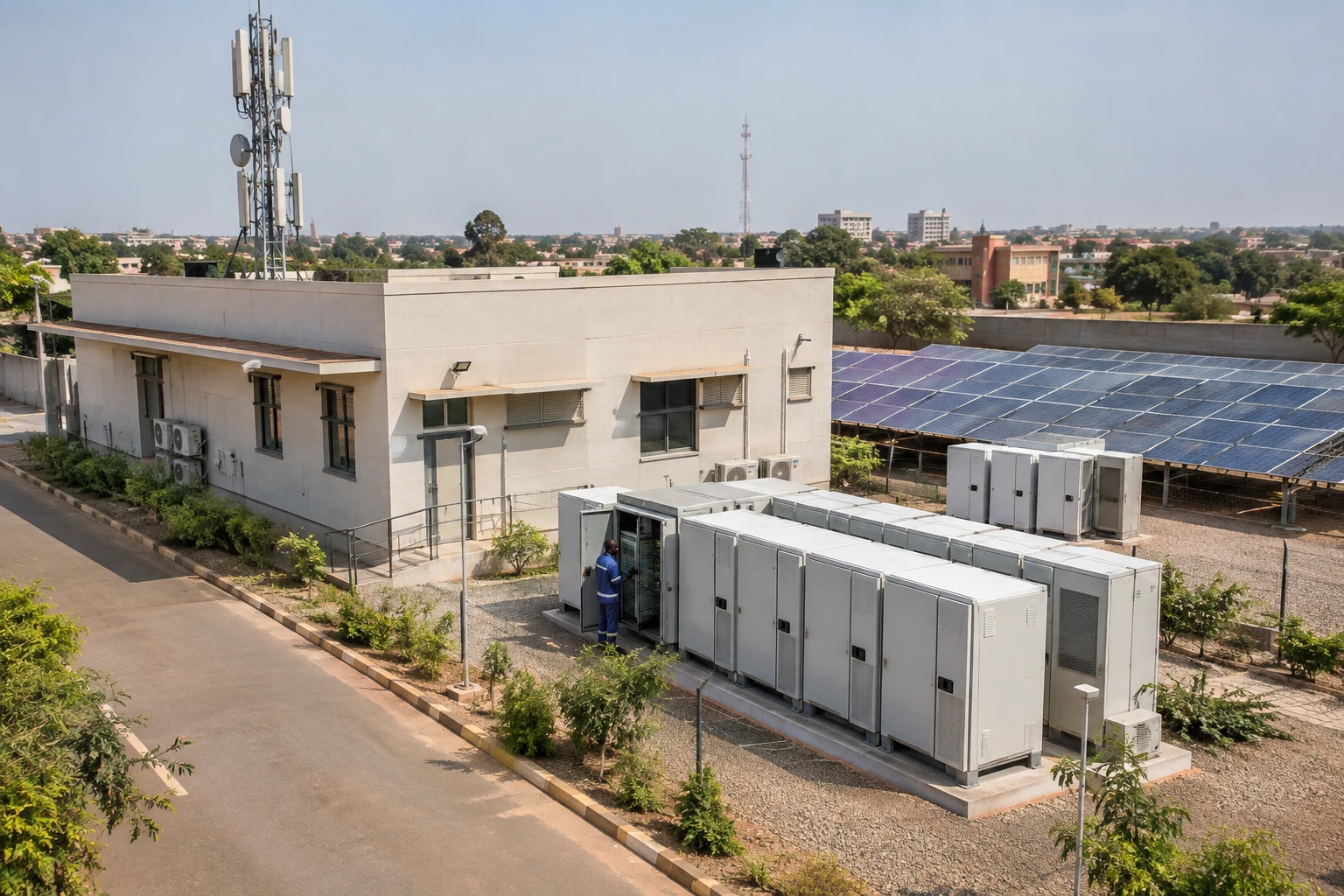
When a mobile relay goes dark for lack of fuel, a call is interrupted, a mobile payment is blocked or a digital service becomes inaccessible. In Mali, powering antenna sites is therefore a matter of maintaining communications, as well as managing costs and emissions.
More reliable power, beyond solar alone
On 17 October 2026, Jinko ESS announced an agreement to supply 34 SunGiga G2 Plus storage systems, with a total stated capacity of 18 megawatt-hours (MWh), for a telecommunications project in Mali. The company has not disclosed the name of its partner, the value of the contract or the sites involved. These details therefore remain attributed to Jinko ESS’s announcement, with no independent confirmation available at this stage.
A battery does not generate electricity. It stores available energy, such as that supplied by solar panels, and releases it when generation falls or the electricity grid is unavailable. For an isolated antenna site, this reserve can limit reliance on generators and reduce the risk of outages caused by delays in fuel deliveries.
The stated capacity alone is not enough to assess how long the installations can operate independently. This depends in particular on equipment consumption, battery power and whether solar panels or other energy sources are available. Jinko has not specified these parameters for the Mali project.
Funding already committed to Mali’s infrastructure
The announcement comes amid a series of investments combining telecommunications and energy in Mali. In March 2025, asset manager CREI entered into financing agreements worth $40 million with Norfund and the Facility for Energy Inclusion (FEI). The aim is to deploy renewable energy assets to power mobile phone towers in the country. According to Norfund, the programme targets 2,876 towers and is intended to reduce fuel consumption through hybrid systems with storage.
In November 2025, the International Finance Corporation (IFC), a member of the World Bank Group, announced an €80 million loan to Orange Mali, with participation from the West African Development Bank (BOAD). The financing is intended to support the installation of 300 new 4G antennas and the expansion of the fibre-optic network, with a target of reaching around 300,000 households and small businesses. Half of the new antennas are to be installed in rural areas. The project also plans to replace diesel generators with solar systems; the IFC estimates that this component could avoid more than 8,000 tonnes of CO₂ emissions a year.
These programmes are not necessarily linked to the contract announced by Jinko ESS. The manufacturer has not identified the client or the delivery locations. They nevertheless show that several players are seeking, through separate initiatives, to strengthen power supplies for Mali’s mobile networks.
Diesel weighs on costs and network continuity
The challenge extends beyond Mali. In an analysis published in July 2025, CrossBoundary Energy estimated that around 70% of Africa’s 500,000 telecoms towers depended on diesel. It put fuel’s share of operating expenses at between 30% and 60% at some remote sites. These continent-wide estimates provide an indication of scale; they do not describe the precise situation at every antenna site in Mali.
For operators, the price of fuel is only part of the problem. Diesel must also be transported to sites, generators maintained and supply disruptions anticipated. In areas where the electricity grid is unreliable or non-existent, a hybrid power supply can therefore help keep services running regularly. Residents and businesses far from major centres may benefit if the equipment does indeed improve coverage and limit interruptions.
The benefits, however, are not automatic. A storage system must be installed, maintained and replaced at the end of its useful life. The information available on Jinko’s agreement gives no details of the delivery schedule, maintenance or arrangements for managing batteries at the end of their life. Without these details, it is too early to assess the concrete effects on costs, network availability or emissions.
A national and regional issue to watch
In Mali, where Bamako accounts for a large share of economic and administrative activity, network quality also matters for services used every day: communications, mobile payments and access to information. The impact of a more reliable power supply will nevertheless depend on where the sites are located. Deployment in rural or remote areas has different implications from upgrading antenna sites that are already well served.
The issue also forms part of a regional landscape in which financing and infrastructure needs extend beyond national borders. BOAD, a joint institution of the West African Economic and Monetary Union (WAEMU), is already helping to finance Orange Mali’s network. Mali is also a member of the Economic Community of West African States (ECOWAS). Telecommunications and energy projects therefore have cross-border significance: digital networks support trade, while storage solutions can help make infrastructure less dependent on fuel supplies.
The next step will be to find out who will receive the 34 systems announced, where they will be installed and on what timetable. Publishing this information would make it possible to distinguish contracted capacity from equipment actually commissioned. For Mali, the challenge is not simply to store more electricity: it is to keep communications accessible and reliable, particularly away from Bamako, without shifting costs to battery maintenance or management.