Algeria
 Egypt
 Libya
 Morocco
 Sudan
 Tunisia
 Burkina Faso
 Cabo Verde
 Côte d'Ivoire
 Ghana
 Guinea
 Guinea-Bissau
 Liberia
 Mali
 Mauritania
 Niger
 Nigeria
 Senegal
 Sierra Leone
 The Gambia
 Togo
 Cameroon
 Central African Republic
 Chad
 DR Congo
 Equatorial Guinea
 Gabon
 Republic of the Congo
 São Tomé and Príncipe
 Burundi
 Comoros
 Djibouti
 Eritrea
 Ethiopia
 Kenya
 Madagascar
 Malawi
 Mauritius
 Mozambique
 Rwanda
 Seychelles
 Somalia
 South Sudan
 Tanzania
 Uganda
 Angola
 Botswana
 Eswatini
 Lesotho
 Namibia
 South Africa
 Zambia
 Zimbabwe
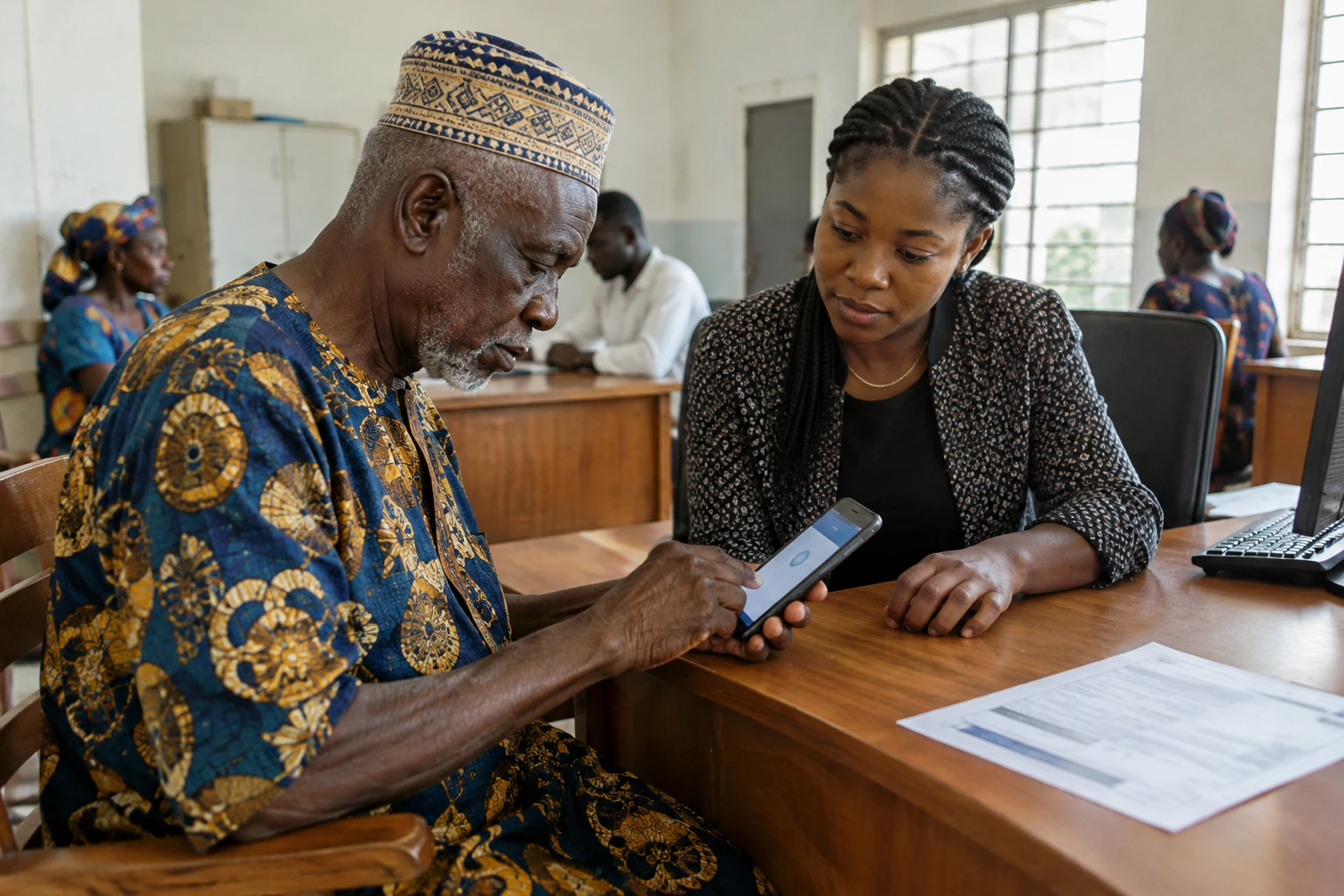
For a pensioner living far from a service desk — or outside Benin — confirming that they are still alive can involve travel and paperwork. Since 15 October 2026, pensioners covered by the National Retirement Fund of Benin (FNRB) have been able to complete this process remotely, during a campaign that ends on 15 November.
A formality to complete from Benin or abroad
The “Proof of Life” mobile app is intended for FNRB beneficiaries living in Benin or abroad. To use it, they must enter their personal identification number (NPI) and pension-book number, then have their fingerprints verified. Confirmation is then sent, including by SMS or email. Communications also mention WhatsApp.
An alternative is available for people who cannot use the app: biometric kiosks installed in some public spaces. This procedure requires a biometric national identity card. The ministry says these options should make it possible to complete the process without travelling to central offices.
The launch and arrangements have been reported by the government and Beninese media. Essential information has also been reported by Bénin Web TV and the public daily La Nation. As of 16 October, the campaign has only just begun: no public figures are available in the information reviewed on how many pensioners have already registered.
A step in the modernisation of pensions
Proof of life is part of a series of changes to pension administration. In November 2020, Benin began automatically processing pensions for state employees retiring from public service. The stated aim was to reduce the wait between retirement and payment of entitlements. The Directorate General of the Budget later described the reform as part of the transformation of services provided to pensioners.
Benin’s system comprises several schemes. The FNRB manages pensions for the state employees it covers, while the National Social Security Fund (CNSS) covers, in particular, private-sector employees. A coordination mechanism between the two bodies was adopted in 2021 to better account for career periods covered by different schemes. This distinction matters: the new campaign is for FNRB pensioners, not automatically all retirees affiliated with the CNSS.
Reports by the Directorate General of the Budget confirm that automatic pension processing and FNRB-CNSS coordination are among the reforms monitored by the administration. They also note that pension management requires significant resources and that the scheme’s financial position remains a public management concern. Digitisation therefore does not, on its own, resolve questions of funding or the quality of career records. Its immediate aim is to facilitate one specific step: the periodic identification of beneficiaries.
Time saved, provided access keeps pace
For pensioners living far from government offices, in the regions or abroad, the remote procedure can spare them a journey and ease scheduling constraints. It may also simplify verification by the authorities, by matching identity data with information in the pension book. For people comfortable using a phone, the app offers a more direct process than visiting a service desk.
But digital access is not the same for everyone. It depends on having a compatible smartphone, a sufficient internet connection and the ability to follow the biometric steps. Kiosks offer a fallback, but their usefulness depends on where they are located and how accessible they are. The public communications reviewed do not yet specify the number of kiosks, their opening hours or what assistance is planned for pensioners who encounter a technical problem.
Biometrics provide an additional check, but also require particular attention to the protection of personal data and the handling of identification errors. Official announcements describe the user journey; the pages reviewed do not detail how long biometric data will be retained or what procedure is available in the event of a failed check. These details will be important in assessing trust in the system, particularly among retirees who cannot travel easily.
A practical test for digital public services
The calendar is now the main reference point for beneficiaries: the official campaign runs from 15 October to 15 November 2026. The authorities have not specified in the information reviewed what consequences might follow if confirmation is completed after this period. Government communications announce the scheme, while Beninese media corroborate the dates and available options; no usage figures have yet been published.
In Benin, whose capital is Porto-Novo, the initiative highlights a wider challenge for West African administrations: making services accessible beyond government counters without excluding people who are less connected. ECOWAS, the regional organisation for West Africa, brings together countries with different social security systems and digital infrastructure. Benin’s experience is therefore not a uniform model for the whole region. It does, however, offer a concrete case to watch: success will be measured as much by the simplicity of the process as by the services’ ability to support those who are not yet reached by digital technology.