Algeria
 Egypt
 Libya
 Morocco
 Sudan
 Benin
 Burkina Faso
 Cabo Verde
 Côte d'Ivoire
 Ghana
 Guinea
 Guinea-Bissau
 Liberia
 Mali
 Mauritania
 Niger
 Nigeria
 Senegal
 Sierra Leone
 The Gambia
 Togo
 Cameroon
 Central African Republic
 Chad
 DR Congo
 Equatorial Guinea
 Gabon
 Republic of the Congo
 São Tomé and Príncipe
 Burundi
 Comoros
 Djibouti
 Eritrea
 Ethiopia
 Kenya
 Madagascar
 Malawi
 Mauritius
 Mozambique
 Rwanda
 Seychelles
 Somalia
 South Sudan
 Tanzania
 Uganda
 Angola
 Botswana
 Eswatini
 Lesotho
 Namibia
 South Africa
 Zambia
 Zimbabwe
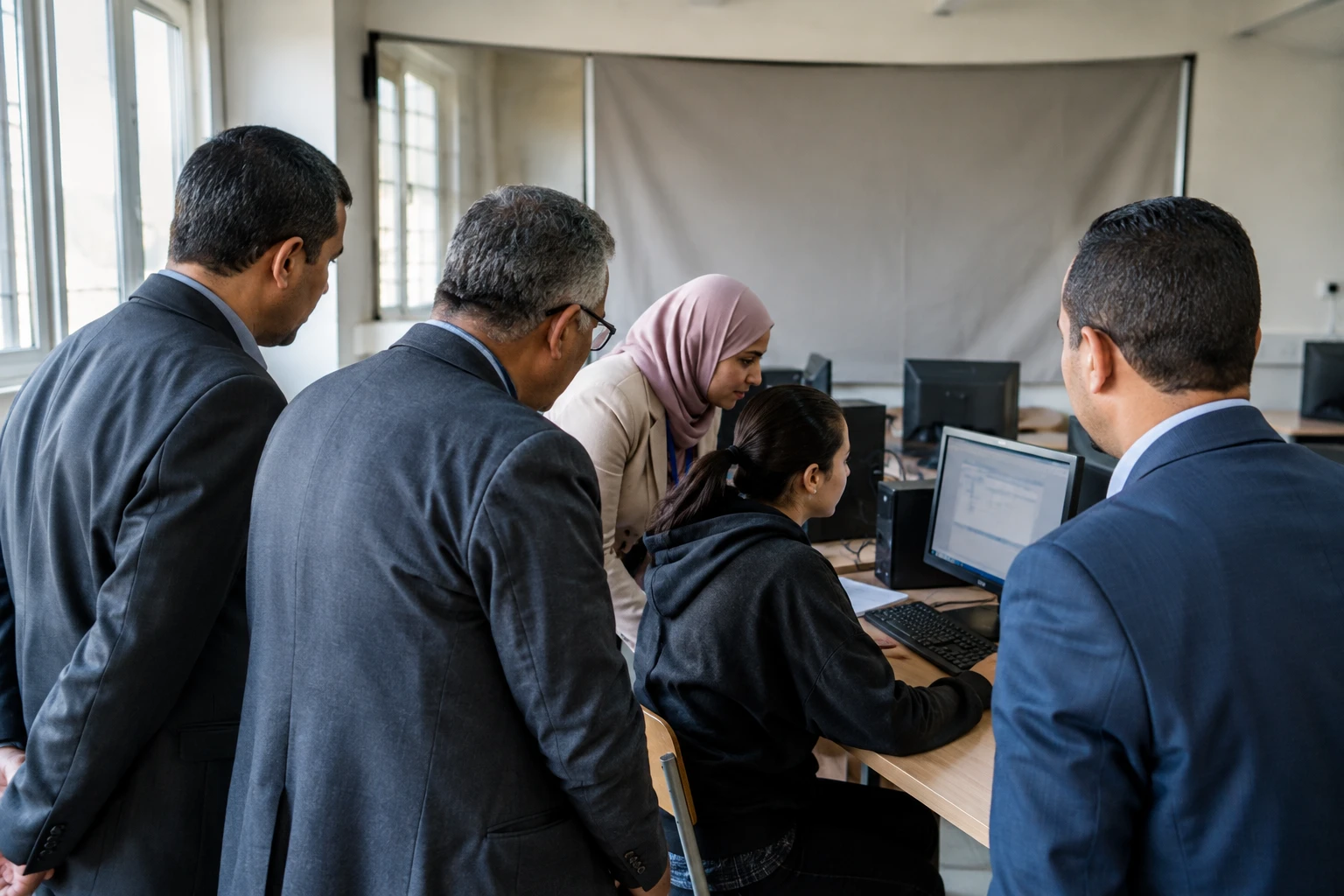
For a young person in training in Tunis or Le Kef, learning to code or secure a network is valuable only if those skills lead to career opportunities. The agreement between Tunisia’s Ministry of Employment and Tunisie Telecom aims to bring training centres closer to businesses’ digital needs. Its success will be measured less by the number of facilities installed than by the career paths they make possible.
A national partnership, with a first foothold in Le Kef
Signed on 14 October 2026, the framework agreement brings together the ministry and the state-owned operator Tunisie Telecom for five years, renewable. It notably provides for improved internet access at training centres, employment offices and the ministry’s regional structures. The two partners also aim to update telecommunications training and expand opportunities for practical experience in businesses. La Presse de Tunisie reports that the agreement was signed in Den Den.
The agreement builds on an initiative already under way on the ground. On 17 September, the ministry inaugurated a first artificial intelligence laboratory at the vocational training and apprenticeship centre in Le Kef. The programme for 2026-2027 envisages twelve in total. In the town of Sers, a centre for rural girls is also to be connected to high-speed broadband, in preparation for training in fibre-optic techniques. The ministry confirmed these steps in its report on the start of the vocational training year. Its official report details the Le Kef laboratory and the Sers connection project.
The agreement also provides for practical placements with the operator and distance learning combined with in-person sessions. An online learning system is to be hosted in Tunisie Telecom’s data centre. Virtual laboratories, with virtual and augmented reality tools, could enable remote exercises. These facilities broaden access to resources, but do not replace the physical equipment or teaching support needed for technical learning.
Meeting demand without reducing training to immediate employment
The choice of these specialities responds to documented demand. A study presented in July by the ministry, the National Observatory of Employment and Qualifications and the International Labour Organization (ILO) puts the number of people employed in information and communications technology in Tunisia at more than 100,000. It identifies demand for software development, web applications, cloud engineering, data management and cybersecurity. Tunisia’s TAP news agency reported on the study and its main findings. TAP’s report on in-demand digital professions.
The ministry had also highlighted a gap between existing training and the skills sought by employers. Laboratories and placements could help narrow this gap, provided that programmes keep pace with the rapid evolution of occupations and that trainers themselves receive appropriate support. The number of jobs available is not enough to establish how many graduates will be hired, or on what terms. The link between training and recruitment will also depend on placements leading to jobs, salaries and Tunisian companies’ ability to create skilled positions.
Access to equipment also matters. Centres in Tunis and the major cities do not always face the same constraints as those in the interior regions. The choice of Le Kef followed by Sers gives the programme a regional dimension. But the announcement of twelve laboratories does not, in itself, specify their deployment timetable, capacity or the resources earmarked for their maintenance. These details will help determine whether the initiative narrows regional disparities or concentrates opportunities in a handful of institutions.
A European opening that needs safeguards
The prospect extends beyond the Tunisian market. A mapping published by the ILO on 16 September examines digital skills needs in Tunisia and five European countries: Germany, Belgium, France, Italy and Luxembourg. It compares these needs with the training and profiles available in Tunisia, and discusses ways to bring skills, qualifications and opportunities for professional mobility closer together. The ILO’s mapping of ICT occupations and skilled mobility.
The sectoral study presented in July estimates that Europe could need about ten million ICT specialists by 2030. This figure should be attributed to the study: it is not a single official European Union target. By comparison, the EU aims to have at least 20 million ICT specialists employed in 2030. This is an employment target, not an equivalent measure of vacancies or recruitment needs. The Council of the European Union sets out this target as part of the Digital Decade.
For Tunisian learners, this demand could open up opportunities at home and abroad. It also raises a fundamental question: how can chosen mobility be facilitated without weakening the businesses and services in Tunisia that need these skills? The ILO mapping emphasises, in particular, the recognition of qualifications and equitable mobility partnerships. Training should therefore not serve only as a recruitment pipeline for foreign markets; it can also support the creation of digital services, innovation and employment in the country.
Tunisia does not belong to a regional economic community comparable to ECOWAS or SADC: in the Maghreb, the Arab Maghreb Union is the relevant regional framework, even though its economic integration remains limited. The agreement is not, in itself, a regional project. Its significance for the continent will depend instead on its ability to strengthen local skills and build balanced cooperation across borders. The next indicators to watch are concrete: the effective deployment of the twelve laboratories, the quality of training and the share of learners who go on to secure skilled employment.